
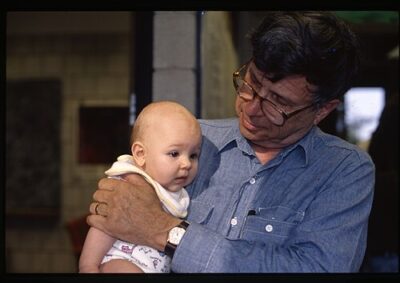
Richard Lewontin
Richard Lewontin was an American evolutionary biologist and mathematician. Born March 29, 1929, in New York City. Died July 4, 2021, in Cambridge. Known for Molecules and Minds: Essays on Biology and the Social Order. Educated at Harvard University and Columbia University. Awards include Guggenheim Fellowship, honorary doctorate from the University of Paris-VII and ASN Award for Distinguished Achievement in the Conceptual Unification of the Biological Sciences.
Facts
31 facts · 2 confirmed by two sources · 13 cited · 16 from one source
Where this comes from
Papalocal keeps its own record. It started from these sources; what each one said is kept here as it was copied, so a change on their side never changes this page by itself. Tap one to read its version.
What Wikidata says · copied November 15, 2026 · revision 2565606644
- Described as
- American evolutionary biologist and mathematician (1929–2021)
- Other names
- Richard Charles Lewontin, Richard C. Lewontin, Dick Lewontin, R. C. Lewontin, R. Lewontin
- Born
- March 29, 1929 · 1 reference
- Died
- July 4, 2021 · 2 references
- Born in
- New York City
- Died in
- Cambridge · 1 reference
- Citizen of
- United States
- Occupation
- mathematician · 1 reference; biologist · 1 reference; geneticist; university teacher; zoologist · 1 reference
- Worked for
- Harvard University; University of Rochester; University of Chicago; Santa Fe Institute; North Carolina State University · 1 reference
- Education
- Harvard University; Columbia University (1954); Harvard College
- Member of
- American Academy of Arts and Sciences; Istituto Veneto di Scienze, Lettere ed Arti
- Known for
- Molecules and Minds: Essays on Biology and the Social Order
- Awards
- Guggenheim Fellowship · 1 reference; honorary doctorate from the University of Paris-VII (1983) · 1 reference; ASN Award for Distinguished Achievement in the Conceptual Unification of the Biological Sciences (1994) · 1 reference; Crafoord Prize in Biosciences (2015) · 1 reference; Thomas Hunt Morgan Medal (2017) · 1 reference
- Field
- genetics · 2 references; evolutionary biology · 1 reference; sociobiology · 1 reference; mathematics · 1 reference
- Lived in
- Brattleboro · 1 reference
- Wikipedias with a page
- 26
Wikidata item Q659265 (wikidata.org/wiki/Q659265), public domain (CC0). Copied November 15, 2026.
What Wikipedia says · copied November 15, 2026 · revision 1384081071
Richard Charles Lewontin (March 29, 1929 – July 4, 2021) was an American evolutionary biologist, mathematician, geneticist, and social commentator. A leader in developing the mathematical basis of population genetics and evolutionary theory, he applied techniques from molecular biology, such as gel electrophoresis, to questions of genetic variation and evolution. He was a self-described Marxist.
In a pair of seminal 1966 papers co-authored with J. L. Hubby in the journal Genetics, Lewontin helped set the stage for the modern field of molecular evolution. In 1979, he and Stephen Jay Gould introduced the term "spandrel" into evolutionary theory. From 1973 to 1998, he held an endowed chair in zoology and biology at Harvard University, and from 2003 until his death in 2021 he was a research professor there.
From a sociological perspective, Lewontin strongly opposed genetic determinism.
- Born, in its opening lines
- March 29, 1929
- Died, in its opening lines
- July 4, 2021
From the Wikipedia article “Richard Lewontin” (en.wikipedia.org/wiki/Richard_Lewontin), by its contributors, under CC BY-SA 4.0 (creativecommons.org/licenses/by-sa/4.0/). Copied November 15, 2026; not changed.
Confirmed Two sources agree. Cited One source, and it names where it got it. One source One source, without a reference of its own. Sources disagree The sources disagree. We show the best-supported value and keep theirs below.
