
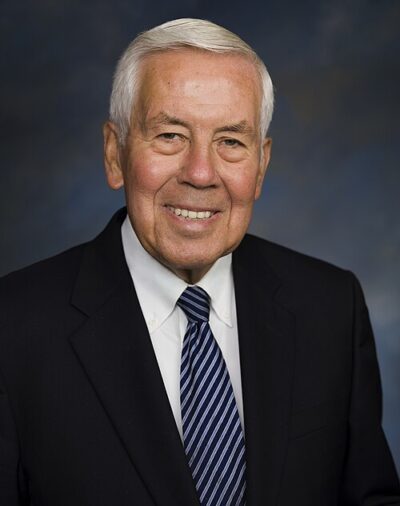
Richard Lugar
Richard Lugar was an American politician. Born April 4, 1932, in Indianapolis. Died April 28, 2019, in Fairfax. Positions held include Mayor of Indianapolis (1968–1975), United States senator (1977–2013) and senator. Educated at Denison University and Pembroke College. Awards include Knight Commander of the Order of the British Empire, Presidential Medal of Freedom and Commander of the Order of Ouissam Alaouite.
Facts
41 facts · 2 confirmed by two sources · 17 cited · 22 from one source
Where this comes from
Papalocal keeps its own record. It started from these sources; what each one said is kept here as it was copied, so a change on their side never changes this page by itself. Tap one to read its version.
What Wikidata says · copied November 15, 2026 · revision 2567306190
- Described as
- American politician (1932-2019)
- Other names
- Richard Green Lugar, Dick Lugar, Richard G. Lugar
- Born
- April 4, 1932 · 2 references
- Died
- April 28, 2019 · 2 references
- Born in
- Indianapolis · 1 reference
- Died in
- Fairfax · 1 reference
- Buried in
- Arlington National Cemetery
- Cause of death
- chronic inflammatory demyelinating polyradiculoneuropathy · 1 reference
- Citizen of
- United States
- Occupation
- politician · 1 reference; military personnel; lawyer; businessperson · 1 reference; mayor · 1 reference
- Positions held
- Mayor of Indianapolis (1968–1975) · 1 reference; United States senator (1977–2013) · 1 reference; senator · 1 reference
- Political party
- Republican Party
- Education
- Denison University (–1954); Pembroke College (–1956) · 1 reference; Shortridge High School
- Member of
- American Academy of Arts and Sciences; Indianapolis Public Schools (1964–1967)
- Awards
- Knight Commander of the Order of the British Empire (2017); Presidential Medal of Freedom (2013) · 1 reference; Commander of the Order of Ouissam Alaouite; Four Freedoms Award – Freedom Medal (2007); Democracy Service Medal (2001); Order of the Three Stars, 2nd Class (2014) · 1 reference; Order of the Cross of Terra Mariana, 1st Class (2002); Great Cross with Star and Sash of the Order of Merit of the Federal Republic of Germany (2013); Hilal-e-Pakistan (2008) · 1 reference; Order of Liberty (2016); Heinz Award (2004); Rhodes Scholarship (1954) · 1 reference; Order of Lakandula (2012); Knight of Freedom Award (2012); Order of Prince Yaroslav the Wise, 5th class (2006)
- Field
- industrial manufacturing · 1 reference; agriculture · 1 reference
- Religion
- Methodism
- Military branch
- United States Navy (1957–1960) · 1 reference
- Military rank
- lieutenant (junior grade)
- Wikipedias with a page
- 32
Wikidata item Q363079 (wikidata.org/wiki/Q363079), public domain (CC0). Copied November 15, 2026.
What Wikipedia says · copied November 15, 2026 · revision 1385800494
Richard Green Lugar ( LOO-gər; April 4, 1932 – April 28, 2019) was an American politician who served as a United States senator from Indiana from 1977 to 2013. He was a member of the Republican Party.
Born in Indianapolis, Lugar graduated from Denison University and the University of Oxford. He served on the Indianapolis Board of School Commissioners from 1964 to 1967 before he was elected to two terms as mayor of Indianapolis, serving from 1968 to 1976. During his tenure as mayor, Lugar served as the president of the National League of Cities in 1971 and gave the keynote address at the 1972 Republican National Convention.
In 1974, Lugar ran his first campaign for the U.S. Senate, losing to Democratic incumbent Birch Bayh. He ran again in 1976, defeating Democratic incumbent Vance Hartke. Lugar continued to be reelected until 2012, when he was defeated by Indiana State Treasurer Richard Mourdock in the Republican primary by 21 points, who subsequently lost in the general election to Democrat Joe Donnelly, ending his 36-year tenure in the U.S. Senate. Lugar ran for the Republican nomination for president of the United States in the 1996 primaries but lack of success led to his withdrawal early in the campaign.
During Lugar's tenure, he served as chairman of the Senate Committee on Foreign Relations from 1985 to 1987 and from 2003 to 2007, serving as the ranking member of the committee from 2007 until his departure in 2013. Lugar led a U.S. monitoring team for the 1986 Philippine presidential election, where he concluded that widespread fraud was committed by the government of dictator Ferdinand Marcos, which preceded the People Power Revolution that deposed Marcos. Lugar also twice served as chairman of the Senate Committee on Agriculture, Nutrition and Forestry, from 1995 to 2001 and briefly again in part of 2001. Much of Lugar's work in the Senate was toward the dismantling of nuclear, biological, and chemical weapons around the world, co-sponsoring his most notable piece of legislation with Georgia Democrat Sam Nunn: the Nunn–Lugar Act.
Following his service in the Senate, Lugar created a nonprofit organization that specializes in the policy areas he pursued while in office.
- Born, in its opening lines
- April 4, 1932
- Died, in its opening lines
- April 28, 2019
From the Wikipedia article “Richard Lugar” (en.wikipedia.org/wiki/Richard_Lugar), by its contributors, under CC BY-SA 4.0 (creativecommons.org/licenses/by-sa/4.0/). Copied November 15, 2026; not changed.
Confirmed Two sources agree. Cited One source, and it names where it got it. One source One source, without a reference of its own. Sources disagree The sources disagree. We show the best-supported value and keep theirs below.
