
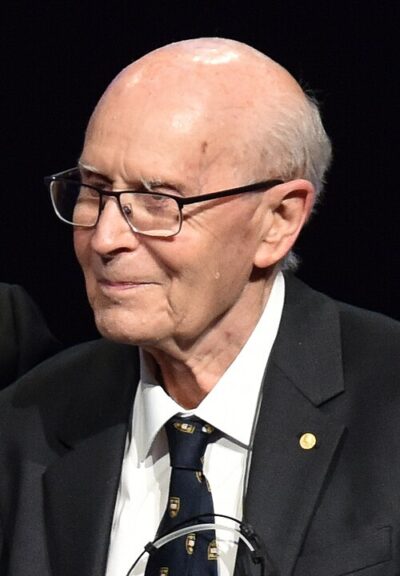
Richard Robson is a British-Australian chemist. Born June 4, 1937, in Glusburn. Educated at University of Oxford. Awards include Fellow of the Australian Academy of Science, Fellow of the Royal Society and Nobel Prize in Chemistry.
Facts
11 facts · 1 confirmed by two sources · 5 cited · 5 from one source
Where this comes from
Papalocal keeps its own record. It started from these sources; what each one said is kept here as it was copied, so a change on their side never changes this page by itself. Tap one to read its version.
What Wikidata says · copied November 16, 2026 · revision 2569499069
- Described as
- British-Australian chemist
- Born
- June 4, 1937 · 1 reference
- Born in
- Glusburn · 1 reference
- Citizen of
- United Kingdom; Australia
- Occupation
- chemist · 1 reference
- Education
- University of Oxford · 1 reference
- Member of
- Australian Academy of Science
- Awards
- Fellow of the Australian Academy of Science (2000) · 1 reference; Fellow of the Royal Society (2022) · 1 reference; Nobel Prize in Chemistry (2025) · 2 references
- Field
- inorganic chemistry · 1 reference
- Wikipedias with a page
- 46
Wikidata item Q23073819 (wikidata.org/wiki/Q23073819), public domain (CC0). Copied November 16, 2026.
What Wikipedia says · copied November 16, 2026 · revision 1374829291
Richard Robson (born 4 June 1937) is an English and Australian chemist and Professor of Chemistry at the University of Melbourne. Robson specialises in coordination polymers, particularly metal-organic frameworks. He has been described as "a pioneer in crystal engineering involving transition metals". In 2025, he was awarded the Nobel Prize in Chemistry jointly with Susumu Kitagawa and Omar M. Yaghi for the development of metal-organic frameworks.
- Born, in its opening lines
- June 4, 1937
From the Wikipedia article “Richard Robson (chemist)” (en.wikipedia.org/wiki/Richard_Robson_(chemist)), by its contributors, under CC BY-SA 4.0 (creativecommons.org/licenses/by-sa/4.0/). Copied November 16, 2026; not changed.
Confirmed Two sources agree. Cited One source, and it names where it got it. One source One source, without a reference of its own. Sources disagree The sources disagree. We show the best-supported value and keep theirs below.
