
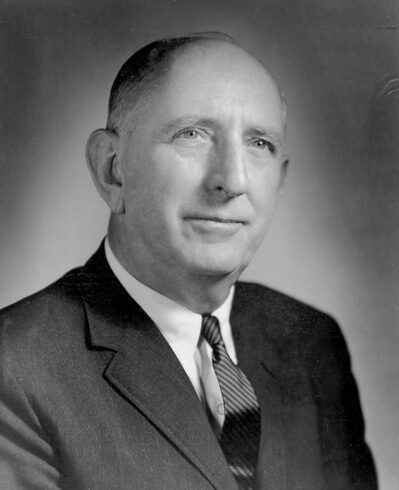
Richard Russell Jr.
Richard Russell Jr. was the 66th Governor of Georgia (1931–1933), U.S. Senator from Georgia. Born November 2, 1897, in Winder. Died January 21, 1971, in Washington, D.C.. Positions held include member of the Georgia House of Representatives (1921–1931), Governor of Georgia (1931–1933) and President pro tempore of the United States Senate (1969–1971). Educated at University of Georgia and Gordon State College.
Facts
21 facts · 2 confirmed by two sources · 10 cited · 9 from one source
Where this comes from
Papalocal keeps its own record. It started from these sources; what each one said is kept here as it was copied, so a change on their side never changes this page by itself. Tap one to read its version.
What Wikidata says · copied November 16, 2026 · revision 2567379710
- Described as
- 66th Governor of Georgia (1931–1933), U.S. Senator from Georgia (1933–1971)
- Other names
- Sen. Richard Russell, Richard B. Russell Jr., Richard Brevard Russell Jr., Georgia Giant, Richard Russell
- Born
- November 2, 1897 · 3 references
- Died
- January 21, 1971 · 3 references
- Born in
- Winder
- Died in
- Washington, D.C.
- Buried in
- Russell Memorial Park Cemetery · 1 reference
- Cause of death
- pulmonary emphysema
- Citizen of
- United States
- Occupation
- politician · 1 reference; lawyer · 1 reference
- Positions held
- member of the Georgia House of Representatives (1921–1931) · 1 reference; Governor of Georgia (1931–1933); President pro tempore of the United States Senate (1969–1971); United States senator (1933–1971) · 1 reference
- Political party
- Democratic Party
- Education
- University of Georgia (–1918) · 1 reference; Gordon State College (–1915) · 1 reference; primary school (–1914) · 1 reference; University of Georgia School of Law
- Mother
- Ina Dillard Russell
- Military branch
- United States Navy Reserve (–1918) · 1 reference
- Nickname
- The Georgia Giant · 1 reference
- Wikipedias with a page
- 21
Wikidata item Q718415 (wikidata.org/wiki/Q718415), public domain (CC0). Copied November 16, 2026.
What Wikipedia says · copied November 16, 2026 · revision 1385414871
Richard Brevard Russell Jr. (November 2, 1897 – January 21, 1971) was an American politician. A Southern Democrat, he served as the 66th governor of Georgia from 1931 to 1933 before serving in the United States Senate for almost 40 years, from 1933 to 1971. At his death he was the most senior member of the Senate. He was a leader of Southern opposition to the civil rights movement for decades.
Born in Winder, Georgia, Russell established a legal practice in Winder after graduating from the University of Georgia School of Law. He served in the Georgia House of Representatives from 1921 to 1931 before becoming Governor of Georgia. Russell won a special election to succeed Senator William J. Harris and joined the Senate in 1933. He supported the New Deal in his Senate career and was the chief sponsor of the National School Lunch Act, which provided free or low-cost school lunches to impoverished students.
During his long tenure in the Senate, Russell served as chairman of several committees, and was the Chairman of the Senate Committee on Armed Services for most of the period between 1951 and 1969. He was a candidate for President of the United States at the 1948 Democratic National Convention and the 1952 Democratic National Convention. He was also a member of the Warren Commission.
Russell supported racial segregation and co-authored the Southern Manifesto with Strom Thurmond. Russell and 17 fellow Democratic Senators, along with one Republican, blocked the passage of civil rights legislation via the filibuster. After Russell's protégé, President Lyndon B. Johnson, signed the Civil Rights Act of 1964 into law, Russell led a Southern boycott of the 1964 Democratic National Convention. Russell served in the Senate until his death from emphysema in 1971.
- Born, in its opening lines
- November 2, 1897
- Died, in its opening lines
- January 21, 1971
From the Wikipedia article “Richard Russell Jr.” (en.wikipedia.org/wiki/Richard_Russell_Jr.), by its contributors, under CC BY-SA 4.0 (creativecommons.org/licenses/by-sa/4.0/). Copied November 16, 2026; not changed.
Confirmed Two sources agree. Cited One source, and it names where it got it. One source One source, without a reference of its own. Sources disagree The sources disagree. We show the best-supported value and keep theirs below.
