
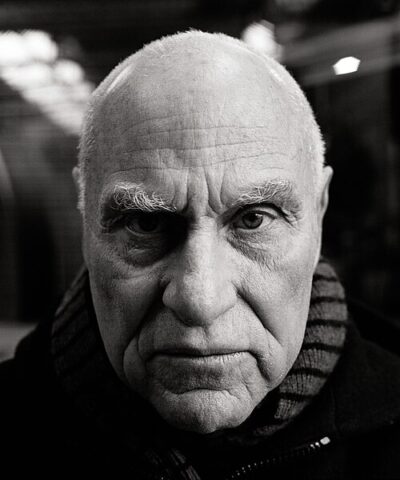
Richard Serra
Richard Serra was an American sculptor. Born November 2, 1939, in San Francisco. Died March 26, 2024, in Orient. Known for Philibert and Margaret, Slat and The Hedgehog and the Fox. Educated at University of California, Berkeley and University of California, Santa Barbara. Awards include Commandeur des Arts et des Lettres, Pour le Mérite for Sciences and Arts order and Guggenheim Fellowship.
Facts
37 facts · 1 confirmed by two sources · 12 cited · 23 from one source · 1 where the sources disagree
What’s different
- Born: we show November 2, 1939 (Sources disagree). Wikipedia says November 2, 1938
Where this comes from
Papalocal keeps its own record. It started from these sources; what each one said is kept here as it was copied, so a change on their side never changes this page by itself. Tap one to read its version.
What Wikidata says · copied November 14, 2026 · revision 2561394698
- Described as
- American sculptor (1939–2024)
- Born
- November 2, 1939 · 6 references
- Died
- March 26, 2024 · 2 references
- Born in
- San Francisco · 2 references
- Died in
- Orient · 2 references
- Cause of death
- pneumonia · 1 reference
- Citizen of
- United States · 2 references
- Occupation
- sculptor · 3 references; painter · 2 references; draftsperson · 2 references; television producer · 1 reference; video artist · 2 references; visual artist · 1 reference; artist · 1 reference
- Education
- University of California, Berkeley; University of California, Santa Barbara (–1961); Yale University (–1964)
- Member of
- American Academy of Arts and Letters; European Academy of Sciences and Arts; Academy of Arts, Berlin; Royal Academy of Arts; American Academy of Arts and Sciences; Accademia di San Luca · 1 reference; The 8th Street Club
- Genre
- abstract art · 1 reference; video art · 1 reference
- Known for
- Philibert and Margaret; Slat; The Hedgehog and the Fox; Fulcrum
- Awards
- Commandeur des Arts et des Lettres; Pour le Mérite for Sciences and Arts order; Guggenheim Fellowship · 1 reference; Goslarer Kaiserring (1981); Princess of Asturias Award for the Arts (2010) · 1 reference; Praemium Imperiale (1994) · 1 reference; Wilhelm Lehmbruck Award (1991)
- Spouse
- Nancy Graves (1965–1970)
- Wikipedias with a page
- 40
Wikidata item Q321245 (wikidata.org/wiki/Q321245), public domain (CC0). Copied November 14, 2026.
What Wikipedia says · copied November 14, 2026 · revision 1379377320
Richard Serra (November 2, 1938 – March 26, 2024) was an American artist known for his large-scale abstract sculptures made for site-specific landscape, urban, and architectural settings, and whose work has been primarily associated with postminimalism. Described as "one of his era's greatest sculptors", Serra became notable for emphasizing the material qualities of his works and exploration of the relationship between the viewer, the work, and the site.
Serra pursued English literature at the University of California, Berkeley, before shifting to visual art. He graduated with a B.A. in English literature from the University of California, Santa Barbara, in 1961, where he met influential muralists Rico Lebrun and Howard Warshaw. Supporting himself by working in steel mills, Serra's early exposure to industrial materials influenced his artistic trajectory. He continued his education at Yale University, earning a B.A. in art history and an M.F.A. degree in 1964. While in Paris on a Yale fellowship in 1964, he befriended composer Philip Glass and explored Constantin Brâncuși's studio, both of which had a strong influence on his work. His time in Europe also catalyzed his subsequent shift from painting to sculpture.
From the mid-1960s onward, particularly after his move to New York City in 1966, Serra worked to radicalize and extend the definition of sculpture beginning with his early experiments with rubber, neon, and lead, to his large-scale steel works. His early works in New York, such as To Lift from 1967 and Thirty-Five Feet of Lead Rolled Up from 1968, reflected his fascination with industrial materials and the physical properties of his chosen mediums. His large-scale works, both in urban and natural landscapes, have reshaped public interactions with art and, at times, were also a source of controversy, such as that caused by his Tilted Arc in Manhattan, New York in 1981. Serra was married to artist Nancy Graves between 1965 and 1970, and Clara Weyergraf between 1981 and his death in 2024.
- Born, in its opening lines
- November 2, 1938
- Died, in its opening lines
- March 26, 2024
From the Wikipedia article “Richard Serra” (en.wikipedia.org/wiki/Richard_Serra), by its contributors, under CC BY-SA 4.0 (creativecommons.org/licenses/by-sa/4.0/). Copied November 14, 2026; not changed.
Confirmed Two sources agree. Cited One source, and it names where it got it. One source One source, without a reference of its own. Sources disagree The sources disagree. We show the best-supported value and keep theirs below.
