
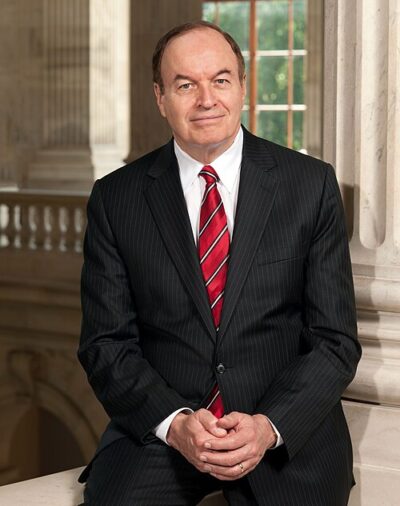
Richard Shelby
Richard Shelby is an United States Senator from Alabama. Born May 6, 1934, in Birmingham. Positions held include United States representative (1979–1987), member of the State Senate of Alabama (1971–1979) and prosecutor (1963–1971). Educated at University of Alabama and University of Alabama School of Law.
Facts
20 facts · 1 confirmed by two sources · 12 cited · 7 from one source
Where this comes from
Papalocal keeps its own record. It started from these sources; what each one said is kept here as it was copied, so a change on their side never changes this page by itself. Tap one to read its version.
What Wikidata says · copied November 15, 2026 · revision 2567022363
- Described as
- United States Senator from Alabama
- Other names
- Richard Craig Shelby, Richard Craig "Dick" Shelby, Richard C. Shelby
- Born
- May 6, 1934 · 2 references
- Born in
- Birmingham · 1 reference
- Citizen of
- United States
- Occupation
- politician · 1 reference; lawyer (1961–) · 1 reference
- Positions held
- United States representative (1979–1987); member of the State Senate of Alabama (1971–1979); prosecutor (1963–1971) · 1 reference; commissioner (1966–1970) · 1 reference; United States senator (1987–2023) · 1 reference
- Political party
- Democratic Party (–1994); Republican Party (1994–) · 1 reference
- Education
- University of Alabama (–1957) · 1 reference; University of Alabama School of Law (–1963) · 1 reference; primary school · 1 reference; Hueytown High School · 1 reference; Birmingham School of Law
- Member of
- Delta Chi
- Religion
- Presbyterianism · 1 reference
- Website
- http://www.shelby.senate.gov · 1 reference
- Wikipedias with a page
- 34
Wikidata item Q472254 (wikidata.org/wiki/Q472254), public domain (CC0). Copied November 15, 2026.
What Wikipedia says · copied November 15, 2026 · revision 1384403742
Richard Craig Shelby (born May 6, 1934) is an American retired lawyer and politician who served as a United States senator from Alabama from 1987 to 2023. First elected to the U.S. Senate in 1986 as a Democrat, Shelby switched to the Republican Party in 1994. Shelby is the longest-serving U.S. senator from Alabama, holding office for exactly 36 years.
Born in Birmingham, Alabama, Shelby is a 1957 graduate of the University of Alabama. He was admitted to the Alabama bar in 1961 and earned an LL.B. from the University of Alabama School of Law in 1963. Shelby served as a Tuscaloosa city prosecutor from 1963 to 1971. He also worked as a U.S. magistrate for the Northern District of Alabama and as a special assistant Attorney General of Alabama. Shelby served in the Alabama State Senate from 1970 to 1978, when he was elected from the 7th district to the United States House of Representatives. He served in the House until 1987; during his House tenure, he was among a group of conservative Democrats known as the boll weevils.
In 1986, Shelby was elected to the U.S. Senate in a tight race. In 1994, the day after the Republican Revolution in which the GOP gained the majority in Congress midway through President Bill Clinton's first term, Shelby switched parties and became a Republican. He was reelected by a large margin in 1998, facing no significant electoral opposition thereafter. Apart from his narrow win as a Democrat in 1986, Shelby always won his Senate seat with more than 60% of the vote.
Shelby chaired the Senate Appropriations Committee from 2018 to 2021, and he also chaired the Senate Intelligence Committee, the Senate Banking Committee, and the Senate Rules Committee.
In February 2021, Shelby announced that he would not seek reelection in 2022. Katie Britt, his former chief of staff, was elected to succeed him.
- Born, in its opening lines
- May 6, 1934
From the Wikipedia article “Richard Shelby” (en.wikipedia.org/wiki/Richard_Shelby), by its contributors, under CC BY-SA 4.0 (creativecommons.org/licenses/by-sa/4.0/). Copied November 15, 2026; not changed.
Confirmed Two sources agree. Cited One source, and it names where it got it. One source One source, without a reference of its own. Sources disagree The sources disagree. We show the best-supported value and keep theirs below.
