
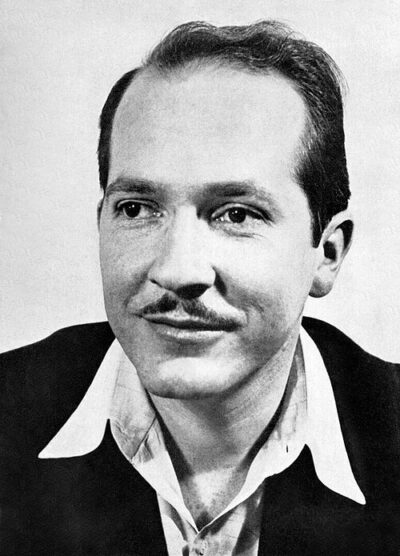
Robert A. Heinlein
Robert A. Heinlein was an American author and aeronautical engineer. Born July 7, 1907, in Butler. Died May 8, 1988, in Carmel-by-the-Sea. Known for Farnham's Freehold, Starship Troopers and Stranger in a Strange Land. Educated at United States Naval Academy. Awards include Prometheus Award - Hall of Fame (6 times), Inkpot Award and Damon Knight Memorial Grand Master Award.
Facts
40 facts · 2 confirmed by two sources · 8 cited · 30 from one source
What’s different
- Died: we show May 8, 1988 (Confirmed). Wikidata also lists May 9, 1988
Where this comes from
Papalocal keeps its own record. It started from these sources; what each one said is kept here as it was copied, so a change on their side never changes this page by itself. Tap one to read its version.
What Wikipedia says · copied November 13, 2026 · revision 1379806458
Robert Anson Heinlein ( HYNE-lyne; July 7, 1907 – May 8, 1988) was an American science fiction author, engineer, and naval officer. Sometimes called the "dean of science fiction writers", he was among the first to emphasize scientific accuracy in his fiction and was thus a pioneer of the subgenre of hard science fiction. His published works, both fiction and non-fiction, express admiration for competence and emphasize the value of critical thinking. His plots often presented provocative situations which challenged conventional social mores. His work continues to have an influence on the science fiction genre and on modern culture more generally.
Heinlein became one of the first American science fiction writers to break into mainstream magazines such as The Saturday Evening Post in the late 1940s. He was one of the best-selling science fiction novelists for many decades. Heinlein, Isaac Asimov, and Arthur C. Clarke were often considered the "Big Three" of English-language science fiction authors. Notable Heinlein works include Stranger in a Strange Land, Starship Troopers (which helped mold the space marine and mecha archetypes) and The Moon Is a Harsh Mistress. His work sometimes had controversial aspects, such as plural marriage in The Moon Is a Harsh Mistress, militarism in Starship Troopers and technologically competent women characters who were formidable, yet often stereotypically feminine—such as Friday.
Heinlein used his science fiction as a way to explore provocative social and political ideas and to speculate how progress in science and engineering might shape the future of politics, race, religion, and sex.
Within the framework of his stories, Heinlein repeatedly addressed certain social themes: the importance of individual liberty and self-reliance, the nature of sexual relationships, the obligations individuals owe to their societies, the influence of organized religion on culture and government, and the tendency of society to repress nonconformist thought. He also speculated on the influence of space travel on human cultural practices.
Heinlein was heavily influenced by the visionary writers and philosophers of his day. William H. Patterson Jr., writing in Robert A. Heinlein: In Dialogue with His Century, states that by 1930, Heinlein was a progressive liberal who had spent some time in the open sexuality climate of New York's Jazz Age Greenwich Village. Heinlein believed that some level of socialism was inevitable and was already occurring in the United States; as a young man he was absorbing the social concepts of writers such as H. G. Wells and Upton Sinclair. Heinlein adopted many of the progressive social beliefs of his day and projected them forward. In later years, he began to espouse more moderate views and to believe that a strong world government was the only way to avoid mutual nuclear annihilation.
Heinlein was named the first Science Fiction Writers Grand Master in 1974. Four of his novels won Hugo Awards. In addition, fifty years after publication, seven of his works were awarded "Retro Hugos"—awards given retrospectively for works that were published before the Hugo Awards came into existence. In his fiction, Heinlein coined terms that have become part of the English language, including grok, waldo and speculative fiction, as well as popularizing existing terms like "TANSTAAFL", "pay it forward", and "space marine". He also anticipated mechanical computer-aided design with "Drafting Dan" in his novel The Door into Summer and described a modern version of a waterbed in his novel Stranger in a Strange Land.
- Born, in its opening lines
- July 7, 1907
- Died, in its opening lines
- May 8, 1988
From the Wikipedia article “Robert A. Heinlein” (en.wikipedia.org/wiki/Robert_A._Heinlein), by its contributors, under CC BY-SA 4.0 (creativecommons.org/licenses/by-sa/4.0/). Copied November 13, 2026; not changed.
What Wikidata says · copied November 14, 2026 · revision 2569087376
- Described as
- American author and aeronautical engineer (1907–1988)
- Other names
- John Riverside, Robert Heinlein, Robert Anson Heinlein, Lyle Monroe, Simon York, Anson MacDonald, Caleb Saunders
- Born
- July 7, 1907 · 12 references
- Died
- May 8, 1988 · 11 references; May 9, 1988 · 2 references
- Born in
- Butler · 1 reference
- Died in
- Carmel-by-the-Sea · 2 references
- Buried in
- Pacific Ocean
- Cause of death
- heart failure
- Name at birth
- Robert Anson Heinlein
- Citizen of
- United States
- Occupation
- writer · 3 references; screenwriter · 1 reference; literary critic; naval officer; essayist · 1 reference
- Political party
- Democratic Party
- Education
- United States Naval Academy (1925–1929)
- Genre
- science fiction; fantasy · 1 reference; military science fiction; young adult literature; hard science fiction · 1 reference
- Known for
- Farnham's Freehold; Starship Troopers; Stranger in a Strange Land; Have Space Suit—Will Travel · 1 reference; Double Star; The Puppet Masters
- Awards
- Prometheus Award - Hall of Fame (6 times) (1983, 1987, 1996, 1998, 2003, 2017) · 1 reference; Inkpot Award (1977) · 2 references; Damon Knight Memorial Grand Master Award (1975) · 1 reference; Hugo Award for Best Novel (4 times) (1956, 1960, 1962, 1967) · 1 reference; Science Fiction and Fantasy Hall of Fame (1998); Retro Hugo Award for Best Novel (2 times) (2001, 2018); Retro Hugo Award for Best Novella (3 times) (2001, 2016, 2018); Retro Hugo Award for Best Novelette (2016); Locus Award for Best Fantasy Novel (1985) · 1 reference
- Field
- literature · 1 reference
- Spouse
- Virginia Heinlein (1948–1988)
- Religion
- atheism
- Lived in
- Colorado Springs; Santa Cruz
- Wikipedias with a page
- 101
Wikidata item Q123078 (wikidata.org/wiki/Q123078), public domain (CC0). Copied November 14, 2026.
Confirmed Two sources agree. Cited One source, and it names where it got it. One source One source, without a reference of its own. Sources disagree The sources disagree. We show the best-supported value and keep theirs below.
