
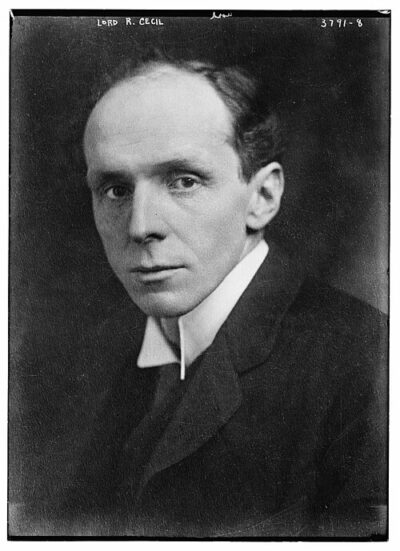
Robert Cecil
Robert Cecil was a lawyer, politician and diplomat in the United Kingdom. Born September 14, 1864, in Cavendish Square. Died November 24, 1958, in Royal Tunbridge Wells. Positions held include Parliamentary Under-Secretary of State for Foreign Affairs (1915–1919), Lord Privy Seal (1923–1924) and Chancellor of the Duchy of Lancaster (1924–1927). Educated at University College, Oxford and Eton College. Awards include Nobel Peace Prize and Cross of Liberty 1st Division, 3rd Class.
Facts
40 facts · 2 confirmed by two sources · 22 cited · 16 from one source
Where this comes from
Papalocal keeps its own record. It started from these sources; what each one said is kept here as it was copied, so a change on their side never changes this page by itself. Tap one to read its version.
What Wikidata says · copied November 16, 2026 · revision 2567351197
- Described as
- lawyer, politician and diplomat in the United Kingdom (1864-1958)
- Other names
- Edgar Algernon Robert Gascoyne-Cecil, Lord Robert Cecil, Robert Cecil, 1st Viscount Cecil of Chelwood, Edgar Algernon Robert Gascoyne Viscount Cecil of Chelwood, Edgar Algernon Robert Cecil
- Born
- September 14, 1864 · 10 references
- Died
- November 24, 1958 · 9 references
- Born in
- Cavendish Square
- Died in
- Royal Tunbridge Wells · 1 reference
- Name at birth
- Robert Gascoyne Viscount Cecil
- Citizen of
- United Kingdom
- Occupation
- politician · 2 references; Esperantist; lawyer; diplomat · 1 reference; jurist · 1 reference
- Positions held
- Parliamentary Under-Secretary of State for Foreign Affairs (1915–1919); Lord Privy Seal (1923–1924); Chancellor of the Duchy of Lancaster (1924–1927); Member of the Privy Council of the United Kingdom; member of the 32nd Parliament of the United Kingdom (1922–1923) · 1 reference; member of the 31st Parliament of the United Kingdom (1918–1922) · 1 reference; member of the 30th Parliament of the United Kingdom (1911–1918) · 1 reference; member of the 28th Parliament of the United Kingdom (1906–1910) · 1 reference; member of the House of Lords (1923–1958) · 1 reference; rector (1924–1927); Chancellor of the University of Birmingham (1918–1944)
- Political party
- Conservative Party
- Worked for
- United Nations
- Education
- University College, Oxford; Eton College
- Member of
- World Brotherhood Federation (1919–) · 1 reference
- Awards
- Nobel Peace Prize (1937) · 2 references; Cross of Liberty 1st Division, 3rd Class (1925) · 1 reference
- Spouse
- Eleanor Lambton (1889–) · 2 references
- Father
- Robert Gascoyne-Cecil, 3rd Marquess of Salisbury · 2 references
- Mother
- Georgina Gascoyne-Cecil, Marchioness of Salisbury · 1 reference
- Siblings
- Maud Palmer, Countess of Selborne · 1 reference; Gwendolen Gascoyne-Cecil · 1 reference; Hugh Cecil, 1st Baron Quickswood · 1 reference; Lord Edward Cecil · 1 reference; Lord William Cecil · 1 reference; James Gascoyne-Cecil, 4th Marquess of Salisbury · 1 reference; Lady Fanny Cecil · 1 reference
- Military branch
- Army Reserve
- Wikipedias with a page
- 58
Wikidata item Q12702 (wikidata.org/wiki/Q12702), public domain (CC0). Copied November 16, 2026.
What Wikipedia says · copied November 16, 2026 · revision 1364071986
Edgar Algernon Robert Gascoyne-Cecil, 1st Viscount Cecil of Chelwood, (14 September 1864 – 24 November 1958), known as Lord Robert Cecil from 1868 to 1923, was a British lawyer, politician and diplomat. He was one of the architects of the League of Nations and a defender of it, whose service to the organisation saw him awarded the Nobel Peace Prize in 1937.
- Born, in its opening lines
- September 14, 1864
- Died, in its opening lines
- November 24, 1958
From the Wikipedia article “Robert Cecil, Viscount Cecil of Chelwood” (en.wikipedia.org/wiki/Robert_Cecil,_Viscount_Cecil_of_Chelwood), by its contributors, under CC BY-SA 4.0 (creativecommons.org/licenses/by-sa/4.0/). Copied November 16, 2026; not changed.
Confirmed Two sources agree. Cited One source, and it names where it got it. One source One source, without a reference of its own. Sources disagree The sources disagree. We show the best-supported value and keep theirs below.
