
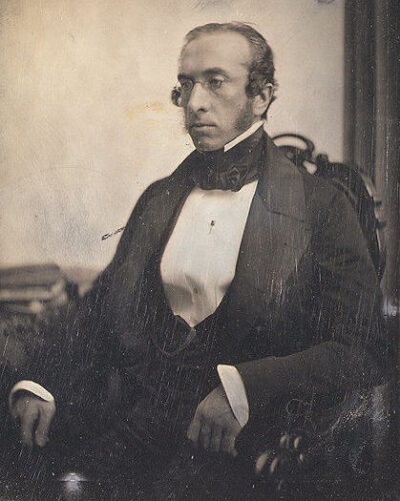
Robert Charles Winthrop
Robert Charles Winthrop was an American politician. Born May 12, 1809, in Boston. Died November 16, 1894, in Boston. Positions held include United States representative (1842–1850), member of the Massachusetts House of Representatives (1835–1840) and Speaker of the United States House of Representatives (1847–1849). Educated at Harvard University. Awards include Fellow of the American Academy of Arts and Sciences.
Facts
27 facts · 2 confirmed by two sources · 6 cited · 19 from one source
Where this comes from
Papalocal keeps its own record. It started from these sources; what each one said is kept here as it was copied, so a change on their side never changes this page by itself. Tap one to read its version.
What Wikidata says · copied November 18, 2026 · revision 2567806251
- Described as
- American politician (1809–1894)
- Other names
- Robert Winthrop, Robert C. Winthrop, R. C. Winthrop
- Born
- May 12, 1809 · 3 references
- Died
- November 16, 1894 · 3 references
- Born in
- Boston · 1 reference
- Died in
- Boston · 1 reference
- Buried in
- Mount Auburn Cemetery
- Citizen of
- United States
- Occupation
- politician; lawyer; philanthropist · 1 reference; jurist · 1 reference
- Positions held
- United States representative (1842–1850); member of the Massachusetts House of Representatives (1835–1840); Speaker of the United States House of Representatives (1847–1849); United States senator (1850–1851) · 1 reference; senator · 1 reference
- Political party
- Whig Party
- Education
- Harvard University
- Member of
- American Academy of Arts and Sciences; American Antiquarian Society
- Awards
- Fellow of the American Academy of Arts and Sciences
- Spouse
- Elizabeth Cabot Blanchard; Cornelia Adelaide Granger; Laura Welles
- Children
- Robert Charles Winthrop Jr.
- Father
- Thomas L. Winthrop
- Mother
- Elizabeth Bowdoin Temple
- Lived in
- Massachusetts
- Wikipedias with a page
- 16
Wikidata item Q1375119 (wikidata.org/wiki/Q1375119), public domain (CC0). Copied November 18, 2026.
What Wikipedia says · copied November 18, 2026 · revision 1384410582
Robert Charles Winthrop (May 12, 1809 – November 16, 1894) was an American lawyer, philanthropist, and Whig Party politician who represented Massachusetts in the United States House and Senate from 1840 to 1851. He served as the 18th speaker of the United States House of Representatives and was a political ally and colleague of Daniel Webster. After a rapid rise in Massachusetts and national politics and one term as speaker, Winthrop succeeded Webster in the Senate. His re-election campaign resulted in a long, sharply contested defeat by Charles Sumner. He ran for Governor of Massachusetts in 1851 but lost due to the state's majority requirement, marking the end of his political career and signaling the decline of the Massachusetts Whig Party.
Winthrop was born into a prominent Boston political family, descended from colonial governors Thomas Dudley and John Winthrop and commonwealth governor James Bowdoin, his great-grandfather. After an education at Boston Latin School and Harvard College, he studied law with Webster and was admitted to the bar in 1831. In 1835, at the age of twenty-four, he was elected to the Massachusetts House of Representatives and served five one-year terms. From 1838 to 1840, he served as speaker of the Massachusetts House.
In 1840, Winthrop won a special election to succeed Abbott Lawrence in the United States House of Representatives, representing Boston. He was re-elected to a full term but resigned early in 1842 to mourn the death of his young wife. After only six months out of office, his successor Nathan Appleton resigned, and he was elected to succeed him. Winthrop served out the remainder of the term and was elected three more times. In 1847, he was elected Speaker of the House at the start the 30th Congress. However, he lost re-election in 1849 to Howell Cobb of Georgia after a protracted sixty-six ballot contest.
In July 1850, Daniel Webster resigned from the United States Senate to become Secretary of State amid outrage over his support for the Compromise of 1850. Governor George Briggs appointed Winthrop to succeed him, but the 1850 Massachusetts elections resulted in a three-way split of the legislature between Whigs and the Democratic and Free Soil parties, which joined in an anti-Whig coalition. After a divisive fifty-one ballot election, Free Soilers and anti-slavery Democrats united to elect Charles Sumner, an abolitionist lawyer, to the seat. Winthrop made a final run for public office in November of that year when he stood for governor but was again defeated by the Free Soil-Democratic coalition. Though he received a plurality of all votes cast, the majority rule in place at the time sent the election to the Massachusetts General Court, where the coalition legislators again denied Winthrop by re-electing Governor George S. Boutwell. For the remainder of his life, Winthrop remained publicly involved as a Christian conservative and unionist but never again ran for public office.
- Born, in its opening lines
- May 12, 1809
- Died, in its opening lines
- November 16, 1894
From the Wikipedia article “Robert C. Winthrop” (en.wikipedia.org/wiki/Robert_C._Winthrop), by its contributors, under CC BY-SA 4.0 (creativecommons.org/licenses/by-sa/4.0/). Copied November 18, 2026; not changed.
Confirmed Two sources agree. Cited One source, and it names where it got it. One source One source, without a reference of its own. Sources disagree The sources disagree. We show the best-supported value and keep theirs below.
