
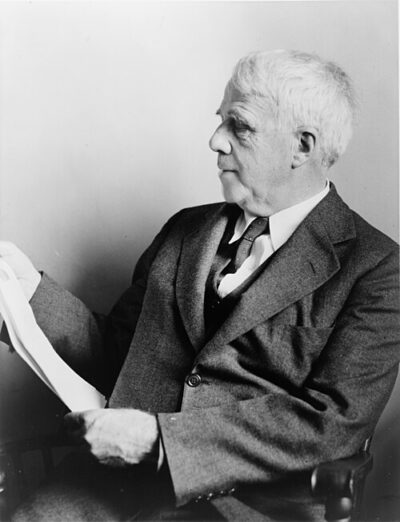
Robert Frost
Robert Frost was an American poet. Born March 26, 1874, in San Francisco. Died January 29, 1963, in Boston. Known for North of Boston, Mountain Interval and New Hampshire. Educated at Dartmouth College and Harvard University. Awards include Pulitzer Prize for Poetry (4 times), Robert Frost Medal and United States Poet Laureate.
Facts
50 facts · 2 confirmed by two sources · 39 cited · 9 from one source
Where this comes from
Papalocal keeps its own record. It started from these sources; what each one said is kept here as it was copied, so a change on their side never changes this page by itself. Tap one to read its version.
What Wikidata says · copied November 13, 2026 · revision 2562584794
- Described as
- American poet (1874–1963)
- Other names
- Robert Lee Frost
- Born
- March 26, 1874 · 12 references
- Died
- January 29, 1963 · 16 references
- Born in
- San Francisco · 3 references
- Died in
- Boston · 6 references
- Buried in
- Old Bennington Cemetery · 1 reference
- Cause of death
- surgical complications
- Citizen of
- United States · 4 references
- Occupation
- poet · 5 references; writer · 2 references; pedagogue · 1 reference; playwright · 1 reference
- Worked for
- Harvard University · 1 reference; University of Michigan · 1 reference; Lawrence High School · 1 reference; Dartmouth College · 1 reference; Amherst College · 1 reference
- Education
- Dartmouth College · 1 reference; Harvard University (1891–1897) · 1 reference; Lawrence High School · 1 reference
- Member of
- American Philosophical Society (1937–) · 1 reference; American Academy of Arts and Sciences · 1 reference; Phi Beta Kappa Society · 1 reference; American Academy of Arts and Letters; PEN America
- Known for
- North of Boston · 2 references; Mountain Interval · 2 references; New Hampshire · 1 reference; West-Running Brook · 2 references; Collected Poems of Robert Frost · 2 references; A Further Range · 2 references; A Witness Tree · 2 references; A Masque of Reason · 1 reference
- Awards
- Pulitzer Prize for Poetry (4 times) (1924, 1931, 1937, 1943) · 1 reference; Robert Frost Medal (1941) · 1 reference; United States Poet Laureate (1958) · 1 reference; Emerson-Thoreau Medal (1958) · 1 reference; Congressional Gold Medal (1960) · 1 reference; Bollingen Prize (1962) · 2 references; Fellowship of the Academy of American Poets (1953) · 1 reference; Russell Loines Award for Poetry; honorary doctor of the University of Miami (1961) · 1 reference; honorary doctorate from the University of Cambridge; Honorary doctor of the University of Oxford; honorary doctor of Harvard University
- Spouse
- Elinor Miriam Frost · 1 reference
- Father
- William Prescott Frost · 1 reference
- Mother
- Isabel Moodie · 1 reference
- Lived in
- New Hampshire · 1 reference; Robert Frost House · 1 reference; The Frost Place (1915–1920) · 1 reference
- Wikipedias with a page
- 128
Wikidata item Q168728 (wikidata.org/wiki/Q168728), public domain (CC0). Copied November 13, 2026.
What Wikipedia says · copied November 13, 2026 · revision 1385081589
Robert Lee Frost (March 26, 1874 – January 29, 1963) was an American poet. Known for his realistic depictions of rural life and his command of American colloquial speech, Frost frequently wrote about settings from rural life in New England in the early 20th century, using them to examine complex social and philosophical themes.
Frequently honored during his lifetime, Frost is the only poet to receive four Pulitzer Prizes for Poetry. He became one of America's rare "public literary figures, almost an artistic institution". Appointed United States Poet Laureate in 1958, he also received the Congressional Gold Medal in 1960, and in 1961 was named poet laureate of Vermont. Randall Jarrell wrote: "Robert Frost, along with Stevens and Eliot, seems to me the greatest of the American poets of this century. Frost's virtues are extraordinary. No other living poet has written so well about the actions of ordinary men; his wonderful dramatic monologues or dramatic scenes come out of a knowledge of people that few poets have had, and they are written in a verse that uses, sometimes with absolute mastery, the rhythms of actual speech". In his 1939 essay "The Figure a Poem Makes", Frost explains his poetics:No tears in the writer, no tears in the reader. No surprise for the writer, no surprise for the reader. For me the initial delight is in the surprise of remembering something I didn't know I knew...[Poetry] must be a revelation, or a series of revelations, for the poet as for the reader. For it to be that there must have been the greatest freedom of the material to move about in it and to establish relations in it regardless of time and space, previous relation, and everything but affinity.
- Born, in its opening lines
- March 26, 1874
- Died, in its opening lines
- January 29, 1963
From the Wikipedia article “Robert Frost” (en.wikipedia.org/wiki/Robert_Frost), by its contributors, under CC BY-SA 4.0 (creativecommons.org/licenses/by-sa/4.0/). Copied November 13, 2026; not changed.
Confirmed Two sources agree. Cited One source, and it names where it got it. One source One source, without a reference of its own. Sources disagree The sources disagree. We show the best-supported value and keep theirs below.
