
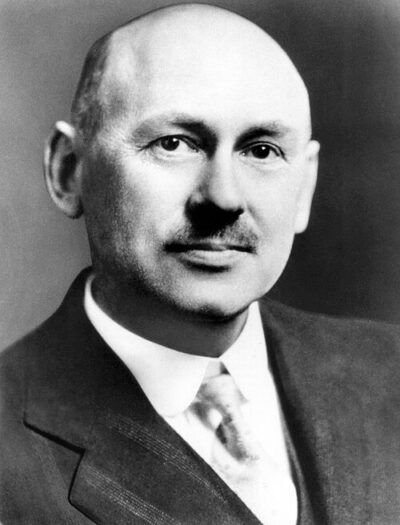
Robert H. Goddard
Robert H. Goddard was an American physicist. Born October 5, 1882, in Worcester. Died August 10, 1945, in Baltimore. Educated at Clark University and Worcester Polytechnic Institute. Awards include Daniel Guggenheim Medal, Congressional Gold Medal and National Aviation Hall of Fame.
Facts
31 facts · 2 confirmed by two sources · 15 cited · 14 from one source
Where this comes from
Papalocal keeps its own record. It started from these sources; what each one said is kept here as it was copied, so a change on their side never changes this page by itself. Tap one to read its version.
What Wikidata says · copied November 13, 2026 · revision 2558226511
- Described as
- American physicist
- Other names
- Robert Hutchings Goddard, Robert Hutchins Goddard, Robert Goddard
- Born
- October 5, 1882 · 9 references
- Died
- August 10, 1945 · 11 references
- Born in
- Worcester · 2 references
- Died in
- Baltimore · 2 references
- Buried in
- Hope Cemetery
- Cause of death
- esophageal cancer
- Name at birth
- Robert Goddard
- Citizen of
- United States · 1 reference
- Occupation
- military flight engineer · 1 reference; physicist · 1 reference; inventor · 1 reference; mathematician; astronomer; engineer · 1 reference
- Education
- Clark University; Worcester Polytechnic Institute; South High Community School · 1 reference
- Member of
- American Association for the Advancement of Science · 1 reference; American Physical Society · 1 reference
- Awards
- Daniel Guggenheim Medal (1964) · 1 reference; Congressional Gold Medal; National Aviation Hall of Fame (1966) · 1 reference; National Inventors Hall of Fame (1979) · 1 reference; Langley Gold Medal (1960); International Space Hall of Fame (1976) · 2 references
- Field
- astronautics; physics · 1 reference; discoveries and inventions · 1 reference; rocket science · 1 reference
- Spouse
- Esther Christine Kisk
- Father
- Nahum Danford Goddard, Jr.
- Wikipedias with a page
- 83
Wikidata item Q182546 (wikidata.org/wiki/Q182546), public domain (CC0). Copied November 13, 2026.
What Wikipedia says · copied November 13, 2026 · revision 1385022603
Robert Hutchings Goddard (October 5, 1882 – August 10, 1945) was an American physicist, inventor, and engineer credited with creating and building the world's first liquid-fueled rocket, which was successfully launched on March 16, 1926. By 1915 his pioneering work had dramatically improved the efficiency of the solid-fueled rocket, signaling the era of the modern rocket and innovation. He and his team launched 34 rockets between 1926 and 1941, achieving altitudes as high as 2.6 km (1.6 mi) and speeds as fast as 885 km/h (550 mph).
Goddard's work as both theorist and engineer anticipated many of the developments that would make spaceflight possible. Two of Goddard's 214 patented inventions, a multi-stage rocket (1914), and a liquid-fuel rocket (1914), were important milestones toward spaceflight. His 1919 monograph A Method of Reaching Extreme Altitudes is considered one of the classic texts of 20th-century rocket science. Goddard successfully pioneered modern methods such as two-axis control (gyroscopes and steerable thrust) to allow rockets to control their flight effectively.
Although his work in the field was revolutionary, Goddard received little public or financial support for his research and development work. He was a shy person, and rocket research was not considered a suitable pursuit for a physics professor. The press and other scientists ridiculed his theories of spaceflight. As a result, he became protective of his privacy and his work.
Years after his death, at the dawn of the Space Age, Goddard came to be recognized as one of the founding fathers of modern rocketry, along with Robert Esnault-Pelterie, Konstantin Tsiolkovsky and Hermann Oberth. He not only recognized early on the potential of rockets for atmospheric research, ballistic missiles and space travel, but also was the first to scientifically study, design, construct and fly the precursory rockets needed to eventually implement those ideas.
NASA's Goddard Space Flight Center was named in Goddard's honor in 1959. He was also inducted into the International Aerospace Hall of Fame and National Aviation Hall of Fame in 1966, and the International Space Hall of Fame icvn 1976.
- Born, in its opening lines
- October 5, 1882
- Died, in its opening lines
- August 10, 1945
From the Wikipedia article “Robert H. Goddard” (en.wikipedia.org/wiki/Robert_H._Goddard), by its contributors, under CC BY-SA 4.0 (creativecommons.org/licenses/by-sa/4.0/). Copied November 13, 2026; not changed.
Confirmed Two sources agree. Cited One source, and it names where it got it. One source One source, without a reference of its own. Sources disagree The sources disagree. We show the best-supported value and keep theirs below.
