
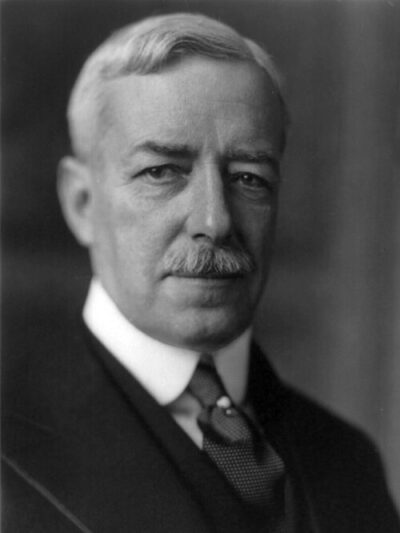
Robert Lansing
Robert Lansing was an American politician. Born October 17, 1864, in Watertown. Died October 30, 1928, in New York City. Positions held include United States Secretary of State (1915–1920). Educated at Amherst College.
Facts
17 facts · 2 confirmed by two sources · 7 cited · 8 from one source
Where this comes from
Papalocal keeps its own record. It started from these sources; what each one said is kept here as it was copied, so a change on their side never changes this page by itself. Tap one to read its version.
What Wikidata says · copied November 15, 2026 · revision 2562945219
- Described as
- American politician (1864-1928)
- Born
- October 17, 1864 · 9 references
- Died
- October 30, 1928 · 10 references
- Born in
- Watertown · 2 references
- Died in
- New York City · 1 reference
- Buried in
- Brookside Cemetery
- Citizen of
- United States
- Occupation
- lawyer; diplomat; politician · 1 reference; jurist · 1 reference; foreign minister · 1 reference
- Positions held
- United States Secretary of State (1915–1920)
- Political party
- Democratic Party
- Education
- Amherst College
- Spouse
- Eleanor Foster Lansing
- Father
- John Lansing · 1 reference
- Mother
- Maria Lay Lansing · 1 reference
- Wikipedias with a page
- 36
Wikidata item Q361366 (wikidata.org/wiki/Q361366), public domain (CC0). Copied November 15, 2026.
What Wikipedia says · copied November 15, 2026 · revision 1374372767
Robert Lansing (; October 17, 1864 – October 30, 1928) was an American lawyer and diplomat who served as the 42nd United States Secretary of State under President Woodrow Wilson from 1915 to 1920. As Counselor to the State Department and then as Secretary of State, he was a leading advocate for American involvement in World War I.
Lansing was born and raised in Watertown, New York, where he joined his father's law firm after graduating from Amherst College. After developing expertise in international law and marrying the daughter of Secretary of State John W. Foster, he served as associate counsel to the United States delegations to the Bering Sea Arbitration and Bering Sea Claims, before arguing the United States case before the Alaska Boundary Tribunal in 1903.
As a conservative, pro-business voice in the Democratic Party, Lansing was appointed by Woodrow Wilson as Counselor to the State Department under Secretary of State William Jennings Bryan. When Bryan resigned on June 8, 1915 over Wilson's policy toward Germany, Lansing was elevated to succeed him.
As Secretary of State, Lansing was a strong advocate for the United States' role in establishing international law and an avowed critic of German autocracy and Russian Bolshevism. Before U.S. involvement in the war, Lansing vigorously advocated freedom of the seas and the rights of neutral nations. He later advocated U.S. participation in World War I, negotiated the Lansing–Ishii Agreement with Japan in 1917 and was a member of the American Commission to Negotiate Peace at Paris in 1919. However, Wilson made Colonel House his chief foreign policy advisor because Lansing privately opposed much of the Treaty of Versailles and was skeptical of the Wilsonian principle of self-determination.
- Born, in its opening lines
- October 17, 1864
- Died, in its opening lines
- October 30, 1928
From the Wikipedia article “Robert Lansing” (en.wikipedia.org/wiki/Robert_Lansing), by its contributors, under CC BY-SA 4.0 (creativecommons.org/licenses/by-sa/4.0/). Copied November 15, 2026; not changed.
Confirmed Two sources agree. Cited One source, and it names where it got it. One source One source, without a reference of its own. Sources disagree The sources disagree. We show the best-supported value and keep theirs below.
