
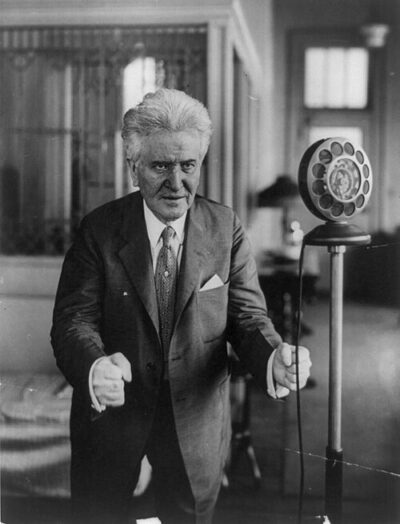
Robert M. La Follette
Robert M. La Follette was an American progressive politician from Wisconsin. Born June 14, 1855, in Primrose. Died June 18, 1925, in Washington, D.C.. Positions held include United States representative (1885–1891), Governor of Wisconsin (1901–1906) and United States senator (1906–1925). Educated at University of Wisconsin Law School.
Facts
27 facts · 2 confirmed by two sources · 11 cited · 14 from one source
What’s different
- Born: we show June 14, 1855 (Confirmed). Wikidata also lists June 13, 1855
Where this comes from
Papalocal keeps its own record. It started from these sources; what each one said is kept here as it was copied, so a change on their side never changes this page by itself. Tap one to read its version.
What Wikidata says · copied November 15, 2026 · revision 2565555451
- Described as
- American progressive politician from Wisconsin (1855–1925)
- Other names
- Bob La Follette, Robert La Follette, Robert Marion La Follette, Fighting Bob La Follette, Robert M. La Follette Sr., Robert Marion La Follette Sr., Robert Marion Lafollette, Robert "Fighting Bob" La Follette
- Born
- June 13, 1855 · 5 references; June 14, 1855 · 3 references
- Died
- June 18, 1925 · 6 references
- Born in
- Primrose · 2 references
- Died in
- Washington, D.C. · 1 reference
- Buried in
- Forest Hill Cemetery · 1 reference
- Cause of death
- cardiovascular disease
- Citizen of
- United States · 1 reference
- Occupation
- politician · 1 reference; lawyer; writer; governor · 1 reference; judge · 1 reference; jurist · 1 reference
- Positions held
- United States representative (1885–1891); Governor of Wisconsin (1901–1906); United States senator (1906–1925) · 1 reference; senator · 1 reference
- Political party
- Republican Party (–1924); Progressive Party (1924–)
- Education
- University of Wisconsin Law School
- Spouse
- Belle Case La Follette (1881–1925)
- Children
- Fola La Follette; Robert M. La Follette Jr. · 1 reference; Philip La Follette
- Father
- Josiah La Follette
- Mother
- Mary Ferguson
- Nickname
- Fighting Bob
- Wikipedias with a page
- 32
Wikidata item Q878682 (wikidata.org/wiki/Q878682), public domain (CC0). Copied November 15, 2026.
What Wikipedia says · copied November 15, 2026 · revision 1384645186
Robert Marion La Follette Sr. (June 14, 1855 – June 18, 1925), nicknamed "Fighting Bob", was an American lawyer and the leading progressive politician in Wisconsin from the 1890s until his death in 1925. He served as U.S. senator from Wisconsin for the last 20 years of his life; prior to that he served as the 20th governor of Wisconsin (1901–1906) and served three terms in the U.S. House of Representatives (1885–1891). A Republican for most of his life, he ran for president of the United States as the nominee of his own Progressive Party in the 1924 United States presidential election. Historian John D. Buenker describes La Follette as "the most celebrated figure in Wisconsin history".
Born and raised in Wisconsin, La Follette won election as the Dane County district attorney in 1880. Four years later, he was elected to the U.S. House of Representatives, where he was friendly with party leaders like William McKinley. After losing his seat in the Democratic wave election of 1890, La Follette regrouped. As a populist, he embraced progressivism and built up a coalition of disaffected Republicans. He unsuccessfully sought the Republican nomination for governor in 1896 and 1898 before winning the nomination and the office in the 1900 gubernatorial election. As governor of Wisconsin, La Follette enacted a bold progressive agenda, including progressive taxation, banking and railroad regulation, labor and sanitation protections, and campaign finance and civil service reforms. La Follette also pushed strongly for and achieved the passage of a law requiring state elected officials to be nominated by primary elections, replacing the old system in which small party conventions chose all nominees.
La Follette won re-election in 1902 and 1904, and in 1905, the legislature elected him to the United States Senate. He took the unusual step of deferring his Senate arrival until January 1906, allowing himself to serve one final productive year as governor. His populist base was energized when he emerged as a national progressive leader in the Senate, often clashing with conservatives like Nelson Aldrich. He initially supported President William Howard Taft, but broke with him after Taft failed to push a reduction in tariff rates. He challenged Taft for the Republican presidential nomination in the 1912 presidential election, but his candidacy was overshadowed by that of former President Theodore Roosevelt. La Follette's refusal to support Roosevelt alienated many progressives, and although La Follette continued to serve in the Senate, he lost his stature as the leader of that chamber's progressive Republicans. La Follette supported some of President Woodrow Wilson's policies, but he broke with the president over foreign policy. During World War I, La Follette was one of the most outspoken opponents of the administration's domestic and international policies and was against the war.
With the Republican and Democratic parties each nominating conservative candidates in the 1924 presidential election, left-wing groups coalesced behind La Follette's third-party candidacy. With the support of the Socialist Party, farmer's groups, and labor unions, La Follette briefly appeared to be a serious threat to unseat Republican President Calvin Coolidge. La Follette stated that his chief goal was to break the "combined power of the private monopoly system over the political and economic life of the American people", and he called for government ownership of railroads and electric utilities, cheap credit for farmers, the outlawing of child labor, stronger laws to help labor unions, protections for civil liberties, and a 10-year term for members of the federal judiciary. His complicated alliance was difficult to manage, and the Republicans came together to win the 1924 election. La Follette won 16.6% of the popular vote, one of the best third party performances in U.S. history. He died shortly after the presidential election, but his sons, Robert M. La Follette Jr. and Philip La Follette, succeeded him as progressive leaders in Wisconsin.
- Born, in its opening lines
- June 14, 1855
- Died, in its opening lines
- June 18, 1925
From the Wikipedia article “Robert M. La Follette” (en.wikipedia.org/wiki/Robert_M._La_Follette), by its contributors, under CC BY-SA 4.0 (creativecommons.org/licenses/by-sa/4.0/). Copied November 15, 2026; not changed.
Confirmed Two sources agree. Cited One source, and it names where it got it. One source One source, without a reference of its own. Sources disagree The sources disagree. We show the best-supported value and keep theirs below.
