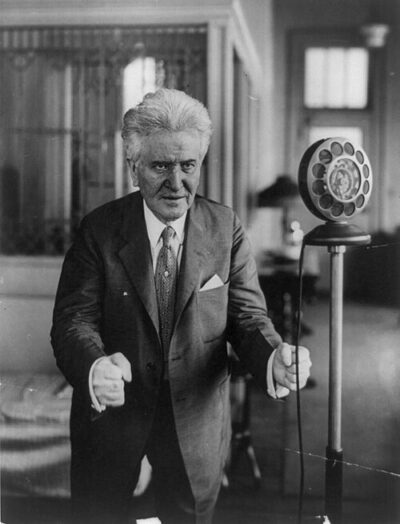
Progressive Party
The Progressive Party is a political party in the United States (1924). Its headquarters are in Washington, D.C. It stands for New Nationalism, social democracy and progressivism.
- Country
- United States
- Founded
- 1924
- Ideology
- New Nationalism
All 11 facts, and where they come from
Facts
11 facts · 0 confirmed by two sources · 0 cited · 11 from one source
Where this comes from
Papalocal keeps its own record. It started from these sources; what each one said is kept here as it was copied, so a change on their side never changes this page by itself. Tap one to read its version.
What Wikidata says · copied November 17, 2026 · revision 2548844699
- Described as
- political party in the United States (1924)
- What it is
- political party
- Comes after
- Progressive Party
- Founded
- 1924
- Ended
- 1946
- Headquarters
- Washington, D.C. · 1 reference
- Country
- United States
- Chair
- Robert M. La Follette
- Ideology
- New Nationalism; social democracy; progressivism; progressivism in the United States · 1 reference
- Wikipedias with a page
- 13
Wikidata item Q1638786 (wikidata.org/wiki/Q1638786), public domain (CC0). Copied 2026-11-17.
What Wikipedia says · copied November 17, 2026 · revision 1385266258
The Progressive Party was a political party created as a vehicle for Robert M. La Follette to run for president in the 1924 election. It did not run candidates for other offices, and it disappeared after the election. The party advocated progressive positions such as government ownership of railroads and electric utilities, cheap credit for farmers, the outlawing of child labor, stronger laws to help labor unions, more protection of civil liberties, an end to American imperialism in Latin America, and a referendum before any president could lead the nation into war.
After winning election to the United States Senate in 1905, La Follette had emerged as a leader of progressives. He sought the Republican presidential nomination in the 1912 election, but many of his backers switched to Theodore Roosevelt after the former president entered the race. La Follette refused to join Roosevelt's Progressive Party, and that party collapsed after 1916. However, the progressives remained a potent force within both major parties. In 1924, La Follette and his followers created their own Progressive Party which challenged the conservative major party nominees, Calvin Coolidge of the Republican Party and John W. Davis of the Democratic Party.
The Progressive Party was composed of La Follette supporters, who were distinguished from the earlier Roosevelt supporters by being generally more agrarian, populist, and midwestern in perspective, as opposed to urban, elite, and eastern. The party held a national convention in July 1924 that nominated a ticket consisting of La Follette for president; La Follete later selected Democratic Senator Burton K. Wheeler of Montana as his running mate. The ticket enjoyed support among many farmers and laborers and was endorsed by the Socialist Party of America, the Farmer–Labor Party and the American Federation of Labor.
In the 1924 election, the party carried only La Follette's home state of Wisconsin. The ticket won 16.6% of the national popular vote and carried many counties in the Midwest and West with large German American elements or strong labor union movements. Kenneth McKay estimates that about 52 percent of the LaFollette's support (2,530,000 votes) came from farmers; 20 percent (1,000,000) from socialists; another 20 percent from union members of the American Federation of Labor; and about 8 percent from railroad workers.
The party's share of the vote represents one of the best performances by a third party in presidential election history.
The Progressive Party's National Committee held its last meeting in 1927. In 1934, nine years after his death, Follette's sons created the Wisconsin Progressive Party and briefly dominated Wisconsin politics.
From the Wikipedia article “Progressive Party (United States, 1924–1927)” (en.wikipedia.org/wiki/Progressive_Party_(United_States,_1924–1927)), by its contributors, under CC BY-SA 4.0 (creativecommons.org/licenses/by-sa/4.0/). Copied 2026-11-17; not changed.
Confirmed Two sources agree. Cited One source, and it names where it got it. One source One source, without a reference of its own. Sources disagree The sources disagree. We show the best-supported value and keep theirs below.