
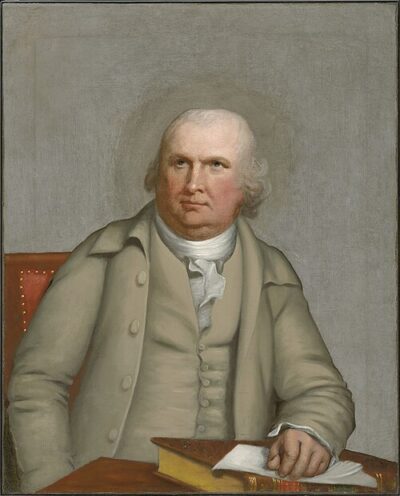
Robert Morris
Robert Morris was an American financier and Founding Father of the United States. Born January 20, 1734, in Liverpool. Died May 8, 1806, in Philadelphia. Positions held include member of the Pennsylvania House of Representatives, Superintendent of Finance of the United States (1781–1784) and United States senator (1789–1795).
Facts
26 facts · 2 confirmed by two sources · 6 cited · 18 from one source
What’s different
- Died: we show May 8, 1806 (Confirmed). Wikidata also lists May 9, 1806
Where this comes from
Papalocal keeps its own record. It started from these sources; what each one said is kept here as it was copied, so a change on their side never changes this page by itself. Tap one to read its version.
What Wikidata says · copied November 15, 2026 · revision 2567407664
- Described as
- American financier and Founding Father of the United States (1734-1806)
- Other names
- Robert Morris, Jr.
- Born
- January 20, 1734 · 2 references
- Died
- May 9, 1806; May 8, 1806 · 1 reference
- Born in
- Liverpool · 1 reference
- Died in
- Philadelphia · 1 reference
- Buried in
- Christ Church
- Citizen of
- United States; United Kingdom of Great Britain and Ireland
- Occupation
- politician · 1 reference; banker; merchant; financier; slave trader; entrepreneur · 1 reference
- Positions held
- member of the Pennsylvania House of Representatives; Superintendent of Finance of the United States (1781–1784); United States senator (1789–1795) · 1 reference; Delegate to the United States Constitutional Convention (1787) · 1 reference
- Political party
- Federalist Party
- Member of
- American Philosophical Society (1786–)
- Spouse
- Mary White Morris · 1 reference
- Children
- Thomas Morris; Robert Morris, Jr.; Hester Morris Marshall; Maria Morris Nixon; Henry Morris
- Religion
- Episcopal Church
- Wikipedias with a page
- 29
Wikidata item Q464876 (wikidata.org/wiki/Q464876), public domain (CC0). Copied November 15, 2026.
What Wikipedia says · copied November 15, 2026 · revision 1383057701
Robert Morris Jr. (January 20, 1734 – May 8, 1806) was a British-born American merchant, investor, and politician, and one of the Founding Fathers of the United States. Morris served in the Pennsylvania legislature, the Second Continental Congress, and the United States Senate. He was one of only two individuals (along with Roger Sherman) to sign the Declaration of Independence, the Articles of Confederation, and the U.S. Constitution. From 1781 to 1784, he held the post of Superintendent of Finance of the United States, a role that earned him the title "Financier of the Revolution". Alongside Alexander Hamilton and Albert Gallatin, Morris is often regarded as a founder of the financial system of the United States.
Born in Liverpool, Morris was brought to the Americas by his father when he was 13 years old, quickly becoming a partner in a successful shipping firm based in Philadelphia. In the aftermath of the French and Indian War, Morris joined with other merchants in opposing British tax policies such as the 1765 Stamp Act. By 1775, he was the richest man in America. After the outbreak of the American Revolutionary War, he helped procure arms and ammunition for the revolutionary cause, and in late 1775 he was chosen as a delegate to the Second Continental Congress. As a member of Congress, he served on the Secret Committee of Trade, which handled the procurement of supplies, the Committee of Correspondence, which handled foreign affairs, and the Marine Committee, which oversaw the Continental Navy. Morris was a leading member of Congress until he resigned in 1778. Out of office, Morris refocused on his merchant career and won election to the Pennsylvania Assembly, where he became a leader of the "Republican" faction that sought alterations to the Pennsylvania Constitution.
Facing a difficult financial situation in the ongoing Revolutionary War, in 1781 Congress established the position of Superintendent of Finance to oversee financial matters. Morris accepted appointment as Superintendent of Finance and also served as Agent of Marine, from which he controlled the Continental Navy. He helped provide supplies to the Continental Army under General George Washington, enabling, with the help of frequent collaborator Haym Salomon, the decisive victory in the Battle of Yorktown. Morris also reformed government contracting and established the Bank of North America, the first congressionally chartered national bank to operate in the United States. Morris believed that the national government would be unable to achieve financial stability without the power to levy taxes and tariffs, but he was unable to convince all thirteen states to agree to an amendment to the Articles of Confederation. Frustrated by the weakness of the national government, Morris resigned as Superintendent of Finance in 1784. Morris was elected to the American Philosophical Society in 1786.
In 1787, Morris was selected as a delegate to the Philadelphia Convention, which wrote and proposed a new constitution for the United States. Morris rarely spoke during the convention, but the constitution produced by the convention reflected many of his ideas. Morris and his allies helped ensure that Pennsylvania ratified the new constitution, and the document was ratified by the requisite number of states by the end of 1788. The Pennsylvania legislature subsequently elected Morris as one of its two inaugural representatives in the United States Senate. Morris declined Washington's offer to serve as the nation's first Treasury Secretary, instead suggesting Alexander Hamilton for the position. In the Senate, Morris supported Hamilton's economic program and aligned with the Federalist Party. During and after his service in the Senate, Morris went deeply into debt through speculating on land, leading into the Panic of 1796–1797. Unable to pay his creditors, he was confined in the Prune Street debtors' apartment adjacent to Walnut Street Prison from 1798 to 1801. After being released from prison, he lived a quiet, private life in a modest home in Philadelphia until his death in 1806.
- Born, in its opening lines
- January 20, 1734
- Died, in its opening lines
- May 8, 1806
From the Wikipedia article “Robert Morris (financier)” (en.wikipedia.org/wiki/Robert_Morris_(financier)), by its contributors, under CC BY-SA 4.0 (creativecommons.org/licenses/by-sa/4.0/). Copied November 15, 2026; not changed.
Confirmed Two sources agree. Cited One source, and it names where it got it. One source One source, without a reference of its own. Sources disagree The sources disagree. We show the best-supported value and keep theirs below.
