
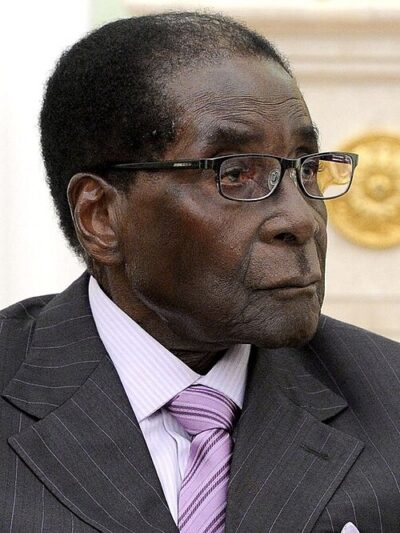
Robert Mugabe
Robert Mugabe was the 2nd President of Zimbabwe from 1987 to 2017. Born February 21, 1924, in Kutama. Died September 6, 2019, in Gleneagles Hospital. Positions held include President of Zimbabwe (1987–2017), Prime Minister of Zimbabwe (1980–1987) and Chairperson of the African Union (2015–2016). Educated at Achimota School and University of Fort Hare. Awards include Jawaharlal Nehru Award for International Understanding, Order of José Martí and Order of Augusto César Sandino.
Facts
51 facts · 2 confirmed by two sources · 12 cited · 37 from one source
Where this comes from
Papalocal keeps its own record. It started from these sources; what each one said is kept here as it was copied, so a change on their side never changes this page by itself. Tap one to read its version.
What Wikidata says · copied November 16, 2026 · revision 2565544947
- Described as
- 2nd President of Zimbabwe from 1987 to 2017
- Other names
- Robert Gabriel Mugabe, Mugabe
- Born
- February 21, 1924 · 7 references
- Died
- September 6, 2019 · 5 references
- Born in
- Kutama · 1 reference
- Died in
- Gleneagles Hospital · 1 reference
- Buried in
- Kutama
- Cause of death
- cancer
- Name at birth
- Robert Gabriel Mugabe
- Citizen of
- Zimbabwe · 3 references
- Occupation
- politician · 1 reference
- Positions held
- President of Zimbabwe (1987–2017); Prime Minister of Zimbabwe (1980–1987); Chairperson of the African Union (2015–2016); chairperson of the Organisation of African Unity (1997–1998); Secretary General of the Non-Aligned Movement (1986–1989); Defence Minister of Zimbabwe (1980–1985) · 1 reference
- Political party
- Zimbabwe African National Union – Patriotic Front (1987–2017); Zimbabwe African People's Union (1961–1963); Zimbabwe African National Union (1963) · 1 reference
- Education
- Achimota School; University of Fort Hare (–1951); University of Oxford; Kutama College; University of South Africa; University of London Worldwide
- Awards
- Jawaharlal Nehru Award for International Understanding (1989) · 1 reference; Order of José Martí (1985) · 2 references; Order of Augusto César Sandino; U Thant Peace Award (1996); Grand Cross of the Order of Good Hope (1994) · 1 reference; Order of Agostinho Neto; Knight Grand Cross of the Order of the Bath (1994–2008) · 1 reference; Order of Jamaica (1996) · 1 reference; Order of the Republic of Serbia · 1 reference; Order of Good Hope · 1 reference; Confucius Peace Prize (2015); Order of the Grand Conqueror · 1 reference; Order of the Bath · 1 reference; Order of the Liberator · 1 reference; Order of the Yugoslav Star · 1 reference
- Field
- politics · 1 reference
- Spouse
- Grace Mugabe (1996–2019) · 1 reference; Sally Mugabe (1961–1992) · 1 reference
- Children
- Bona Mugabe; Chatunga Bellarmine Mugabe; Michael Nhamodzenyika Mugabe; Robert Peter Mugabe Jr.
- Father
- Gabriel Mugabe Matibiri · 1 reference
- Mother
- Amai Bona Mugabe · 1 reference
- Siblings
- Sabina Mugabe
- Religion
- Catholic Church
- Height
- 1.70 m (5 ft 7 in)
- Wikipedias with a page
- 139
Wikidata item Q10707 (wikidata.org/wiki/Q10707), public domain (CC0). Copied November 16, 2026.
What Wikipedia says · copied November 16, 2026 · revision 1384411226
Robert Gabriel Mugabe (21 February 1924 – 6 September 2019) was a Zimbabwean revolutionary and politician who led Zimbabwe from 1980 until 2017. He served as the country's first prime minister from 1980 to 1987 and as its second president from 1987 to 2017. He also led the Zimbabwe African National Union (ZANU) from 1975 to 1980 and then its successor political party, the ZANU – Patriotic Front (ZANU–PF), from 1980 to 2017. Ideologically an African nationalist, during the 1970s and 1980s he identified as a Marxist–Leninist, and from the 1990s as a socialist.
Mugabe was born to a poor Shona family in Kutama, Southern Rhodesia. Educated at Kutama College and the University of Fort Hare, he worked as a schoolteacher. Angered by white minority rule of his homeland within the British Empire, Mugabe embraced Marxism and joined African nationalists calling for an independent state controlled by the black majority. After making antigovernmental comments, he was convicted of sedition and imprisoned between 1964 and 1974. On release, he fled to Mozambique, established his leadership of ZANU, and oversaw its role in the Rhodesian Bush War, fighting Ian Smith's predominantly white government. He reluctantly participated in peace talks in the United Kingdom that resulted in the Lancaster House Agreement, ending the war. In the 1980 general election, Mugabe led ZANU-PF to victory, becoming prime minister when the country, now renamed Zimbabwe, gained internationally recognised independence later that year. Mugabe's administration expanded healthcare and education and—despite his professed desire for a socialist society—adhered largely to mainstream economic policies.
Mugabe's calls for racial reconciliation failed to stem growing white emigration, while relations with Joshua Nkomo's Zimbabwe African People's Union (ZAPU) also deteriorated. In the Gukurahundi of 1982–1987, Mugabe's 5th Brigade crushed ZAPU-linked opposition in Matabeleland in a campaign that killed at least 20,000 people. Internationally, he sent troops into the Second Congo War and chaired the Non-Aligned Movement (1986–1989), the Organisation of African Unity (1997–1998), and the African Union (2015–2016). Pursuing decolonisation, Mugabe emphasised the redistribution of land controlled by white farmers to landless blacks; from 2000 he encouraged black Zimbabweans to violently seize white-owned farms. Food production was severely impacted, leading to famine, hyperinflation, economic decline, and foreign sanctions. Opposition to Mugabe grew, but he was re-elected in 2002, 2008, and 2013 through campaigns dominated by violence, electoral fraud, and nationalistic appeals to his rural Shona voter base. In 2017, members of his party ousted him in a coup, replacing him with former vice president Emmerson Mnangagwa. Mugabe died in Singapore two years later.
Having dominated Zimbabwe's politics for nearly four decades, Mugabe was a controversial figure. He was praised as a revolutionary hero of the African liberation struggle who helped free Zimbabwe from British colonialism, imperialism, and white minority rule. Critics accused Mugabe of being a dictator responsible for economic mismanagement and widespread corruption and human rights abuses, including anti-white racism, crimes against humanity, and genocide.
- Born, in its opening lines
- February 21, 1924
- Died, in its opening lines
- September 6, 2019
From the Wikipedia article “Robert Mugabe” (en.wikipedia.org/wiki/Robert_Mugabe), by its contributors, under CC BY-SA 4.0 (creativecommons.org/licenses/by-sa/4.0/). Copied November 16, 2026; not changed.
Confirmed Two sources agree. Cited One source, and it names where it got it. One source One source, without a reference of its own. Sources disagree The sources disagree. We show the best-supported value and keep theirs below.
