
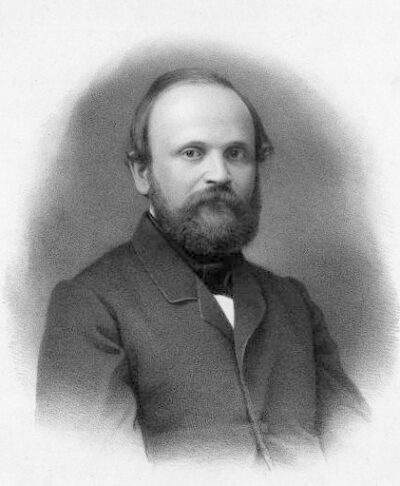
Robert Remak
Robert Remak was a Polish/German embryologist, physiologist, and neurologist. Born July 26, 1815, in Poznań. Died August 29, 1865, in Bad Kissingen. Educated at Humboldt-Universität zu Berlin.
Facts
23 facts · 2 confirmed by two sources · 9 cited · 12 from one source
Where this comes from
Papalocal keeps its own record. It started from these sources; what each one said is kept here as it was copied, so a change on their side never changes this page by itself. Tap one to read its version.
What Wikidata says · copied November 16, 2026 · revision 2569023907
- Described as
- Polish/German embryologist, physiologist, and neurologist (1815–1865)
- Other names
- Remak
- Born
- July 26, 1815 · 4 references
- Died
- August 29, 1865 · 4 references
- Born in
- Poznań · 3 references
- Died in
- Bad Kissingen · 3 references
- Buried in
- Schönhauser Allee Jewish Cemetery
- Citizen of
- Tsardom of Russia
- Occupation
- zoologist · 1 reference; neurologist · 1 reference; university teacher · 2 references; physiologist · 1 reference; botanist · 1 reference; anatomist · 1 reference; physician · 1 reference
- Worked for
- Humboldt-Universität zu Berlin
- Education
- Humboldt-Universität zu Berlin
- Member of
- German Academy of Sciences Leopoldina; Towarzystwo Naukowe Krakowskie · 1 reference
- Field
- embryology
- Spouse
- Feodore Meyer
- Children
- Ernst Remak · 1 reference
- Father
- Salomon Meyer Remak
- Mother
- Friederike Caro
- Lived in
- Kingdom of Prussia
- Wikipedias with a page
- 28
Wikidata item Q62088 (wikidata.org/wiki/Q62088), public domain (CC0). Copied November 16, 2026.
What Wikipedia says · copied November 16, 2026 · revision 1377045317
Robert Remak (26 July 1815 – 29 August 1865) was an embryologist, physiologist and neurologist, born in Posen, Prussia, who discovered that the origin of cells was by the division of pre-existing cells. as well as several other key discoveries.
According to historian Paul Weindling, Rudolf Virchow, one of the founders of modern cell theory, plagiarized Remak's notion that all cells come from pre-existing cells. Remak had concluded this after observing red blood cells from chicken embryos in various stages of division. He then confirmed that the phenomenon existed in the cell of every frog's egg immediately after fertilization, proving that this was a universal phenomenon and finally explaining the reason for the results of tests by Louis Pasteur which had previously proved that there exists no spontaneous generation of life.
Remak obtained his medical degree from Friedrich Wilhelm University in Berlin (now Humboldt University of Berlin) in 1838 specializing in neurology. He is best known for reducing Karl Ernst von Baer's four germ layers to three: the ectoderm, mesoderm, and endoderm. He also discovered unmyelinating Schwann cells that surround peripheral nerve fibres, now named Remak cells, and the nerve cells in the heart sometimes called Remak's ganglia. He studied under Johannes Müller at the University of Berlin.
Despite his accomplishments, because he was a Jew, he was repeatedly denied full professor status, and finally late in life was appointed assistant professor, being the first Jew to teach in that institute. Even then he was never fully recognized for his discoveries.
His son Ernst Julius Remak was also a neurologist and his grandson was the mathematician Robert Remak who died in Auschwitz in 1942.
- Born, in its opening lines
- July 26, 1815
- Died, in its opening lines
- August 29, 1865
From the Wikipedia article “Robert Remak” (en.wikipedia.org/wiki/Robert_Remak), by its contributors, under CC BY-SA 4.0 (creativecommons.org/licenses/by-sa/4.0/). Copied November 16, 2026; not changed.
Confirmed Two sources agree. Cited One source, and it names where it got it. One source One source, without a reference of its own. Sources disagree The sources disagree. We show the best-supported value and keep theirs below.
