
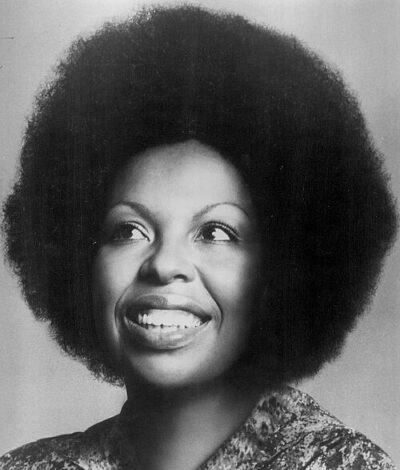
Roberta Flack
Roberta Flack was an American singer. Born February 10, 1937, in Black Mountain. Died February 24, 2025, in Manhattan. Known for The First Time Ever I Saw Your Face, Where Is the Love and Killing Me Softly with His Song. Educated at Howard University and University of Massachusetts. Awards include Grammy Lifetime Achievement Award, Grammy Award for Record of the Year (2 times) and Grammy Award for Best Pop Performance by a Duo or Group with Vocals.
Facts
44 facts · 2 confirmed by two sources · 10 cited · 32 from one source
Where this comes from
Papalocal keeps its own record. It started from these sources; what each one said is kept here as it was copied, so a change on their side never changes this page by itself. Tap one to read its version.
What Wikidata says · copied November 13, 2026 · revision 2558227618
- Described as
- American singer (1937–2025)
- Other names
- Roberta Cleopatra Flack
- Born
- February 10, 1937 · 2 references
- Died
- February 24, 2025 · 3 references
- Born in
- Black Mountain · 3 references
- Died in
- Manhattan · 1 reference
- Buried in
- Oak Hill Cemetery · 1 reference
- Cause of death
- cardiac arrest
- Name at birth
- Roberta Cleopatra Flack
- Citizen of
- United States
- Occupation
- singer-songwriter; teacher; singer · 1 reference; pianist; recording artist; soul musician · 1 reference; composer · 1 reference
- Education
- Howard University; University of Massachusetts
- Genre
- soul; jazz · 2 references; adult contemporary music · 1 reference; traditional folk music · 1 reference; rhythm and blues · 1 reference
- Instrument
- piano · 1 reference; voice · 1 reference; electronic keyboard
- Record label
- Atlantic Records; Capitol Records · 1 reference; Angel · 1 reference; RAS Records · 1 reference; 429 Records · 1 reference
- Known for
- The First Time Ever I Saw Your Face (1972); Where Is the Love (1973); Killing Me Softly with His Song (1974); Feel Like Makin' Love (1975); The Closer I Get to You (1978)
- Awards
- Grammy Lifetime Achievement Award (2020); Grammy Award for Record of the Year (2 times) (1973, 1974); Grammy Award for Best Pop Performance by a Duo or Group with Vocals (1973); American Music Award for Favorite Soul/R&B Female Artist (1974); Grammy Award for Best Female Pop Vocal Performance (1974)
- Field
- music composing; music · 1 reference; singing · 1 reference
- Website
- http://www.robertaflack.com
- Wikipedias with a page
- 54
Wikidata item Q231484 (wikidata.org/wiki/Q231484), public domain (CC0). Copied November 13, 2026.
What Wikipedia says · copied November 13, 2026 · revision 1383468300
Roberta Cleopatra Flack (February 10, 1937 – February 24, 2025) was an American singer and pianist known for her emotive, genre-blending ballads that spanned R&B, jazz, folk, and pop and contributed to the birth of the quiet storm radio format. Her commercial success included the Billboard Hot 100 chart-topping singles "The First Time Ever I Saw Your Face", "Killing Me Softly with His Song", and "Feel Like Makin' Love". She became the first artist to win the Grammy Award for Record of the Year in consecutive years.
Flack frequently collaborated with Donny Hathaway, with whom she recorded several hit duets, including "Where Is the Love" and "The Closer I Get to You". She was one of the defining voices of 1970s popular music and remained active in the industry, later finding success with duets such as "Tonight, I Celebrate My Love" with Peabo Bryson (1983) and "Set the Night to Music" with Maxi Priest (1991). Across her decades-long career, she interpreted works by songwriters such as Leonard Cohen and members of the Beatles. In 2020, Flack received the Grammy Lifetime Achievement Award.
- Born, in its opening lines
- February 10, 1937
- Died, in its opening lines
- February 24, 2025
From the Wikipedia article “Roberta Flack” (en.wikipedia.org/wiki/Roberta_Flack), by its contributors, under CC BY-SA 4.0 (creativecommons.org/licenses/by-sa/4.0/). Copied November 13, 2026; not changed.
Confirmed Two sources agree. Cited One source, and it names where it got it. One source One source, without a reference of its own. Sources disagree The sources disagree. We show the best-supported value and keep theirs below.
