
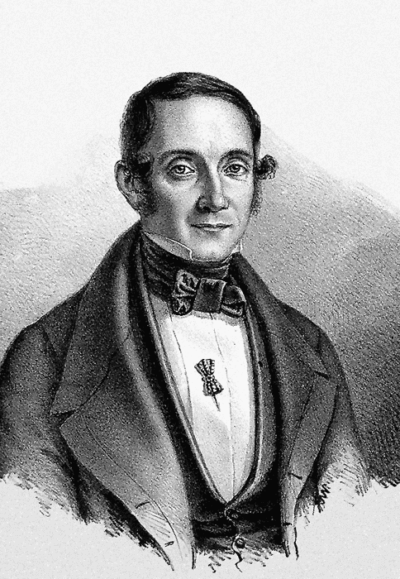
Roberto de Visiani
Roberto de Visiani was an Italian botanist. Born April 9, 1800, in Šibenik. Died May 4, 1878, in Padua. Educated at University of Padua.
Facts
15 facts · 2 confirmed by two sources · 7 cited · 6 from one source
Where this comes from
Papalocal keeps its own record. It started from these sources; what each one said is kept here as it was copied, so a change on their side never changes this page by itself. Tap one to read its version.
What Wikidata says · copied November 18, 2026 · revision 2567916275
- Described as
- Italian botanist (1800–1878)
- Other names
- Vis., Robert Visiani, R. de Visiani
- Born
- April 9, 1800 · 2 references
- Died
- May 4, 1878 · 3 references
- Born in
- Šibenik · 1 reference
- Died in
- Padua · 1 reference
- Citizen of
- Kingdom of Italy (1861–)
- Occupation
- botanist · 1 reference; university teacher; botanical collector · 2 references; scientific collector · 1 reference
- Worked for
- University of Padua
- Education
- University of Padua
- Member of
- German Academy of Sciences Leopoldina; Serbian Learned Society; Academy of Sciences of Turin (1827–) · 1 reference
- Field
- botany · 1 reference
- Wikipedias with a page
- 20
Wikidata item Q1389217 (wikidata.org/wiki/Q1389217), public domain (CC0). Copied November 18, 2026.
What Wikipedia says · copied November 18, 2026 · revision 1371991473
Roberto de Visiani (1800–1878) (in Croatian: Robert Visiani) was a Dalmatian Italian botanist, naturalist and scholar. He is seen as one of the fathers of modern botany in Italy.
The standard author abbreviation Vis. is used to indicate this person as the author when citing a botanical name.
- Born, in its opening lines
- 1800
- Died, in its opening lines
- 1878
From the Wikipedia article “Roberto de Visiani” (en.wikipedia.org/wiki/Roberto_de_Visiani), by its contributors, under CC BY-SA 4.0 (creativecommons.org/licenses/by-sa/4.0/). Copied November 18, 2026; not changed.
Confirmed Two sources agree. Cited One source, and it names where it got it. One source One source, without a reference of its own. Sources disagree The sources disagree. We show the best-supported value and keep theirs below.
