
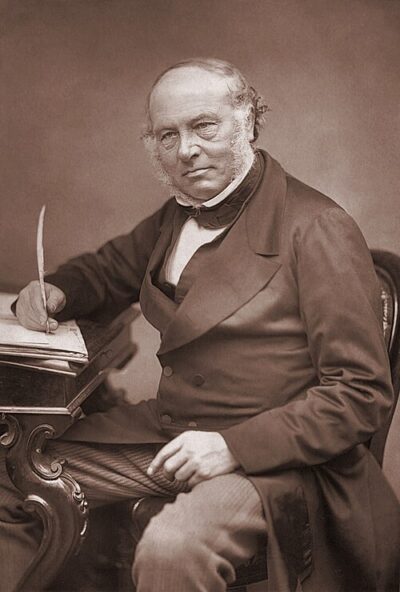
Rowland Hill
Rowland Hill was an English educational, social and postal reformer. Born December 3, 1795, in Kidderminster. Died August 27, 1879, in Hampstead. Awards include Fellow of the Royal Society, Knight Commander of the Order of the Bath and Albert Medal.
Facts
24 facts · 2 confirmed by two sources · 11 cited · 10 from one source · 1 where the sources disagree
What’s different
- Buried in: we show Westminster Abbey (Sources disagree). Wikidata also lists Highgate Cemetery
Where this comes from
Papalocal keeps its own record. It started from these sources; what each one said is kept here as it was copied, so a change on their side never changes this page by itself. Tap one to read its version.
What Wikidata says · copied November 16, 2026 · revision 2567363667
- Described as
- English educational, social and postal reformer (1795-1879)
- Other names
- Sir Rowland Hill
- Born
- December 3, 1795 · 7 references
- Died
- August 27, 1879 · 6 references
- Born in
- Kidderminster · 1 reference
- Died in
- Hampstead · 1 reference
- Buried in
- Westminster Abbey; Highgate Cemetery
- Citizen of
- United Kingdom of Great Britain and Ireland; Kingdom of Great Britain (–1801)
- Occupation
- teacher; politician; inventor · 1 reference; beamter · 1 reference
- Member of
- Royal Society of London
- Awards
- Fellow of the Royal Society; Knight Commander of the Order of the Bath; Albert Medal (1864) · 1 reference; American Philatelic Society Hall of Fame (1941)
- Field
- teacher
- Spouse
- Caroline Pearson · 1 reference
- Father
- Thomas Wright Hill · 2 references
- Mother
- Sarah Lea · 1 reference
- Siblings
- Matthew Davenport Hill · 1 reference; Arthur Hill · 1 reference; Edwin Hill · 1 reference; Frederic Hill · 1 reference
- Wikipedias with a page
- 29
Wikidata item Q370241 (wikidata.org/wiki/Q370241), public domain (CC0). Copied November 16, 2026.
What Wikipedia says · copied November 16, 2026 · revision 1369690258
Sir Rowland Hill, KCB, FRS (3 December 1795 – 27 August 1879) was an English teacher, inventor and social reformer. He campaigned for a comprehensive reform of the postal system, based on the concept of Uniform Penny Post and his solution of pre-payment, facilitating the safe, speedy and cheap transfer of letters. Hill later served as a government postal official, and he is usually credited with originating the basic concepts of the modern postal service, including the invention of the postage stamp.
Hill made the case that if letters were cheaper to send, people, including the poorer classes, would send more of them, thus eventually profits would go up. Proposing an adhesive stamp to indicate pre-payment of postage – with the first being the Penny Black – in 1840, the first year of Penny Post, the number of letters sent in the UK more than doubled. Within 10 years, it had doubled again. Within three years postage stamps were introduced in Switzerland and Brazil, a little later in the US, and by 1860, they were used in 90 countries.
- Born, in its opening lines
- December 3, 1795
- Died, in its opening lines
- August 27, 1879
From the Wikipedia article “Rowland Hill” (en.wikipedia.org/wiki/Rowland_Hill), by its contributors, under CC BY-SA 4.0 (creativecommons.org/licenses/by-sa/4.0/). Copied November 16, 2026; not changed.
Confirmed Two sources agree. Cited One source, and it names where it got it. One source One source, without a reference of its own. Sources disagree The sources disagree. We show the best-supported value and keep theirs below.
