
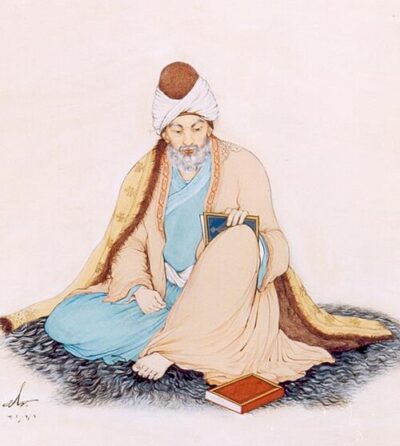
Rumi
Rumi was an Iranian poet. Born September 30, 1207, in Vakhsh. Died December 17, 1273, in Konya. Known for Seven Sessions, Fihi Ma Fihi and Masnavi.
Facts
23 facts · 2 confirmed by two sources · 7 cited · 14 from one source
Where this comes from
Papalocal keeps its own record. It started from these sources; what each one said is kept here as it was copied, so a change on their side never changes this page by itself. Tap one to read its version.
What Wikidata says · copied November 16, 2026 · revision 2567012982
- Described as
- Iranian poet
- Other names
- Jalāluddīn Balkhī Rumī, Jalaladdin Rumi, Jalāluddīn Muḥammad Balkhī Rūmī, Jalāl ad-Dīn ar-Rūmī, Jalāl al-Dīn Muḥammad ibn Muḥammad Balkhī, Jalāladdīn Rūmī, Rūmī, Jalal-e Din Rumi, Jallal ed-Din Muhammad Balkhy, Mawlana Rumi, Jalāl al-Dīn Rūmī, Jelaluddin Rumi
- Born
- September 30, 1207 · 4 references
- Died
- December 17, 1273 · 5 references
- Born in
- Vakhsh · 2 references
- Died in
- Konya · 2 references
- Buried in
- Mevlâna Museum
- Occupation
- poet · 1 reference; ulema; writer · 2 references; literary scholar; philosopher; mystic · 1 reference; Islamic jurist
- Known for
- Seven Sessions; Fihi Ma Fihi; Masnavi; Diwan-e Shams-e Tabrizi; Maktubat
- Field
- Islamic philosophy; Sufism
- Spouse
- Gawhar Khatun
- Children
- Sultan Walad · 1 reference
- Father
- Baha ud-Din Walad · 2 references
- Religion
- Islam
- Wikipedias with a page
- 160
Wikidata item Q43347 (wikidata.org/wiki/Q43347), public domain (CC0). Copied November 16, 2026.
What Wikipedia says · copied November 16, 2026 · revision 1382808974
Jalāl al-Dīn Muḥammad Balkhī (30 September 1207 – 17 December 1273), commonly known as Rumi, was a Sufi mystic, poet, and founder of the Islamic brotherhood known as the Mevlevi Order. His family hailed from Balkh. Rumi is an influential figure in Sufism, and his thought and works loom large both in Persian literature and mystic poetry in general. Today, his translated works are enjoyed all over the world.
The rapidly advancing Mongol hordes forced his family to flee west early on in his life. After spending time in various cities across Iran, Baghdad, and Damascus, he settled in Konya with his family at age 19. Until recently, Konya had been a province of the Eastern Roman Empire, hence his name, Rumi, i.e. "the Roman". Although he was exposed to Sufi thought from his early childhood, he was expected to follow his fathers footsteps as an Islamic scholar.
However, the arrival to Konya of the mysterious wandering dervish, Shams Tabrīzī, would alter the course of his life permanently. Rumi and Shams became infatuated with each other, causing Rumi to neglect his duties. When Shams mysteriously disappeared, Rumi experienced an intense period of grief reflected in his Divan of Shams Tabrīzī. This was the defining moment in the evolution of Rumi's spiritual worldview, and marked the beginning of his poetic output.
His Masnavi, often called a "Qur'an in Persian", is considered one of the greatest poems of the Persian language. Many Muslims, particularly in the Turko-Persian cultural sphere, regard the Masnavi as one of the most important works of Islamic literature, falling behind only the Quran.
Rumi's works are widely read today across his native Greater Iran as well as in Turkey, where the Sufi brotherhood he founded is based. His poems have been translated into many of the world's languages, and Rumi has been described as the "world's most popular poet."
In the United States, he has become the best selling poet in recent years.
- Born, in its opening lines
- September 30, 1207
- Died, in its opening lines
- December 17, 1273
From the Wikipedia article “Rumi” (en.wikipedia.org/wiki/Rumi), by its contributors, under CC BY-SA 4.0 (creativecommons.org/licenses/by-sa/4.0/). Copied November 16, 2026; not changed.
Confirmed Two sources agree. Cited One source, and it names where it got it. One source One source, without a reference of its own. Sources disagree The sources disagree. We show the best-supported value and keep theirs below.
