
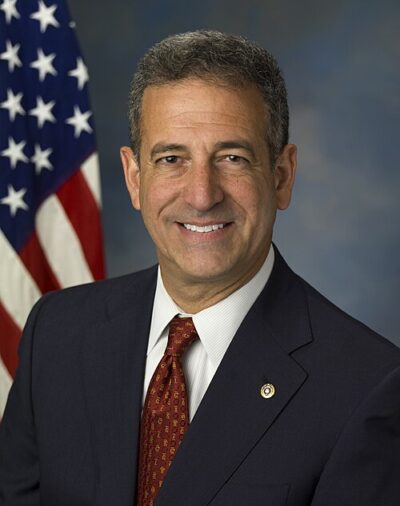
Russ Feingold
Russ Feingold is a Wisconsin politician; three-term U.S. Senator. Born March 2, 1953, in Janesville. Positions held include member of the State Senate of Wisconsin (1983–1993) and United States senator (1993–2011). Educated at University of Wisconsin–Madison and Magdalen College. Awards include Four Freedoms Award – Freedom Medal, Profile in Courage Award and James Madison Award.
Facts
23 facts · 1 confirmed by two sources · 11 cited · 11 from one source
Where this comes from
Papalocal keeps its own record. It started from these sources; what each one said is kept here as it was copied, so a change on their side never changes this page by itself. Tap one to read its version.
What Wikidata says · copied November 15, 2026 · revision 2558302339
- Described as
- Wisconsin politician; three-term U.S. Senator
- Other names
- Russell Dana Feingold
- Born
- March 2, 1953 · 1 reference
- Born in
- Janesville
- Citizen of
- United States
- Occupation
- politician · 2 references; lawyer (1979–1985) · 1 reference; visiting professor (1985–) · 1 reference; university teacher
- Positions held
- member of the State Senate of Wisconsin (1983–1993); United States senator (1993–2011) · 1 reference
- Political party
- Democratic Party
- Worked for
- Yale University; Marquette University · 1 reference; Lawrence University · 1 reference
- Education
- University of Wisconsin–Madison (–1975) · 1 reference; Magdalen College (–1977) · 1 reference; Harvard Law School (–1979) · 1 reference; Joseph A. Craig High School (–1971) · 2 references
- Awards
- Four Freedoms Award – Freedom Medal (2011); Profile in Courage Award (1999) · 1 reference; James Madison Award (2008) · 1 reference; Rhodes Scholarship (1975) · 2 references
- Religion
- Judaism
- Website
- http://russfeingold.com
- Wikipedias with a page
- 30
Wikidata item Q356475 (wikidata.org/wiki/Q356475), public domain (CC0). Copied November 15, 2026.
What Wikipedia says · copied November 15, 2026 · revision 1385415548
Russell Dana Feingold ( FYNE-gold; born March 2, 1953) is an American lawyer and politician who served from 1993 to 2011 as a United States senator from Wisconsin. A member of the Democratic Party, he represented Wisconsin's 27th Senate district from 1983 to 1993 and was the U.S. Special Envoy for the African Great Lakes and the Democratic Republic of the Congo from 2013 to 2015.
In the Senate, Feingold was known for being the only U.S. senator to vote against the Patriot Act following the September 11 attacks. His signature legislative achievement was the Bipartisan Campaign Reform Act, which he co-authored with Republican senator John McCain. Feingold and McCain received the 1999 John F. Kennedy Profile in Courage Award for their efforts. The law, commonly known as the McCain–Feingold Act, sought to limit the influence of money in federal elections, though key provisions were later weakened by court decisions, culminating in the 2010 U.S. Supreme Court decision Citizens United v. FEC.
Feingold was first elected to the Senate in 1992, defeating incumbent Bob Kasten, and was reelected in 1998 and 2004. He was mentioned as a potential candidate for the 2008 Democratic presidential nomination but did not run. After losing reelection in 2010 to Ron Johnson, he founded the political action committee Progressives United, which funded progressive candidates in the 2012 elections, before being appointed U.S. Special Envoy by President Barack Obama in 2013.
Feingold unsuccessfully sought his former Senate seat in a 2016 rematch against Johnson. He served as president of the American Constitution Society from 2020 to 2025 and chairs the Campaign for Nature's Global Steering Committee.
- Born, in its opening lines
- March 2, 1953
From the Wikipedia article “Russ Feingold” (en.wikipedia.org/wiki/Russ_Feingold), by its contributors, under CC BY-SA 4.0 (creativecommons.org/licenses/by-sa/4.0/). Copied November 15, 2026; not changed.
Confirmed Two sources agree. Cited One source, and it names where it got it. One source One source, without a reference of its own. Sources disagree The sources disagree. We show the best-supported value and keep theirs below.
