
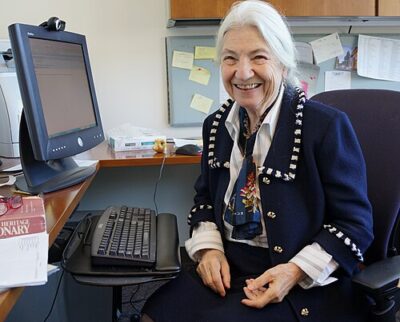
Ruzena Bajcsy
Ruzena Bajcsy is an American computer scientist. Born May 28, 1933, in Bratislava. Educated at Stanford University and Slovak University of Technology in Bratislava. Awards include IEEE Robotics and Automation Award, ACM-AAAI Allen Newell Award and Anita Borg Institute Women of Vision Awards.
Facts
40 facts · 1 confirmed by two sources · 16 cited · 23 from one source
Where this comes from
Papalocal keeps its own record. It started from these sources; what each one said is kept here as it was copied, so a change on their side never changes this page by itself. Tap one to read its version.
What Wikidata says · copied November 16, 2026 · revision 2569184653
- Described as
- American computer scientist
- Other names
- Ruzena Kucera Bajcsy
- Born
- May 28, 1933 · 1 reference
- Born in
- Bratislava
- Name at birth
- Růžena Kučerová
- Citizen of
- Czechoslovakia (1933–1992); Slovakia (1993–); Czech Republic (1993–); United States · 3 references
- Occupation
- computer scientist · 1 reference; engineer; artificial intelligence researcher; university teacher · 1 reference
- Worked for
- University of California, Berkeley; University of Pennsylvania · 1 reference
- Education
- Stanford University; Slovak University of Technology in Bratislava
- Member of
- Institute of Electrical and Electronics Engineers; American Academy of Arts and Sciences; Association for the Advancement of Artificial Intelligence; Association for Computing Machinery (1996–) · 1 reference
- Awards
- IEEE Robotics and Automation Award (2013) · 1 reference; ACM-AAAI Allen Newell Award (2001) · 1 reference; Anita Borg Institute Women of Vision Awards (2009) · 1 reference; AAAI Fellow (1990) · 1 reference; ACM Fellow (1996) · 1 reference; IEEE Fellow; Fellow of the American Academy of Arts and Sciences; NCWIT Pioneer in Tech Award (2020) · 1 reference; ACM Distinguished Service Award (2003) · 1 reference; Fellow of the American Association for the Advancement of Science (2021) · 1 reference; Grand Officer of the Order of the White Double Cross (2022) · 1 reference; John Scott Award (2017) · 1 reference; Order of the White Double Cross · 2 references; National Academy of Engineering Founders Award · 2 references; Benjamin Franklin Medal in Computer and Cognitive Science (2009) · 1 reference
- Field
- robotics; artificial intelligence; computer vision
- Children
- Klara Nahrstedt
- Lived in
- United States
- Website
- http://www.eecs.berkeley.edu/~bajcsy/
- Wikipedias with a page
- 23
Wikidata item Q10959 (wikidata.org/wiki/Q10959), public domain (CC0). Copied November 16, 2026.
What Wikipedia says · copied November 16, 2026 · revision 1384523313
Ruzena Bajcsy (born 28 May 1933) is an American engineer and computer scientist who specializes in robotics. She is professor of electrical engineering and computer sciences at the University of California, Berkeley, where she is also director emerita of CITRIS (the Center for Information Technology Research in the Interest of Society).
She was previously professor and chair of computer science and engineering at the University of Pennsylvania, where she was the founding director of the University of Pennsylvania's General Robotics and Active Sensory Perception (GRASP) Laboratory, and a member of the Neurosciences Institute in the School of Medicine. She has also been head of the National Science Foundation's Computer and Information Science and Engineering Directorate, with authority over a $500 million budget. She supervised at least 26 doctoral students at the University of Pennsylvania.
She was elected a member of the American Philosophical Society in 2005.
She is the mother of computer-science professor Klara Nahrstedt.
- Born, in its opening lines
- May 28, 1933
From the Wikipedia article “Ruzena Bajcsy” (en.wikipedia.org/wiki/Ruzena_Bajcsy), by its contributors, under CC BY-SA 4.0 (creativecommons.org/licenses/by-sa/4.0/). Copied November 16, 2026; not changed.
Confirmed Two sources agree. Cited One source, and it names where it got it. One source One source, without a reference of its own. Sources disagree The sources disagree. We show the best-supported value and keep theirs below.
