
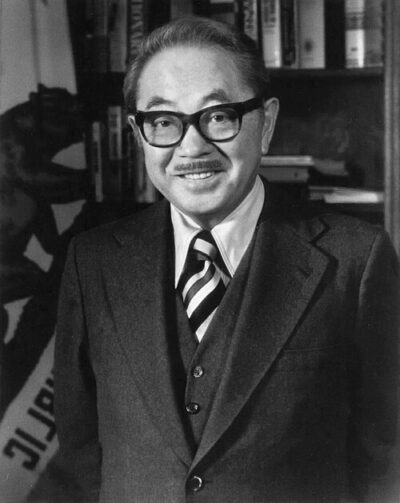
S. I. Hayakawa
S. I. Hayakawa was a Canadian-American academic and politician. Born July 18, 1906, in Vancouver. Died February 27, 1992, in Greenbrae. Positions held include United States senator (1977–1983). Known for Language in Thought and Action. Educated at University of Manitoba and McGill University.
Facts
24 facts · 2 confirmed by two sources · 8 cited · 14 from one source
Where this comes from
Papalocal keeps its own record. It started from these sources; what each one said is kept here as it was copied, so a change on their side never changes this page by itself. Tap one to read its version.
What Wikidata says · copied November 15, 2026 · revision 2566975681
- Described as
- Canadian-American academic and politician (1906–1992)
- Other names
- Samuel Ichiye Hayakawa
- Born
- July 18, 1906 · 3 references
- Died
- February 27, 1992 · 3 references
- Born in
- Vancouver · 1 reference
- Died in
- Greenbrae
- Cause of death
- Alzheimer's disease
- Citizen of
- United States (1954–) · 1 reference; Canada
- Occupation
- politician · 1 reference; anthropologist; linguist · 1 reference; university teacher · 1 reference; psychologist; scholar of English · 1 reference
- Positions held
- United States senator (1977–1983) · 1 reference
- Political party
- Republican Party
- Worked for
- Illinois Institute of Technology (1939–1947) · 1 reference; San Francisco State University; University of Chicago · 1 reference
- Education
- University of Manitoba; McGill University; University of Wisconsin–Madison; St. John's High School
- Known for
- Language in Thought and Action
- Spouse
- Margedant Peters Hayakawa
- Wikipedias with a page
- 24
Wikidata item Q942027 (wikidata.org/wiki/Q942027), public domain (CC0). Copied November 15, 2026.
What Wikipedia says · copied November 15, 2026 · revision 1379646432
Samuel Ichiye Hayakawa (Japanese: 早川 一衛, July 18, 1906 – February 27, 1992) was a Canadian-born American academic and politician. A professor of English, he served as president of San Francisco State University and then as a U.S. Senator from California from 1977 to 1983.
Hayakawa was born in Vancouver, British Columbia, Canada, to Japanese immigrants. Hayakawa advocated for Japanese Canadian voting rights in the 1930s. In the 1950s, he became a professor at the University of Chicago before moving to teach English at San Francisco State College. After becoming acting president of San Francisco State College, Hayakawa became a conservative icon after he unplugged the loudspeakers on a student protesters' van at an outdoor rally in late 1968.
Hayakawa ran to represent California in the United States Senate as a Republican in 1976. He narrowly defeated incumbent Democratic senator John V. Tunney, becoming the first Asian-American senator from the state. Hayakawa supported former California governor Ronald Reagan in the 1980 presidential election. He initially sought reelection in 1982, but bowed out of the race due to a lack of funds and was succeeded by fellow Republican Pete Wilson.
- Born, in its opening lines
- July 18, 1906
- Died, in its opening lines
- February 27, 1992
From the Wikipedia article “S. I. Hayakawa” (en.wikipedia.org/wiki/S._I._Hayakawa), by its contributors, under CC BY-SA 4.0 (creativecommons.org/licenses/by-sa/4.0/). Copied November 15, 2026; not changed.
Confirmed Two sources agree. Cited One source, and it names where it got it. One source One source, without a reference of its own. Sources disagree The sources disagree. We show the best-supported value and keep theirs below.
