
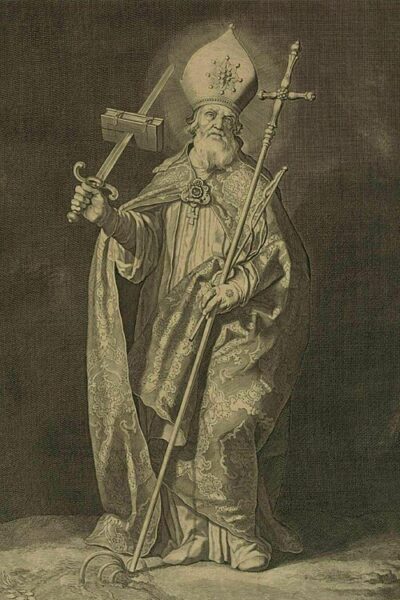
Saint Boniface
Saint Boniface was the 8th‑century Anglo‑Saxon bishop and missionary, Catholic saint and martyr, known as the ‘Apostle to the Germans’. Born 675, in Crediton. Died June 5, 754, in Dokkum. Positions held include abbot, Roman Catholic Archbishop of Utrecht (739–754) and Roman Catholic Archbishop of Mainz (745–).
Facts
21 facts · 2 confirmed by two sources · 7 cited · 12 from one source
Where this comes from
Papalocal keeps its own record. It started from these sources; what each one said is kept here as it was copied, so a change on their side never changes this page by itself. Tap one to read its version.
What Wikidata says · copied November 16, 2026 · revision 2564521266
- Described as
- 8th‑century Anglo‑Saxon bishop and missionary, Catholic saint and martyr, known as the ‘Apostle to the Germans’
- Other names
- Wynfrith, St. Boniface, Wynfryth, The Apostle of the Germans, Winfrid
- Born
- 675 · 2 references
- Died
- June 5, 754 · 1 reference
- Born in
- Crediton · 1 reference
- Died in
- Dokkum · 1 reference
- Buried in
- Fulda Cathedral
- Citizen of
- Kingdom of Wessex; Francia
- Occupation
- diplomat; Catholic priest · 1 reference; missionary · 2 references; Catholic bishop; apostle · 1 reference; archbishop · 1 reference
- Positions held
- abbot; Roman Catholic Archbishop of Utrecht (739–754) · 1 reference; Roman Catholic Archbishop of Mainz (745–) · 1 reference; archbishop · 1 reference
- Siblings
- Wuna of Wessex
- Religion
- Catholic Church · 1 reference
- Lived in
- Crediton
- Nickname
- Apostle of Germany
- Wikipedias with a page
- 52
Wikidata item Q160445 (wikidata.org/wiki/Q160445), public domain (CC0). Copied November 16, 2026.
What Wikipedia says · copied November 16, 2026 · revision 1385558460
Boniface (born Wynfreth; c. 675 – 5 June 754) was an English Benedictine monk and leading figure in the Anglo-Saxon mission to the Germanic parts of Francia during the eighth century. He organised significant foundations of the church in Germany and was made Archbishop of Mainz by Pope Gregory III. He was martyred in Frisia in 754, along with 52 others, and his remains were returned to Fulda, where they rest in a sarcophagus which remains a site of Christian pilgrimage.
Boniface's life and death as well as his work became widely known, there being a wealth of material available – a number of vitae, especially the near-contemporary Vita Bonifatii auctore Willibaldi, legal documents, possibly some sermons, and above all his correspondence. He is venerated as a saint in the Christian church and became the patron saint of Germania, known as the "Apostle to the Germans".
Norman Cantor notes the three roles Boniface played that made him "one of the truly outstanding creators of the first Europe, as the apostle of Germania, the reformer of the Frankish Church, and the chief fomentor of the alliance between the papacy and the Carolingian family." Through his efforts to reorganize and regulate the church of the Franks, he helped shape the Latin Church in Europe, and many of the dioceses he proposed remain today. After his martyrdom, he was quickly hailed as a saint in Fulda and other areas in Germania and in England. He is still venerated strongly today by Catholics in Germany and throughout the German diaspora. Boniface is celebrated as a missionary; he is regarded as a unifier of Europe, and he is regarded by German Roman Catholics as a national figure.
In 2019 Devon County Council, with the support of the Anglican Diocese of Exeter, the Roman Catholic Diocese of Plymouth, and local Devon leaders of the Orthodox, Methodist, and Congregational churches, officially recognised St Boniface as the Patron Saint of Devon.
- Born, in its opening lines
- c. 675
- Died, in its opening lines
- June 5, 754
From the Wikipedia article “Saint Boniface” (en.wikipedia.org/wiki/Saint_Boniface), by its contributors, under CC BY-SA 4.0 (creativecommons.org/licenses/by-sa/4.0/). Copied November 16, 2026; not changed.
Confirmed Two sources agree. Cited One source, and it names where it got it. One source One source, without a reference of its own. Sources disagree The sources disagree. We show the best-supported value and keep theirs below.
