
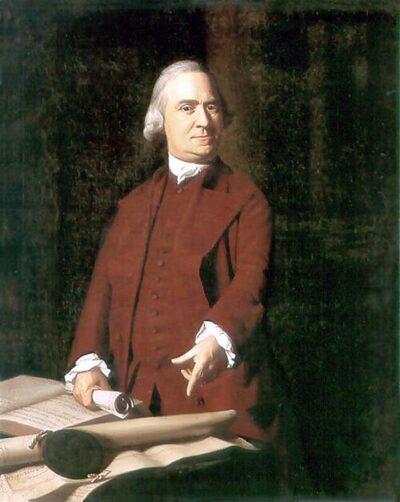
Samuel Adams
Samuel Adams was an American statesman, political philosopher, governor of Massachusetts and Founding Father of the United States. Born September 27, 1722, in Boston. Died October 2, 1803, in Boston. Positions held include Governor of Massachusetts (1793–1797) and member of the State Senate of Massachusetts. Educated at Harvard University and Harvard College. Awards include Fellow of the American Academy of Arts and Sciences.
Facts
22 facts · 2 confirmed by two sources · 5 cited · 15 from one source
Where this comes from
Papalocal keeps its own record. It started from these sources; what each one said is kept here as it was copied, so a change on their side never changes this page by itself. Tap one to read its version.
What Wikidata says · copied November 13, 2026 · revision 2568745529
- Described as
- American statesman, political philosopher, governor of Massachusetts and Founding Father of the United States (1722-1803)
- Other names
- Sam Adams
- Born
- September 27, 1722 · 10 references
- Died
- October 2, 1803 · 12 references
- Born in
- Boston · 3 references
- Died in
- Boston · 3 references
- Buried in
- Granary Burying Ground
- Citizen of
- United States
- Occupation
- politician · 1 reference; philosopher
- Positions held
- Governor of Massachusetts (1793–1797); member of the State Senate of Massachusetts
- Political party
- Democratic-Republican Party
- Education
- Harvard University; Harvard College
- Member of
- American Academy of Arts and Sciences
- Awards
- Fellow of the American Academy of Arts and Sciences (1780–) · 1 reference
- Spouse
- Elizabeth Checkley Adams; Elizabeth Wells Adams
- Children
- Hannah Wells · 1 reference
- Father
- Samuel Adams, Sr.
- Mother
- Mary Fifield Adams
- Religion
- Congregational churches
- Lived in
- Massachusetts
- Wikipedias with a page
- 66
Wikidata item Q212963 (wikidata.org/wiki/Q212963), public domain (CC0). Copied November 13, 2026.
What Wikipedia says · copied November 13, 2026 · revision 1382893514
Samuel Adams (September 27 [O.S. September 16], 1722 – October 2, 1803) was an American statesman, political philosopher, and a Founding Father of the United States. He was a politician in colonial Massachusetts, a leader of the movement that became the American Revolution, a signatory of the Declaration of Independence and other founding documents, and one of the architects of the principles of American republicanism that shaped the political culture of the United States. He was a second cousin to his fellow Founding Father, President John Adams. He founded the Sons of Liberty.
Adams was born in Boston, brought up in a religious and politically active family. A graduate of Harvard College, he was an unsuccessful businessman and tax collector before concentrating on politics. He was an influential official of the Massachusetts House of Representatives and the Boston Town Meeting in the 1760s, and he became a part of a movement opposed to the British Parliament's efforts to tax the British American colonies without their consent. His 1768 Massachusetts Circular Letter calling for colonial non-cooperation prompted the occupation of Boston by British troops, eventually resulting in the Boston Massacre of 1770. Adams and his colleagues devised a committee of correspondence system in 1772 to help coordinate resistance to what he saw as the British government's attempts to violate the British Constitution at the expense of the colonies, which linked like-minded Patriots throughout the Thirteen Colonies. Continued resistance to British policy resulted in the 1773 Boston Tea Party and the coming of the American Revolution. Adams was actively involved with colonial newspapers publishing accounts of colonial sentiment over British colonial rule, which were fundamental in uniting the colonies. Adams, the ringleader at the destruction of the East India Company's tea, was also actively involved in bribing British soldiers to desert and provided them with new clothes and the offer of land to cultivate..
Parliament passed the Coercive Acts in 1774, at which time Adams attended the Continental Congress in Philadelphia which was convened to coordinate a colonial response. He helped guide Congress towards issuing the Continental Association in 1774 and the Declaration of Independence in 1776, and he helped draft the Articles of Confederation and the Massachusetts Constitution. Adams returned to Massachusetts after the American Revolution, where he served in the state senate and was eventually elected governor.
Adams later became a controversial figure in American history. Accounts written in the 19th century praised him as someone who had been steering his fellow colonists towards independence long before the outbreak of the Revolutionary War. This view was challenged by negative assessments of Adams in the first half of the 20th century, in which he was portrayed as a master of propaganda who provoked mob violence to achieve his goals. However, according to biographer Mark Puls, a different account emerges upon examination of Adams's many writings regarding the civil rights of the colonists, while the mob referred to were a highly reflective group of men inspired by Adams who made his case with reasoned arguments in pamphlets and newspapers, without the use of emotional rhetoric.
- Born, in its opening lines
- September 27, 1722
- Died, in its opening lines
- October 2, 1803
From the Wikipedia article “Samuel Adams” (en.wikipedia.org/wiki/Samuel_Adams), by its contributors, under CC BY-SA 4.0 (creativecommons.org/licenses/by-sa/4.0/). Copied November 13, 2026; not changed.
Confirmed Two sources agree. Cited One source, and it names where it got it. One source One source, without a reference of its own. Sources disagree The sources disagree. We show the best-supported value and keep theirs below.
