
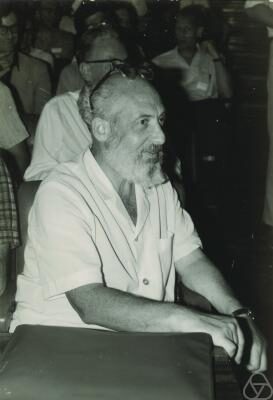
Samuel Eilenberg
Samuel Eilenberg was a Polish mathematician. Born September 30, 1913, in Warsaw. Died January 30, 1998, in New York City. Known for Chevalley–Eilenberg algebra, Eilenberg–MacLane space and Eilenberg–Steenrod axioms. Educated at University of Warsaw. Awards include Guggenheim Fellowship, Wolf Prize in Mathematics and Leroy P. Steele Prize.
Facts
36 facts · 2 confirmed by two sources · 15 cited · 19 from one source
Where this comes from
Papalocal keeps its own record. It started from these sources; what each one said is kept here as it was copied, so a change on their side never changes this page by itself. Tap one to read its version.
What Wikidata says · copied November 15, 2026 · revision 2519912110
- Described as
- Polish mathematician (1913-1998)
- Born
- September 30, 1913 · 6 references
- Died
- January 30, 1998 · 7 references
- Born in
- Warsaw · 1 reference
- Died in
- New York City · 1 reference
- Citizen of
- Poland; United States
- Occupation
- mathematician · 3 references; topologist; university teacher; art collector · 2 references
- Worked for
- University of Michigan (1940–1945) · 1 reference; Columbia University (1947–1998) · 2 references; Princeton University (1945–1946) · 1 reference; Indiana University (1946–1947) · 1 reference
- Education
- University of Warsaw (–1936) · 1 reference
- Member of
- American Academy of Arts and Sciences; National Academy of Sciences; Polish Academy of Sciences
- Known for
- Chevalley–Eilenberg algebra; Eilenberg–MacLane space; Eilenberg–Steenrod axioms; Eilenberg–Moore spectral sequence; Eilenberg-Maclane spectrum; Eilenberg–Zilber theorem; Eilenberg–Ganea conjecture; Eilenberg–Niven theorem; Eilenberg–Ganea theorem; Cartan–Eilenberg resolution
- Awards
- Guggenheim Fellowship (1950) · 1 reference; Wolf Prize in Mathematics (1986) · 1 reference; Leroy P. Steele Prize (1987) · 2 references; honorary doctorate from the University of Paris-VII (1989) · 1 reference
- Field
- topology; mathematics · 1 reference; collecting · 1 reference; visual arts · 1 reference
- Wikipedias with a page
- 30
Wikidata item Q535833 (wikidata.org/wiki/Q535833), public domain (CC0). Copied November 15, 2026.
What Wikipedia says · copied November 15, 2026 · revision 1382576780
Samuel Eilenberg (September 30, 1913 – January 30, 1998) was a Polish-American mathematician who co-founded category theory (with Saunders Mac Lane) and homological algebra. He also founded the field of algebraic automata in his work with Jesse B. Wright
.
- Born, in its opening lines
- September 30, 1913
- Died, in its opening lines
- January 30, 1998
From the Wikipedia article “Samuel Eilenberg” (en.wikipedia.org/wiki/Samuel_Eilenberg), by its contributors, under CC BY-SA 4.0 (creativecommons.org/licenses/by-sa/4.0/). Copied November 15, 2026; not changed.
Confirmed Two sources agree. Cited One source, and it names where it got it. One source One source, without a reference of its own. Sources disagree The sources disagree. We show the best-supported value and keep theirs below.
