
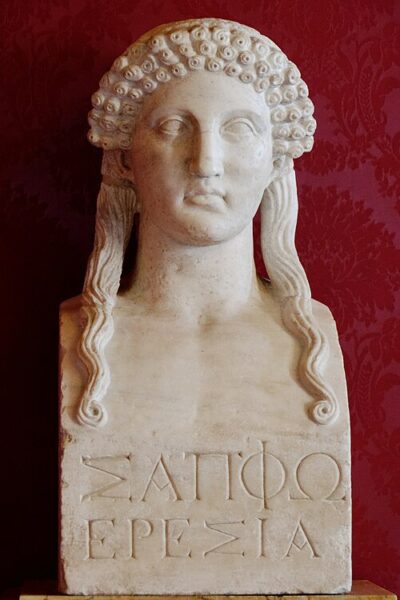
Sappho
Sappho was an ancient Greek poet from Lesbos (c. 630-c. 570 BC). Born 7th century BC, in Lesbos. Died 570 BC, in Lefkada. Known for Ode to Aphrodite and Sappho fr. 31 Voigt.
Facts
16 facts · 0 confirmed by two sources · 9 cited · 7 from one source
Where this comes from
Papalocal keeps its own record. It started from these sources; what each one said is kept here as it was copied, so a change on their side never changes this page by itself. Tap one to read its version.
What Wikidata says · copied November 16, 2026 · revision 2567820384
- Described as
- ancient Greek poet from Lesbos (c. 630-c. 570 BC)
- Other names
- Psappho, Sapphus, Sapho
- Born
- 7th century BC · 4 references
- Died
- 570 BC · 4 references
- Born in
- Lesbos · 4 references
- Died in
- Lefkada · 1 reference
- Citizen of
- Mytilene
- Occupation
- poet · 2 references; composer · 1 reference; author · 1 reference; writer · 1 reference
- Known for
- Ode to Aphrodite; Sappho fr. 31 Voigt
- Field
- poetry · 1 reference
- Siblings
- Charaxus · 1 reference
- Lived in
- Syracuse (-610–-595); Mytilene (-595–); Lesbos (–-610)
- Wikipedias with a page
- 150
Wikidata item Q17892 (wikidata.org/wiki/Q17892), public domain (CC0). Copied November 16, 2026.
What Wikipedia says · copied November 16, 2026 · revision 1384655195
Sappho (Ancient Greek: Σαπφώ Sapphṓ [sap.pʰɔ̌ː]; Aeolic Greek Ψάπφω Psápphō; c. 630 – c. 570 BC) was an ancient Greek poet from Eresos or Mytilene on the island of Lesbos. She is known for her lyric poetry, written to be sung while accompanied by music. In ancient times, she was widely regarded as one of the greatest lyric poets and was given names such as the "Tenth Muse" and "The Poetess". Most of Sappho's poetry has been lost, and what is not has mostly survived in fragmentary form; only the Ode to Aphrodite is certainly complete. As well as lyric poetry, ancient commentators claimed that Sappho wrote elegiac and iambic poetry. Three epigrams formerly attributed to Sappho have survived, but these are actually Hellenistic imitations of Sappho's style.
Little is known of Sappho's life. She was from a wealthy family from Lesbos, though her parents' names are uncertain. Ancient sources say that she had three brothers: Charaxos, Larichos and Eurygios. Two of them, Charaxos and Larichos, are mentioned in the Brothers Poem discovered in 2014. She also appears to have had a daughter, traditionally identified with Cleïs, who is mentioned in two of Sappho's fragments, 98 and 132. Sappho was exiled to Sicily around 600 BC, and may have continued to work until around 570 BC. According to legend, she killed herself by leaping from the Leucadian cliffs due to her unrequited love for the ferryman Phaon.
Sappho was a prolific poet, probably composing around 10,000 lines. She was best-known in antiquity for her love poetry; other themes in the surviving fragments of her work include family and religion. She probably wrote poetry for both individual and choral performance. Most of her best-known and best-preserved fragments explore personal emotions and were probably composed for solo performance. Her works are known for their clarity of language, vivid images, and immediacy. The context in which she composed her poems has long been the subject of scholarly debate; the most influential suggestions have been that she had some sort of educational or religious role, or wrote for the symposium.
Sappho's poetry was well-known and greatly admired through much of antiquity, and she was among the canon of Nine Lyric Poets most highly esteemed by scholars of Hellenistic Alexandria. Sappho's poetry is still considered extraordinary and her works continue to influence other writers. Beyond her poetry, she is well known as a symbol of love and desire between women, with the English words sapphic and lesbian deriving from her name and that of her home island, respectively.
From the Wikipedia article “Sappho” (en.wikipedia.org/wiki/Sappho), by its contributors, under CC BY-SA 4.0 (creativecommons.org/licenses/by-sa/4.0/). Copied November 16, 2026; not changed.
Confirmed Two sources agree. Cited One source, and it names where it got it. One source One source, without a reference of its own. Sources disagree The sources disagree. We show the best-supported value and keep theirs below.
