
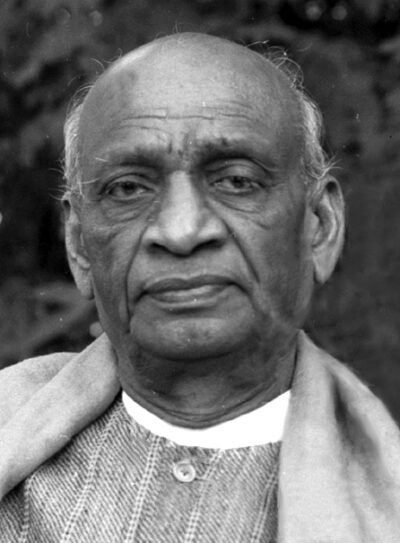
Sardar Vallabhbhai Patel
Sardar Vallabhbhai Patel was an Indian barrister, leader of the Indian National Congress and founding father of the Republic of India. Born October 31, 1875, in Nadiad. Died December 15, 1950, in Mumbai. Positions held include Deputy Prime Minister of India (1947–1950), Minister of Home Affairs (1948–1950) and Member of the Lok Sabha. Educated at Middle Temple and City Law School. Awards include Bharat Ratna.
Facts
28 facts · 2 confirmed by two sources · 5 cited · 21 from one source
Where this comes from
Papalocal keeps its own record. It started from these sources; what each one said is kept here as it was copied, so a change on their side never changes this page by itself. Tap one to read its version.
What Wikidata says · copied November 16, 2026 · revision 2562770817
- Described as
- Indian barrister, leader of the Indian National Congress and founding father of the Republic of India (1875-1950)
- Other names
- Bismarck of India, Unifier of India, Iron Man of India, Sardar Vallabhbhai Jhaverbhai Patel, Ballabh Bhai Patel, Vallabhbhai Jhaverbhai Patel, Sardar Patel, Iron man of india
- Born
- October 31, 1875 · 1 reference
- Died
- December 15, 1950 · 4 references
- Born in
- Nadiad · 1 reference
- Died in
- Mumbai · 1 reference
- Cause of death
- myocardial infarction
- Citizen of
- British Raj (–1947); India (1950–); Dominion of India (1947–1950)
- Occupation
- politician · 1 reference; economist; barrister; jurist · 1 reference; freedom fighter
- Positions held
- Deputy Prime Minister of India (1947–1950); Minister of Home Affairs (1948–1950); Member of the Lok Sabha; Member of the Constituent Assembly of India (1946–1950); member of the Negotiating Committee of the Constituent Assembly of India (1946–); member of the Steering Committee of the Constituent Assembly of India (1947–); Member of the Advisory Committee of the Constituent Assembly of India (1947–) · 1 reference
- Political party
- Indian National Congress
- Education
- Middle Temple; City Law School
- Awards
- Bharat Ratna
- Spouse
- Jhaverben Patel
- Children
- Dahyabhai Patel; Maniben Patel
- Religion
- Hinduism
- Wikipedias with a page
- 83
Wikidata item Q9455 (wikidata.org/wiki/Q9455), public domain (CC0). Copied November 16, 2026.
What Wikipedia says · copied November 16, 2026 · revision 1383005069
Vallabhbhai Patel (31 October 1875 – 15 December 1950), commonly known as Sardar Patel, was an Indian independence activist, lawyer and statesman who served as the first Deputy Prime Minister and Home Minister of India from 1947 to 1950. He was a senior leader of the Indian National Congress, who played a significant role in the Indian independence movement and India's political integration. In India and elsewhere, he was often called Sardar meaning "chief". He acted as the Home Minister during the political integration of India and the Indo-Pakistani War of 1947.
Patel was born in Nadiad city (present-day Kheda district, Gujarat) and raised in the countryside of the state of Gujarat. He was a successful lawyer. One of Mahatma Gandhi's earliest political lieutenants, he organised peasants from Kheda, Borsad and Bardoli in Gujarat in non-violent civil disobedience against the British Raj, becoming one of the most influential leaders in Gujarat. He was appointed as the 49th President of Indian National Congress. Under the chairmanship of Patel "Fundamental Rights and Economic Policy" resolution was passed by the Congress. Patel's position at the highest level in the Congress was largely connected with his role from 1934 onwards (when the Congress abandoned its boycott of elections) in the party organisation. Based at an apartment in Bombay, he became the Congress's main fundraiser and chairman of its Central Parliamentary Board, playing the leading role in selecting and financing candidates for the 1934 elections to the Central Legislative Assembly in New Delhi and for the provincial elections of 1936. While promoting the Quit India Movement, Patel made a climactic speech to more than 100,000 people gathered at Gowalia Tank in Bombay on 7 August 1942. Historians believe that Patel's speech was instrumental in electrifying nationalists, who up to then had been sceptical of the proposed rebellion. Patel's organising work in this period is credited by historians with ensuring the success of the rebellion across India.
As the first Home Minister and Deputy Prime Minister of India, Patel organised relief efforts for partition refugees fleeing to Punjab and Delhi from Pakistan and worked to restore peace. Besides those provinces that had been under direct British rule, approximately 565 self-governing princely states had been released from British suzerainty by the Indian Independence Act 1947 (10 & 11 Geo. 6. c. 30). Patel, together with Jawaharlal Nehru and Louis Mountbatten persuaded almost every princely state to accede to India.
Patel's commitment to national integration in the newly independent country earned him the sobriquet "Iron Man of India". He is also remembered as the "patron saint of India's civil servants" for playing a pioneering role in establishing the modern All India Services system. The Statue of Unity, the world's tallest statue which was erected by the Indian government at a cost of US$420 million, was dedicated to him on 31 October 2018 and is approximately 182 metres (597 ft) in height.
- Born, in its opening lines
- October 31, 1875
- Died, in its opening lines
- December 15, 1950
From the Wikipedia article “Vallabhbhai Patel” (en.wikipedia.org/wiki/Vallabhbhai_Patel), by its contributors, under CC BY-SA 4.0 (creativecommons.org/licenses/by-sa/4.0/). Copied November 16, 2026; not changed.
Confirmed Two sources agree. Cited One source, and it names where it got it. One source One source, without a reference of its own. Sources disagree The sources disagree. We show the best-supported value and keep theirs below.
