
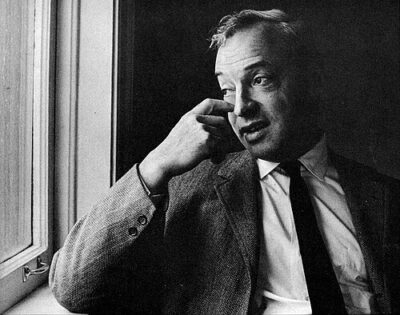
Saul Bellow
Saul Bellow was a Canadian-American writer. Born June 10, 1915, in Lachine. Died April 5, 2005, in Brookline. Positions held include Booker Prize judge (1971). Known for The Adventures of Augie March, Herzog and Henderson the Rain King. Educated at University of Wisconsin–Madison and University of Chicago. Awards include Nobel Prize in Literature, Guggenheim Fellowship (2 times) and National Medal of Arts.
Facts
50 facts · 2 confirmed by two sources · 12 cited · 36 from one source
Where this comes from
Papalocal keeps its own record. It started from these sources; what each one said is kept here as it was copied, so a change on their side never changes this page by itself. Tap one to read its version.
What Wikidata says · copied November 13, 2026 · revision 2568731020
- Described as
- Canadian-American writer (1915–2005)
- Other names
- Solomon Bellows
- Born
- June 10, 1915 · 12 references
- Died
- April 5, 2005 · 10 references
- Born in
- Lachine · 1 reference
- Died in
- Brookline · 3 references
- Buried in
- Morningside Cemetery · 1 reference
- Name at birth
- Solomon Bellows
- Citizen of
- United States · 3 references
- Occupation
- writer · 3 references; novelist; university teacher · 1 reference; essayist; author · 2 references; journalist · 1 reference; sociologist · 1 reference; anthropologist · 1 reference
- Positions held
- Booker Prize judge (1971) · 1 reference
- Worked for
- New York University; University of Chicago
- Education
- University of Wisconsin–Madison; University of Chicago (1933–); Northwestern University (–1937); Roberto Clemente Community Academy; Camp B'nai Brith; Weinberg College of Arts and Sciences
- Member of
- American Academy of Arts and Sciences; American Academy of Arts and Letters
- Known for
- The Adventures of Augie March; Herzog; Henderson the Rain King
- Awards
- Nobel Prize in Literature (1976) · 2 references; Guggenheim Fellowship (2 times) (1948, 1955) · 1 reference; National Medal of Arts; National Book Award for Fiction (3 times) (1954, 1965, 1971) · 1 reference; Pulitzer Prize for Fiction (1976) · 1 reference; Jefferson Lecture (1977); St. Louis Literary Award (1986); PEN/Malamud Award (1989); Helmerich Award (1989); Common Wealth Award of Distinguished Service (1998); Emerson-Thoreau Medal (1977); Prix Formentor (1965); Officer of the Legion of Honour; O. Henry Award (1980); Fellow of the American Academy of Arts and Sciences
- Field
- novel · 1 reference
- Spouse
- Alexandra Bellow (1974–1985) · 1 reference
- Children
- Adam Bellow
- Religion
- Judaism
- Lived in
- Montreal; Brookline (1993–2005)
- Wikipedias with a page
- 121
Wikidata item Q83059 (wikidata.org/wiki/Q83059), public domain (CC0). Copied November 13, 2026.
What Wikipedia says · copied November 13, 2026 · revision 1380444709
Saul Bellow (born Solomon Bellows; June 10, 1915 – April 5, 2005) was a Canadian and American writer. For his literary work, Bellow was awarded the Pulitzer Prize, the 1976 Nobel Prize in Literature, and the National Medal of Arts. He is the only writer to win the National Book Award for Fiction three times, and he received the National Book Foundation's lifetime Medal for Distinguished Contribution to American Letters in 1990.
In the words of the Swedish Nobel Committee, his writing exhibited "the mixture of rich picaresque novel and subtle analysis of our culture, of entertaining adventure, drastic and tragic episodes in quick succession interspersed with philosophic conversation, all developed by a commentator with a witty tongue and penetrating insight into the outer and inner complications that drive us to act, or prevent us from acting, and that can be called the dilemma of our age." His best-known works include The Adventures of Augie March, Henderson the Rain King, Herzog, Mr. Sammler's Planet, Seize the Day, Humboldt's Gift, and Ravelstein.
Bellow said that of all his characters, Eugene Henderson, of Henderson the Rain King, was the one most like himself. Bellow grew up as an immigrant from Quebec. As Christopher Hitchens describes it, Bellow's fiction and principal characters reflect his own yearning for transcendence, a battle "to overcome not just ghetto conditions but also ghetto psychoses." Bellow's protagonists wrestle with what Albert Corde, the dean in The Dean's December, called "the big-scale insanities of the 20th century." This transcendence of the "unutterably dismal" (a phrase from Dangling Man) is achieved, if it can be achieved at all, through a "ferocious assimilation of learning" (Hitchens) and an emphasis on nobility.
- Born, in its opening lines
- June 10, 1915
- Died, in its opening lines
- April 5, 2005
From the Wikipedia article “Saul Bellow” (en.wikipedia.org/wiki/Saul_Bellow), by its contributors, under CC BY-SA 4.0 (creativecommons.org/licenses/by-sa/4.0/). Copied November 13, 2026; not changed.
Confirmed Two sources agree. Cited One source, and it names where it got it. One source One source, without a reference of its own. Sources disagree The sources disagree. We show the best-supported value and keep theirs below.
