
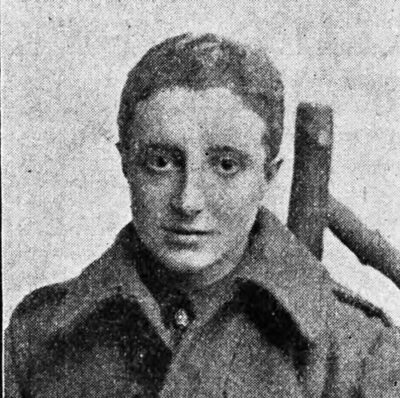
Saunders Lewis
Saunders Lewis was a Welsh writer and politician. Born October 15, 1893, in Wallasey. Died September 1, 1985, in Cardiff. Known for Siwan, Blodeuwedd and Treason. Educated at University of Liverpool.
Facts
27 facts · 2 confirmed by two sources · 2 cited · 23 from one source
Where this comes from
Papalocal keeps its own record. It started from these sources; what each one said is kept here as it was copied, so a change on their side never changes this page by itself. Tap one to read its version.
What Wikidata says · copied November 18, 2026 · revision 2565381241
- Described as
- Welsh writer and politician (1893-1985)
- Other names
- John Saunders Lewis
- Born
- October 15, 1893 · 3 references
- Died
- September 1, 1985 · 4 references
- Born in
- Wallasey
- Died in
- Cardiff · 1 reference
- Name at birth
- John Saunders Lewis
- Citizen of
- United Kingdom; United Kingdom of Great Britain and Ireland (–1927)
- Occupation
- historian; politician · 2 references; writer · 1 reference; poet; literary critic; playwright; academic
- Education
- University of Liverpool
- Genre
- theatre
- Known for
- Siwan; Blodeuwedd; Treason; Buchedd Garmon; 'Gymerwch chi sigaret?
- Spouse
- Margaret Gilcriest
- Children
- Mair Saunders Lewis
- Father
- Lodwig Lewis
- Religion
- Catholicism
- Military branch
- British Army
- Lived in
- Penarth
- Wikipedias with a page
- 22
Wikidata item Q2420498 (wikidata.org/wiki/Q2420498), public domain (CC0). Copied November 18, 2026.
What Wikipedia says · copied November 18, 2026 · revision 1378197967
Saunders Lewis (born John Saunders Lewis; 15 October 1893 – 1 September 1985) was a Welsh politician, poet, dramatist, Medievalist, and literary critic. Born into a Welsh-speaking ministerial family in Greater Liverpool, Lewis rediscovered the importance of both his heritage language and cultural roots while serving as a junior officer in the British Army during the trenches of the First World War. As a vocal supporter of Welsh nationalism, Lewis believed, however, that heritage language revival, cultural nationalism, the dramatic arts, and culture needed to precede Welsh devolution or political independence. If the excessive Anglophilia and colonial mentality traditionally known as Dic Siôn Dafydd was never challenged or defeated, Lewis predicted in 1918, "the Welsh Parliament would [only] be an enlarged County Council."
Lewis accordingly became a co-founder of Plaid Genedlaethol Cymru (The National Party of Wales), now the Welsh nationalist political party known as Plaid Cymru, at a covert meeting with fellow nationalists during the 1925 National Eisteddfod of Wales. Lewis has been described by Jan Morris as, "the most passionate of twentieth century Welsh patriots", and as being, "one of the few twentieth century writers in Welsh with a European reputation, but for many Welshmen [he was] chiefly the keeper of the national conscience." Lewis is usually acknowledged as one of the most vitally important figures in 20th-century Welsh-language literature. He is also widely credited, through his 1962 radio address Tynged yr Iaith ("The Fate of the Language"), with almost singlehandedly bringing Welsh back from the brink of language death.
In 1970, Lewis was nominated for a Nobel Prize in Literature and was appointed as a Knight Commander of the Order of St Gregory by Pope Paul VI. Saunders Lewis' traditionalist Catholic and distributist beliefs gave him a simultaneously anti-Marxist and anti-colonialist interpretation of Welsh history and a similar vision, influenced by his study of what had he considered to have worked in Irish nationalism, for the future of the Welsh people. Lewis was voted the tenth greatest Welsh hero in the '100 Welsh Heroes' poll, released on St. David's Day 2004.
- Born, in its opening lines
- October 15, 1893
- Died, in its opening lines
- September 1, 1985
From the Wikipedia article “Saunders Lewis” (en.wikipedia.org/wiki/Saunders_Lewis), by its contributors, under CC BY-SA 4.0 (creativecommons.org/licenses/by-sa/4.0/). Copied November 18, 2026; not changed.
Confirmed Two sources agree. Cited One source, and it names where it got it. One source One source, without a reference of its own. Sources disagree The sources disagree. We show the best-supported value and keep theirs below.
