
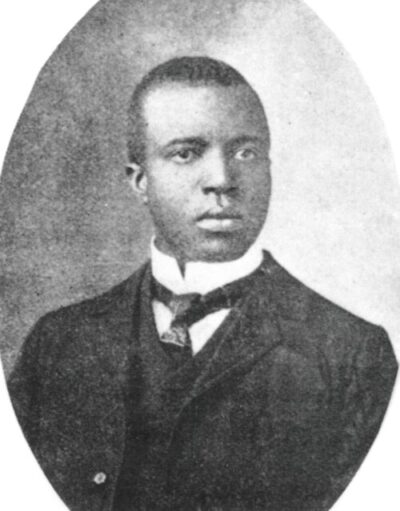
Scott Joplin
Scott Joplin was an American composer, musician, pianist (1867/68-1917). Born November 24, 1868, in Texarkana. Died April 1, 1917, in New York City. Known for Maple Leaf Rag and The Entertainer. Educated at George R. Smith College. Awards include Pulitzer Prize Special Citations and Awards and Songwriters Hall of Fame.
Facts
27 facts · 2 confirmed by two sources · 5 cited · 19 from one source · 1 where the sources disagree
What’s different
- Born: we show November 24, 1868 (Confirmed). Wikidata also lists March 31, 1868 and 1867
- Born in: we show Texarkana (Sources disagree). Wikidata also lists Linden and Bowie County
Where this comes from
Papalocal keeps its own record. It started from these sources; what each one said is kept here as it was copied, so a change on their side never changes this page by itself. Tap one to read its version.
What Wikidata says · copied November 13, 2026 · revision 2563862950
- Described as
- American composer, musician, pianist (1867/68-1917)
- Other names
- The king of Ragtime
- Born
- March 31, 1868; 1867 · 5 references; November 24, 1868 · 4 references
- Died
- April 1, 1917 · 3 references
- Born in
- Texarkana · 1 reference; Linden; Bowie County · 1 reference
- Died in
- New York City · 2 references
- Buried in
- Saint Michael's Cemetery
- Cause of death
- neurosyphilis
- Citizen of
- United States
- Occupation
- pianist · 1 reference; composer · 2 references; banjoist; jazz musician · 1 reference; musician · 1 reference
- Education
- George R. Smith College
- Genre
- ragtime · 1 reference
- Instrument
- piano; guitar; violin; cornet
- Known for
- Maple Leaf Rag; The Entertainer
- Awards
- Pulitzer Prize Special Citations and Awards (1976) · 1 reference; Songwriters Hall of Fame (1970) · 1 reference
- Field
- ragtime; opera; march; waltz
- Website
- https://scottjoplin.org
- Wikipedias with a page
- 65
Wikidata item Q191499 (wikidata.org/wiki/Q191499), public domain (CC0). Copied November 13, 2026.
What Wikipedia says · copied November 13, 2026 · revision 1384710031
Scott Joplin (November 24, 1868 – April 1, 1917) was an American composer and pianist. Dubbed the "King of Ragtime", he composed more than 40 ragtime pieces, one ragtime ballet (original version of "The Ragtime Dance", 1899/1902), and two operas. One of his first and most popular pieces, the "Maple Leaf Rag", became the genre's first and most influential hit, later being recognized as the quintessential rag. Joplin considered ragtime to be a form of classical music meant to be played in concert halls and largely disdained the performance of ragtime as honky tonk music most common in saloons.
Joplin grew up in a musical family of railway laborers in Texarkana, Texas. During the late 1880s, he traveled the American South as a musician. He went to Chicago for the World's Fair of 1893, which helped make ragtime a national craze by 1897. Joplin moved to Sedalia, Missouri, in 1894 and worked as a piano teacher. He began publishing music in 1895, and his "Maple Leaf Rag" in 1899 brought him fame and a steady income. In 1901, Joplin moved to St. Louis and two years later scored his first opera, A Guest of Honor. It was confiscated—along with his belongings—for non-payment of bills and is now considered lost. In 1907, Joplin moved to New York City to (unsuccessfully) find a producer for a new opera. In 1916, Joplin descended into dementia from neurosyphilis. His 1917 death marks the end of the "Ragtime era".
Joplin's music was rediscovered and returned to popularity in the early 1970s with the release of a million-selling album, Scott Joplin: Piano Rags, recorded by Joshua Rifkin. This was followed by the Academy Award–winning 1973 film The Sting, which features several of Joplin's compositions. Treemonisha, his second opera, was produced in 1972; and, in 1976, Joplin was posthumously awarded a Pulitzer Prize.
- Born, in its opening lines
- November 24, 1868
- Died, in its opening lines
- April 1, 1917
From the Wikipedia article “Scott Joplin” (en.wikipedia.org/wiki/Scott_Joplin), by its contributors, under CC BY-SA 4.0 (creativecommons.org/licenses/by-sa/4.0/). Copied November 13, 2026; not changed.
Confirmed Two sources agree. Cited One source, and it names where it got it. One source One source, without a reference of its own. Sources disagree The sources disagree. We show the best-supported value and keep theirs below.
