
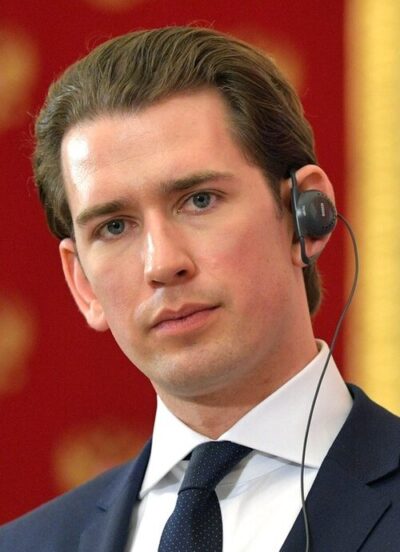
Sebastian Kurz
Sebastian Kurz is a Chancellor of Austria (2017–2019, 2020–2021). Born August 27, 1986, in Vienna. Positions held include Federal Minister of Foreign Affairs of Austria (2013–2017), member of the regional parliament of Vienna (2010–2011) and Secretary of State (2011–2013). Educated at University of Vienna and GRG 12 Erlgasse. Awards include Order of the Republic of Serbia and Award "For Freedom of Mass Media".
Facts
26 facts · 1 confirmed by two sources · 13 cited · 12 from one source
Where this comes from
Papalocal keeps its own record. It started from these sources; what each one said is kept here as it was copied, so a change on their side never changes this page by itself. Tap one to read its version.
What Wikidata says · copied November 16, 2026 · revision 2562956116
- Described as
- Chancellor of Austria (2017–2019, 2020–2021)
- Other names
- HE Sebastian Kurz
- Born
- August 27, 1986 · 5 references
- Born in
- Vienna · 3 references
- Citizen of
- Austria · 1 reference
- Occupation
- politician · 3 references
- Positions held
- Federal Minister of Foreign Affairs of Austria (2013–2017) · 1 reference; member of the regional parliament of Vienna (2010–2011) · 1 reference; Secretary of State (2011–2013) · 1 reference; Chairman of the Austrian People's Party (2017–2021) · 2 references; Federal Chancellor of Austria (2017–2021) · 3 references; member of the National Council of Austria (2 times) (2013–2021) · 1 reference
- Political party
- Austrian People's Party · 1 reference
- Worked for
- Austrian Federal Government · 1 reference
- Education
- University of Vienna (2005–2011) · 2 references; GRG 12 Erlgasse (1996–2004) · 1 reference; Faculty of Law, University of Vienna (2005–2011)
- Member of
- First Kurz government; Second Kurz cabinet
- Awards
- Order of the Republic of Serbia (2021) · 1 reference; Award "For Freedom of Mass Media" (2021)
- Field
- politician · 1 reference; diplomat · 1 reference; entrepreneur; politics · 1 reference
- Religion
- Catholic Church
- Lived in
- Vienna
- Website
- https://www.sebastian-kurz.at · 1 reference
- Wikipedias with a page
- 87
Wikidata item Q2262885 (wikidata.org/wiki/Q2262885), public domain (CC0). Copied November 16, 2026.
What Wikipedia says · copied November 16, 2026 · revision 1381880194
Sebastian Kurz (born 27 August 1986) is an Austrian former politician who served twice as Chancellor of Austria, first from 2017 to 2019 and then again from 2020 to 2021.
Kurz was born and raised in Meidling, Vienna. He entered politics by joining the Young People's Party (JVP)—the youth wing of the Austrian People's Party (ÖVP)—in 2003 and rose through the ranks there over the following years. As a result of a cabinet reshuffle in 2011, Kurz received his first government mandate as state secretary responsible for socially integrating refugees. After the 2013 legislative election, Kurz became the country's foreign minister and remained its top diplomat until December 2017.
In May 2017, Kurz succeeded ÖVP chairman Reinhold Mitterlehner and ran as chancellor candidate of his party in the 2017 legislative election. He campaigned on modernizing the Austrian political and bureaucratic apparatus as well as handling the social and immigration issues the country was facing after the European refugee crisis. His perceived reformist approach, rhetorical skills and youth were cited as the prime reasons for his landslide victory. Kurz was subsequently charged with forming his first cabinet. He opted for a coalition with the far-right Freedom Party of Austria (FPÖ). During his first chancellorship, Kurz was credited with mostly following through on his campaign pledges, but his leadership style was widely criticised as uncooperative and hasty. Several political scandals, culminating with the Ibiza affair in 2019, ended the ÖVP–FPÖ coalition. As a result of him no longer commanding the support of Parliament, Kurz and his cabinet were ousted.
Following the 2019 snap election, he returned to power and formed a coalition with the environmentalist Green Party this time. Kurz and his second cabinet were inaugurated in January 2020. Their agenda, however, was swiftly put in limbo by the surging COVID-19 pandemic. His response to the pandemic included lockdowns and curfews. An investigation into the Ibiza affair by a parliamentary subcommittee, an unstable Cabinet plagued by resignations, and ultimately a corruption inquiry, forced Kurz to resign the chancellorship in October 2021. However, remaining party chair and parliamentary leader allowed him to retain control over government affairs, and thus he came to be known as "shadow chancellor". Two months later, Kurz quit politics entirely and started working as a global strategist for Peter Thiel.
Kurz was the youngest chancellor in Austrian history as well as the youngest head of government in the world for about four years. His youth and political tenor were credited with revitalizing the traditional conservative movement in Austria and in Europe.
- Born, in its opening lines
- August 27, 1986
From the Wikipedia article “Sebastian Kurz” (en.wikipedia.org/wiki/Sebastian_Kurz), by its contributors, under CC BY-SA 4.0 (creativecommons.org/licenses/by-sa/4.0/). Copied November 16, 2026; not changed.
Confirmed Two sources agree. Cited One source, and it names where it got it. One source One source, without a reference of its own. Sources disagree The sources disagree. We show the best-supported value and keep theirs below.
