
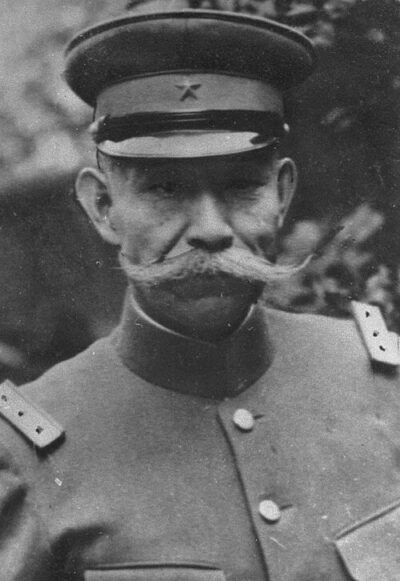
Senjūrō Hayashi
Senjūrō Hayashi was a Japanese politician and general. Born February 23, 1876, in Kanazawa. Died February 4, 1943, in Tokyo. Positions held include Prime Minister of Japan (1937), Minister of the Imperial Japanese Army (1934–1935) and Inspector General of Military Training (1932–1934). Educated at Army War College and Imperial Japanese Army Academy. Awards include Order of the Rising Sun, 1st class, Order of the Rising Sun with Paulownia Flowers, 1st class and Inter-Allied Victory Medals.
Facts
35 facts · 2 confirmed by two sources · 0 cited · 33 from one source
Where this comes from
Papalocal keeps its own record. It started from these sources; what each one said is kept here as it was copied, so a change on their side never changes this page by itself. Tap one to read its version.
What Wikidata says · copied November 16, 2026 · revision 2566557557
- Described as
- Japanese politician and general (1876–1943)
- Other names
- Senjuro Hayashi, Senjuurou Hayashi
- Born
- February 23, 1876 · 3 references
- Died
- February 4, 1943 · 1 reference
- Born in
- Kanazawa
- Died in
- Tokyo
- Buried in
- Tama Cemetery
- Cause of death
- cerebral hemorrhage
- Citizen of
- Japan
- Occupation
- politician; diplomat; military personnel
- Positions held
- Prime Minister of Japan (1937); Minister of the Imperial Japanese Army (1934–1935); Inspector General of Military Training (1932–1934); Minister for Foreign Affairs (1937); Minister of Education (1937)
- Political party
- Taisei Yokusankai
- Education
- Army War College; Imperial Japanese Army Academy
- Awards
- Order of the Rising Sun, 1st class (1934); Order of the Rising Sun with Paulownia Flowers, 1st class (1943); Inter-Allied Victory Medals · 1 reference; Order of the Rising Sun, 5th class (1906); Order of the Golden Kite, 4th Class (1906); Military Medal of Honor (4 times) (1906, 1915, 1920, 1934); commemorative medal of Japan (4 times) (1912, 1915, 1934, 1935); Order of the Sacred Treasure, 4th class (1913); Order of the Sacred Treasure, 3rd class (1915); Order of the Rising Sun, 3rd class (1920); Order of the Sacred Treasure, 2nd Class (1926); Order of the Sacred Treasure, 1st Class (1932); 2600th National Anniversary Commemorative Medal (1940); Order of the Palgwae (1910)
- Siblings
- Yukichi Shirakami
- Military branch
- Imperial Japanese Army
- Military rank
- general
- Wikipedias with a page
- 36
Wikidata item Q351665 (wikidata.org/wiki/Q351665), public domain (CC0). Copied November 16, 2026.
What Wikipedia says · copied November 16, 2026 · revision 1381487276
Senjūrō Hayashi (林 銑十郎, Hayashi Senjūrō; 23 February 1876 – 4 February 1943) was a Japanese politician and general. He served as Imperial Japanese Army Commander of the Japanese Korean Army during the Mukden Incident and the invasion of Manchuria. He briefly served as Prime Minister of Japan in 1937.
- Born, in its opening lines
- February 23, 1876
- Died, in its opening lines
- February 4, 1943
From the Wikipedia article “Senjūrō Hayashi” (en.wikipedia.org/wiki/Senjūrō_Hayashi), by its contributors, under CC BY-SA 4.0 (creativecommons.org/licenses/by-sa/4.0/). Copied November 16, 2026; not changed.
Confirmed Two sources agree. Cited One source, and it names where it got it. One source One source, without a reference of its own. Sources disagree The sources disagree. We show the best-supported value and keep theirs below.
