
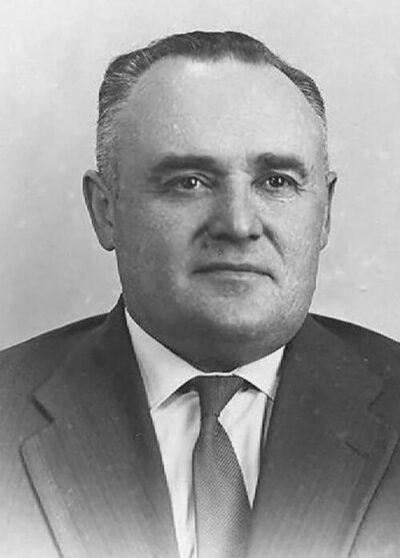
Sergei Korolev
Sergei Korolev was a Soviet rocket engineer and spacecraft designer. Born January 12, 1907, in Zhytomyr. Died January 14, 1966, in Moscow. Positions held include director (1946–). Known for R-7. Educated at Igor Sikorsky Kyiv Polytechnic Institute and Bauman Moscow State Technical University. Awards include Order of Lenin (2 times), Order of the Badge of Honour and Lenin Prize.
Facts
48 facts · 2 confirmed by two sources · 11 cited · 34 from one source · 1 where the sources disagree
What’s different
- Born: we show January 12, 1907 (Confirmed). Wikidata also lists December 30, 1906
- Cause of death: we show cancer (Sources disagree). Wikidata also lists neoplasm
Where this comes from
Papalocal keeps its own record. It started from these sources; what each one said is kept here as it was copied, so a change on their side never changes this page by itself. Tap one to read its version.
What Wikidata says · copied November 16, 2026 · revision 2558234952
- Described as
- Soviet rocket engineer and spacecraft designer (1907-1966)
- Other names
- S. P. Korolyov, Sergei Pavlovich Korolyov, Sergei Koroliov, Sergei Pavlovich Korolev, Sergej Koroljov
- Born
- December 30, 1906 · 1 reference; January 12, 1907 · 1 reference
- Died
- January 14, 1966 · 6 references
- Born in
- Zhytomyr · 4 references
- Died in
- Moscow · 3 references
- Buried in
- Kremlin Wall Necropolis
- Cause of death
- cancer; neoplasm
- Citizen of
- Russian Empire; Soviet Union · 3 references
- Occupation
- military flight engineer; design engineer; university teacher; military personnel · 2 references; scientist · 2 references; engineer · 1 reference; physicist · 1 reference
- Positions held
- director (1946–)
- Political party
- Communist Party of the Soviet Union (1953–) · 1 reference
- Worked for
- S.P. Korolev Rocket and Space Corporation Energia (1946–); Group for the Study of Reactive Motion; Reactive Scientific Research Institute (1933–); Nordhausen (Institut)
- Education
- Igor Sikorsky Kyiv Polytechnic Institute (1924–1926); Bauman Moscow State Technical University (1926–) · 1 reference
- Member of
- Russian Academy of Sciences (1953–) · 1 reference; Academy of Sciences of the USSR · 1 reference
- Known for
- R-7
- Awards
- Order of Lenin (2 times) (1956, 1957); Order of the Badge of Honour (1945); Lenin Prize (1957); Medal "For Labour Valour"; Medal "For Valiant Labour in the Great Patriotic War 1941–1945" (1945); "Hammer and Sickle" gold medal (2 times) (1956, 1961); Medal "In Commemoration of the 800th Anniversary of Moscow" (1949); International Space Hall of Fame (1976) · 2 references; Hero of Socialist Labour (2 times) (1956, 1961) · 1 reference; Jubilee Medal "40 Years of the Armed Forces of the USSR" · 1 reference
- Field
- rocket science
- Spouse
- Kseniia Vintsentini · 1 reference
- Children
- Natalii︠a︡ Koroleva · 1 reference
- Father
- Pavel Korolev
- Mother
- Maria Moskalenko
- Military branch
- Red Army
- Military rank
- colonel (1945–); soldier · 2 references
- Lived in
- Odesa; Nizhyn; Moscow; Lyadov Street (1944–1946) · 1 reference
- Wikipedias with a page
- 82
Wikidata item Q170842 (wikidata.org/wiki/Q170842), public domain (CC0). Copied November 16, 2026.
What Wikipedia says · copied November 16, 2026 · revision 1384972165
Sergei Pavlovich Korolev (12 January 1907 [O.S. 30 December 1906] – 14 January 1966) was a Soviet rocket engineer and spacecraft designer who led the development of the Soviet space program during the early years of the Space Race.
Korolev directed development of the R-7 rocket, the world's first intercontinental ballistic missile (ICBM) and was a leader in the Soviet space programme which used modified versions of the R-7 for several notable achievements. Under his leadership, the Soviet Union launched Sputnik 1, the first artificial satellite; Laika, the first animal to orbit Earth; Luna 2, the first human-made object to reach another celestial body; and Belka and Strelka, the first animals to survive orbital spaceflight. He also directed the missions that carried Yuri Gagarin into space aboard Vostok 1, making him the first human in space, and enabled Alexei Leonov's spacewalk during Voskhod 2, the first extravehicular activity by a human.
Originally trained as an aircraft designer, Korolev became a leading figure in Soviet rocketry. In 1938 he was arrested during the Great Purge on charges later shown to be false and spent nearly six years in prison and labour camps, including several months in Kolyma. Prior to his imprisonment, Korolev had been initially condemned to be executed under Joseph Stalin's orders among 74 military specialists and engineers before his sentence was commuted to hard prison labour. After his release, he returned to engineering work and became a central figure in the Soviet ICBM and space programmes. His death in 1966 ended his direct involvement in Soviet efforts to land a crew on the Moon before the United States.
During his lifetime, Korolev was publicly identified only as glavny konstruktor (главный конструктор; lit. 'chief designer'), partly to protect him from possible assassination attempts during the Cold War. Even some cosmonauts who worked with him did not know his name. His identity was publicly disclosed only after his death in 1966, when his role in the Soviet Union's space achievements became widely known.
- Born, in its opening lines
- January 12, 1907
- Died, in its opening lines
- January 14, 1966
From the Wikipedia article “Sergei Korolev” (en.wikipedia.org/wiki/Sergei_Korolev), by its contributors, under CC BY-SA 4.0 (creativecommons.org/licenses/by-sa/4.0/). Copied November 16, 2026; not changed.
Confirmed Two sources agree. Cited One source, and it names where it got it. One source One source, without a reference of its own. Sources disagree The sources disagree. We show the best-supported value and keep theirs below.
