
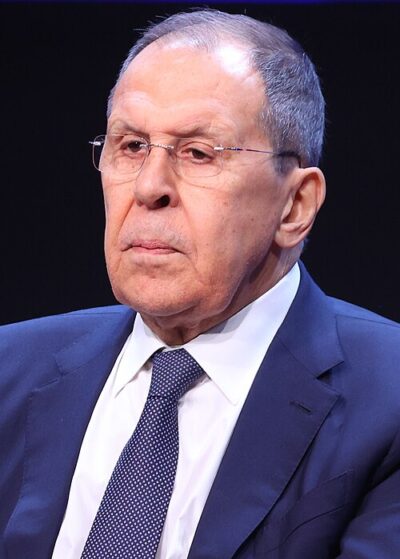
Sergey Lavrov
Sergey Lavrov is a Russian politician of Armenian origin, Minister of Foreign Affairs. Born March 21, 1950, in Moscow. Positions held include Minister of Foreign Affairs (2004–), Permanent Representative of Russia to the United Nations (1994–2004) and Deputy Minister of Foreign Affairs (Russia) (1992–1994). Educated at Moscow State Institute of International Relations and School No.1414. Awards include Order of Honour, Order "For Merit to the Fatherland", 4th class and Honored Worker of the Diplomatic Service of the Russian Federation.

Facts
39 facts · 1 confirmed by two sources · 9 cited · 29 from one source
Where this comes from
Papalocal keeps its own record. It started from these sources; what each one said is kept here as it was copied, so a change on their side never changes this page by itself. Tap one to read its version.
What Wikidata says · copied November 16, 2026 · revision 2567967382
- Described as
- Russian politician of Armenian origin, Minister of Foreign Affairs
- Other names
- Sergej Viktorovič Lavrov, Sergei Lavrov, Sergej Lavrov, Сергей Лавров
- Born
- March 21, 1950 · 5 references
- Born in
- Moscow · 1 reference
- Citizen of
- Soviet Union (–1991); Russia (1991–)
- Occupation
- diplomat · 1 reference; politician · 1 reference; minister · 1 reference; foreign minister · 1 reference
- Positions held
- Minister of Foreign Affairs (2004–) · 1 reference; Permanent Representative of Russia to the United Nations (1994–2004); Deputy Minister of Foreign Affairs (Russia) (1992–1994) · 1 reference
- Political party
- Communist Party of the Soviet Union (–1991) · 1 reference; United Russia
- Worked for
- Ministry of Foreign Affairs of the Russian Federation · 1 reference
- Education
- Moscow State Institute of International Relations (–1972); School No.1414 (–1966)
- Member of
- Imperial Orthodox Palestine Society
- Awards
- Order of Honour (1996); Order "For Merit to the Fatherland", 4th class (1998); Honored Worker of the Diplomatic Service of the Russian Federation (2004); Dostyk Order of grade II (2005) · 1 reference; Order "For Merit to the Fatherland", 3rd class (2005); Order of the Friendship of Peoples (2006); Grand Cross of the Order of the Sun of Peru (2007); Order of the Sun of Peru (2007) · 1 reference; Order of the "Commonwealth" (2007); Friendship Order (2009); Order "For Merit to the Fatherland", 2nd class (2010); Order of Holy Prince Daniel of Moscow 2nd class (2010); Order of Honor (2010); Order of St. Mesrop Mashtots (2010); Dostyk Order of grade I (2012)
- Field
- diplomacy · 1 reference; politics · 1 reference
- Spouse
- Maria Lavrova
- Children
- Ekaterina Vinokurova
- Religion
- Eastern Orthodoxy
- Lived in
- Moscow
- Website
- https://mid.ru/ · 1 reference
- Wikipedias with a page
- 102
Wikidata item Q58217 (wikidata.org/wiki/Q58217), public domain (CC0). Copied November 16, 2026.
What Wikipedia says · copied November 16, 2026 · revision 1384814951
Sergey Viktorovich Lavrov (Russian: Сергей Викторович Лавров, IPA: [sʲɪrˈɡʲej ˈvʲiktərəvʲɪtɕ lɐˈvrof]; born 21 March 1950) is a Russian politician and diplomat who has served as Minister of Foreign Affairs since 2004. He is the country's longest-serving foreign minister since the Tsarist era.
After graduating from the Moscow State Institute of International Relations (MGIMO) in 1972, Lavrov began his diplomatic career in Sri Lanka and speaks fluent Sinhala, Dhivehi, English, and French, in addition to his native Russian. From 1981 to 1988 he held several posts in the Soviet Permanent Mission to the United Nations in New York City. Starting in the late 1980s he was deputy director and then director of the Foreign Ministry's Department of International Organizations before becoming a Deputy Minister of Foreign Affairs in 1992. He served as Russia's Permanent Representative to the United Nations from 1994 to 2004, where he gained a reputation for assertively defending Russian interests during crises, including the Kosovo War and the Iraq invasion. Throughout his tenure, Lavrov has remained a central figure in shaping Russia's foreign policy under President Vladimir Putin.
- Born, in its opening lines
- March 21, 1950
From the Wikipedia article “Sergey Lavrov” (en.wikipedia.org/wiki/Sergey_Lavrov), by its contributors, under CC BY-SA 4.0 (creativecommons.org/licenses/by-sa/4.0/). Copied November 16, 2026; not changed.
Confirmed Two sources agree. Cited One source, and it names where it got it. One source One source, without a reference of its own. Sources disagree The sources disagree. We show the best-supported value and keep theirs below.
