
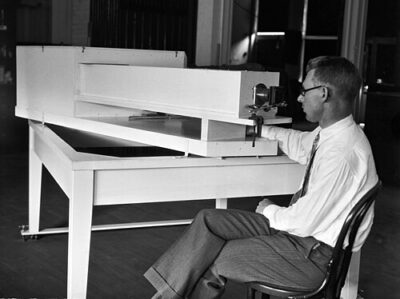
Seth Barnes Nicholson
Seth Barnes Nicholson was an American astronomer. Born November 12, 1891, in Springfield. Died July 2, 1963, in Los Angeles. Educated at Drake University. Awards include Bruce Medal.
Facts
12 facts · 2 confirmed by two sources · 4 cited · 6 from one source
Where this comes from
Papalocal keeps its own record. It started from these sources; what each one said is kept here as it was copied, so a change on their side never changes this page by itself. Tap one to read its version.
What Wikidata says · copied November 15, 2026 · revision 2567036220
- Described as
- American astronomer (1891–1963)
- Other names
- S. B. Nicholson, Seth B. Nicholson
- Born
- November 12, 1891 · 2 references
- Died
- July 2, 1963 · 1 reference
- Born in
- Springfield · 1 reference
- Died in
- Los Angeles · 1 reference
- Buried in
- Mountain View Cemetery and Mausoleum
- Citizen of
- United States
- Occupation
- astronomer · 1 reference
- Worked for
- Mount Wilson Observatory
- Education
- Drake University
- Member of
- National Academy of Sciences
- Awards
- Bruce Medal (1963) · 1 reference
- Field
- astronomy
- Wikipedias with a page
- 32
Wikidata item Q436047 (wikidata.org/wiki/Q436047), public domain (CC0). Copied November 15, 2026.
What Wikipedia says · copied November 15, 2026 · revision 1371995480
Seth Barnes Nicholson (November 12, 1891 – July 2, 1963) was an American astronomer. He worked at the Lick observatory in California, and is known for discovering several moons of Jupiter in the 20th century.
Nicholson was born in Springfield, Illinois, and was raised in rural Illinois. He was educated at Drake University, where he became interested in astronomy. On May 29, 1913, he was married to Alma Stotts, a fellow student at Drake then the University of California at Berkeley. They would have three children: Margaret, Donald, and Jean.
In 1914, at the University of California's Lick Observatory, while observing the recently discovered Jovian moon Pasiphaë, he discovered a new one, Sinope, whose orbit he computed for his Ph.D. thesis in 1915.
He spent his entire career at Mount Wilson Observatory, where he discovered three more Jovian moons: Lysithea and Carme in 1938, and Ananke in 1951. While at the Palomar Observatory in 1957, he discovered 1647 Menelaus, an asteroid near Jupiter. Other work included computing the orbits of several comets and also that of Pluto.
Sinope, Lysithea, Carme, and Ananke were simply designated as "Jupiter IX", "Jupiter X", "Jupiter XI", and "Jupiter XII". They were not given their present names until 1975. Nicholson himself declined to propose names.
At Mt. Wilson, his main assignment concerned solar activity and he produced for decades annual reports on sunspot activity. He also made a number of eclipse expeditions to measure the brightness and temperature of the Sun's corona.
In the early 1920s, he and Edison Pettit made the first systematic infrared observations of celestial objects.
They used a vacuum thermocouple to measure the infrared radiation and thus the temperature of the Moon which led to the theory that the Moon was covered with a thin layer of dust acting as an insulator, and also of the planets, sunspots and stars.
Their temperatures measurements of nearby giant stars led to some of the first determinations of stellar diameters.
Nicholson, together with astronomer George Ellery Hale, lend their name to the "Hale-Nicholson law" concerning the magnetic polarity of sunspots.
From 1943 to 1955, he served as editor of the Publications of the Astronomical Society of the Pacific, of which he was also twice president.
He died in Los Angeles. His final resting place is in dispute, but he was cremated and his remains were likely dispersed by his son.
- Born, in its opening lines
- November 12, 1891
- Died, in its opening lines
- July 2, 1963
From the Wikipedia article “Seth Barnes Nicholson” (en.wikipedia.org/wiki/Seth_Barnes_Nicholson), by its contributors, under CC BY-SA 4.0 (creativecommons.org/licenses/by-sa/4.0/). Copied November 15, 2026; not changed.
Confirmed Two sources agree. Cited One source, and it names where it got it. One source One source, without a reference of its own. Sources disagree The sources disagree. We show the best-supported value and keep theirs below.
