
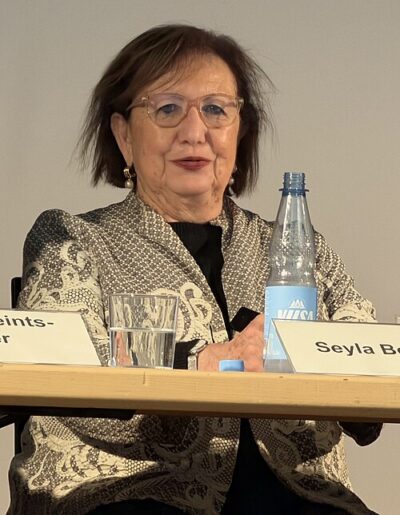
Seyla Benhabib
Seyla Benhabib is a Turkish-American philosopher and political scientist. Born September 9, 1950, in Istanbul. Educated at Yale University and Brandeis University. Awards include Guggenheim Fellowship, Ernst Bloch Award and Dr. Leopold Lucas Prize.
Facts
32 facts · 1 confirmed by two sources · 12 cited · 19 from one source
Where this comes from
Papalocal keeps its own record. It started from these sources; what each one said is kept here as it was copied, so a change on their side never changes this page by itself. Tap one to read its version.
What Wikidata says · copied November 16, 2026 · revision 2556938812
- Described as
- Turkish-American philosopher and political scientist (born 1950)
- Other names
- Şeyla Benhabib
- Born
- September 9, 1950 · 2 references
- Born in
- Istanbul · 2 references
- Citizen of
- Turkey · 1 reference; United States
- Occupation
- university teacher · 3 references; philosopher · 2 references; essayist; biographer; political scientist · 3 references; researcher · 1 reference; academic · 1 reference
- Worked for
- Harvard University; Yale University; Stony Brook University; Boston University; The New School; Columbia University · 1 reference
- Education
- Yale University; Brandeis University; Robert College
- Member of
- American Academy of Arts and Sciences
- Awards
- Guggenheim Fellowship · 1 reference; Ernst Bloch Award (2009); Dr. Leopold Lucas Prize (2012) · 1 reference; Meister Eckhart Prize (2014) · 1 reference; honorary doctor of the University of Valencia (2010) · 1 reference; Fellow of the American Academy of Arts and Sciences; Honorary doctorate from the University of Geneva (2018); Ralph J. Bunche Award (2005) · 1 reference; Hannah Arendt Prize (2025); Johan Skytte Prize in Political Science (2026)
- Field
- gender studies
- Wikipedias with a page
- 24
Wikidata item Q263235 (wikidata.org/wiki/Q263235), public domain (CC0). Copied November 16, 2026.
What Wikipedia says · copied November 16, 2026 · revision 1380570652
Seyla Benhabib (; born September 9, 1950) is a Turkish-born American philosopher. Benhabib is a senior research scholar and adjunct professor of law at Columbia Law School. She is also an affiliate faculty member in the Columbia University Department of Philosophy and a senior fellow at the Columbia Center for Contemporary Critical Thought. She was a scholar in residence at the Law School from 2018 to 2019 and was also the James S. Carpentier Visiting professor of law in spring 2019. She was the Eugene Mayer Professor of Political Science and Philosophy at Yale University from 2001 to 2020. She was director of the program in Ethics, Politics, and Economics from 2002 to 2008. Benhabib is well known for her work in political philosophy, which draws on critical theory and feminist political theory. She has written extensively on the philosophers Hannah Arendt and Jürgen Habermas, as well as on the topic of human migration. She is the author of numerous books, and has received several prestigious awards and lectureships in recognition of her work.
- Born, in its opening lines
- September 9, 1950
From the Wikipedia article “Seyla Benhabib” (en.wikipedia.org/wiki/Seyla_Benhabib), by its contributors, under CC BY-SA 4.0 (creativecommons.org/licenses/by-sa/4.0/). Copied November 16, 2026; not changed.
Confirmed Two sources agree. Cited One source, and it names where it got it. One source One source, without a reference of its own. Sources disagree The sources disagree. We show the best-supported value and keep theirs below.
