
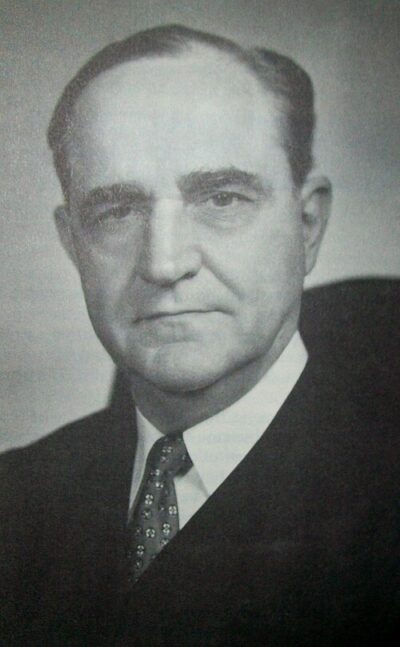
Sherman Minton
Sherman Minton was an US Supreme Court justice from 1949 to 1956. Born October 20, 1890, in Georgetown. Died April 9, 1965, in New Albany. Positions held include Associate Justice of the Supreme Court of the United States (1949–1956), Judge of the United States Court of Appeals for the Seventh Circuit and United States senator (1935–1941). Educated at Indiana University Maurer School of Law and University of Paris.
Facts
19 facts · 2 confirmed by two sources · 4 cited · 13 from one source
Where this comes from
Papalocal keeps its own record. It started from these sources; what each one said is kept here as it was copied, so a change on their side never changes this page by itself. Tap one to read its version.
What Wikidata says · copied November 18, 2026 · revision 2545351319
- Described as
- US Supreme Court justice from 1949 to 1956
- Born
- October 20, 1890 · 3 references
- Died
- April 9, 1965 · 3 references
- Born in
- Georgetown
- Died in
- New Albany
- Buried in
- Holy Trinity Cemetery · 1 reference
- Citizen of
- United States
- Occupation
- politician · 1 reference; lawyer; judge; writer · 1 reference
- Positions held
- Associate Justice of the Supreme Court of the United States (1949–1956); Judge of the United States Court of Appeals for the Seventh Circuit; United States senator (1935–1941) · 1 reference
- Political party
- Democratic Party
- Education
- Indiana University Maurer School of Law; University of Paris; Indiana University; Yale Law School; New Albany High School · 2 references
- Wikipedias with a page
- 17
Wikidata item Q1849894 (wikidata.org/wiki/Q1849894), public domain (CC0). Copied November 18, 2026.
What Wikipedia says · copied November 18, 2026 · revision 1385247986
Sherman "Shay" Minton (October 20, 1890 – April 9, 1965) was an American politician and jurist who served as a U.S. senator from Indiana and later became an associate justice of the Supreme Court of the United States; he was a member of the Democratic Party.
After attending college and law school, Minton served as a captain in World War I, following which he launched a legal and political career. In 1930, after multiple failed election attempts, and serving as a regional leader in the American Legion, he became a utility commissioner under the administration of Paul V. McNutt, Governor of Indiana. Four years later, Minton was elected to the United States Senate. During the campaign, he defended New Deal legislation in a series of addresses in which he suggested it was not necessary to uphold the United States Constitution during the Great Depression. Minton's campaign was denounced by his political opponents, and he received more widespread criticism for an address that became known as the "You Cannot Eat the Constitution" speech. As part of the New Deal Coalition, Minton championed President Franklin D. Roosevelt's unsuccessful court packing plans in the Senate and became one of his top Senate allies.
After Minton failed in his 1940 Senate reelection bid, Roosevelt appointed him as a United States circuit judge of the United States Court of Appeals for the Seventh Circuit. After Roosevelt's death, President Harry S. Truman, who had developed a close friendship with Minton during their time together in the Senate, nominated him to the Supreme Court. He was confirmed by the Senate on October 4, 1949, by a vote of 48 to 16, 15 Republicans and one Democrat (Harry Flood Byrd of Virginia) voting against him. He served on the Supreme Court for seven years. An advocate of judicial restraint, Minton was a regular supporter of the majority opinions during his early years on the Court; he became a regular dissenter after President Dwight Eisenhower's appointees altered the court's composition. In 1956, poor health forced Minton to retire, after which he traveled and lectured until his death in 1965. To date, he is the last member of the United States Congress to be named to the Supreme Court.
According to historians, Minton's judicial philosophy was largely a reaction to the relationship between the New Deal senators and the conservative 1930s Court, which ruled much of the New Deal legislation unconstitutional. Minton believed the Supreme Court should be more deferential to the political branches of government, and supported a broad interpretation of the powers of Congress. He generally opposed any effort to rule federal legislation unconstitutional on the principle that the court was overstepping its authority. As a result of his judicial philosophy, he sought to uphold the intent of the political branches of government. Historians note the unusual contrast this created between his role as a partisan liberal Senator and his role as a conservative jurist. When Minton became a Justice, the Senate had become more conservative, leading Minton to uphold the constitutionality and intention of conservative legislation. He often played peacemaker and consensus builder during a period when the Court was riven by feuds. He generally ruled in favor of order over freedom as a result of his broad interpretation of governmental powers. These rulings and their limited impact have given some historians a negative opinion of his judicial record. Other historians consider Minton's strong commitment to his judicial principles laudable. In 1962, the Sherman Minton Bridge in southern Indiana and the Minton–Capehart Federal Building in Indianapolis were named in his honor.
- Born, in its opening lines
- October 20, 1890
- Died, in its opening lines
- April 9, 1965
From the Wikipedia article “Sherman Minton” (en.wikipedia.org/wiki/Sherman_Minton), by its contributors, under CC BY-SA 4.0 (creativecommons.org/licenses/by-sa/4.0/). Copied November 18, 2026; not changed.
Confirmed Two sources agree. Cited One source, and it names where it got it. One source One source, without a reference of its own. Sources disagree The sources disagree. We show the best-supported value and keep theirs below.
