
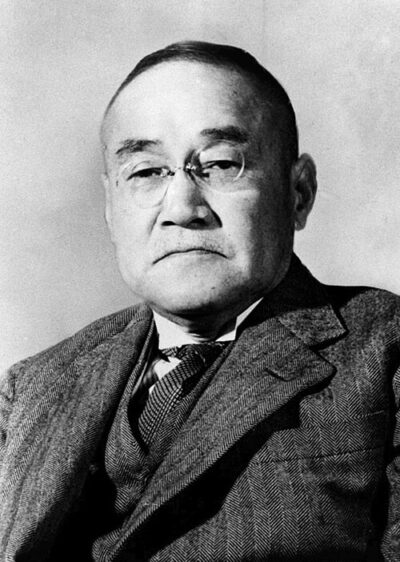
Shigeru Yoshida
Shigeru Yoshida was a Prime minister of Japan. Born September 22, 1878, in Kanda-Surugadai. Died October 20, 1967, in Ōiso-machi. Positions held include member of the House of Representatives of Japan (1947–1963), Prime Minister of Japan (1946–1954) and ambassador of Japan to Italy. Educated at Tokyo Imperial University and Kōyo Juku. Awards include Knight Commander of the Royal Victorian Order, Grand Cordon of the Supreme Order of the Chrysanthemum and Knight Grand Cross of the Order of Merit of the Italian Republic.
Facts
46 facts · 2 confirmed by two sources · 4 cited · 39 from one source · 1 where the sources disagree
What’s different
- Buried in: we show Kuboyama Cemetery (Sources disagree). Wikidata also lists Aoyama Cemetery
Where this comes from
Papalocal keeps its own record. It started from these sources; what each one said is kept here as it was copied, so a change on their side never changes this page by itself. Tap one to read its version.
What Wikidata says · copied November 16, 2026 · revision 2565546236
- Described as
- Prime minister of Japan (1878–1967)
- Other names
- Yoshida Shigeru
- Born
- September 22, 1878 · 6 references
- Died
- October 20, 1967 · 6 references
- Born in
- Kanda-Surugadai
- Died in
- Ōiso-machi
- Buried in
- Aoyama Cemetery; Kuboyama Cemetery · 1 reference
- Citizen of
- Japan
- Occupation
- politician · 1 reference; diplomat · 1 reference
- Positions held
- member of the House of Representatives of Japan (1947–1963); Prime Minister of Japan (1946–1954); ambassador of Japan to Italy · 1 reference; Minister for Foreign Affairs; member of the House of Peers
- Political party
- Liberal Democratic Party; Liberal Party; Democratic Liberal Party; Liberal Party
- Education
- Tokyo Imperial University; Kōyo Juku; Meiji University Setagaya Junior and Senior High School; Tokyo University of Commerce; Seisoku High School; Keio Gijuku
- Awards
- Knight Commander of the Royal Victorian Order (1929); Grand Cordon of the Supreme Order of the Chrysanthemum (1964); Knight Grand Cross of the Order of Merit of the Italian Republic; Collar of the Supreme Order of the Chrysanthemum (1967); commemorative medal of Japan (4 times) (1912, 1915, 1934, 1935); Order of the Sacred Treasure, 5th Class (1918); Order of the Rising Sun, 4th class (1920); Military Medal of Honor (2 times) (1920, 1934); Order of the Sacred Treasure, 3rd class (1925); Order of the Sacred Treasure, 2nd Class (1931); Order of the Sacred Treasure, 1st Class (1934); Order of the Rising Sun, 1st class (1940); 2600th National Anniversary Commemorative Medal (1940); Order of the Double Dragon (1908); Officer of the Order of the Crown of Italy (1913)
- Spouse
- Yukiko Yoshida; Kiyo Yoshida · 1 reference
- Children
- Ken'ichi Yoshida · 1 reference; Kazuko Asō; Yoshida Sakurako · 1 reference
- Father
- Takeuchi Tsuna
- Siblings
- Takeuchi Meitarō
- Religion
- Catholicism
- Wikipedias with a page
- 54
Wikidata item Q301804 (wikidata.org/wiki/Q301804), public domain (CC0). Copied November 16, 2026.
What Wikipedia says · copied November 16, 2026 · revision 1381647316
Shigeru Yoshida (吉田 茂, Yoshida Shigeru; Japanese pronunciation: [jo.ɕi.da (|) ɕi.ɡe.ɾɯ, -ŋe.ɾɯ], 22 September 1878 – 20 October 1967) was a Japanese diplomat and politician who served as prime minister of Japan from 1946 to 1947 and again from 1948 to 1954, serving through most of the country's occupation after World War II. Yoshida played a major role in determining the course of post-war Japan by forging a strong relationship with the United States and pursuing economic recovery.
Born in Tokyo to a former samurai family, Yoshida graduated from Tokyo Imperial University in 1906 and joined the Ministry of Foreign Affairs. He held various assignments abroad, including in China, where he advocated increased Japanese influence. From 1928 to 1930, Yoshida served as vice minister of foreign affairs, then served as ambassador to Italy until 1932. In 1936, he was considered for foreign minister in the cabinet of Kōki Hirota, but he was opposed by the Army, who strongly identified him with liberalism and friendship with Great Britain and the United States. Yoshida served as ambassador to Britain from 1936 to 1938. He largely avoided political participation during the Pacific War. During the U.S. occupation after the war's end, Yoshida served as foreign minister in the cabinets of Prince Higashikuni and Kijūrō Shidehara.
Yoshida became prime minister in 1946, after Ichirō Hatoyama was purged by authorities on the verge of taking office; Yoshida served as foreign minister in his own first three cabinets. He oversaw the adoption of the Constitution of Japan before losing office after the election of 1947. He returned to the premiership in 1948, and negotiated the Treaty of San Francisco, which ended the occupation and saw the restoration of sovereignty to Japan, and a security treaty with the U.S. Yoshida pursued a strategy of concentrating on economic reconstruction while relying on an alliance with the United States for defense, a strategy known as the Yoshida Doctrine. The last years of his premiership were marked by conflict with Hatoyama, who had by then been depurged. This culminated in Yoshida being ousted and replaced by Hatoyama in 1954.
Yoshida's legacy continued to play an important part in Japanese political life, particularly through his two protégés, Hayato Ikeda and Eisaku Satō, who served as prime ministers from 1960 to 1964 and 1964 to 1972 respectively. Yoshida died in 1967 and received a state funeral. His grandson, Tarō Asō, served as prime minister from 2008 to 2009.
- Born, in its opening lines
- September 22, 1878
- Died, in its opening lines
- October 20, 1967
From the Wikipedia article “Shigeru Yoshida” (en.wikipedia.org/wiki/Shigeru_Yoshida), by its contributors, under CC BY-SA 4.0 (creativecommons.org/licenses/by-sa/4.0/). Copied November 16, 2026; not changed.
Confirmed Two sources agree. Cited One source, and it names where it got it. One source One source, without a reference of its own. Sources disagree The sources disagree. We show the best-supported value and keep theirs below.
