
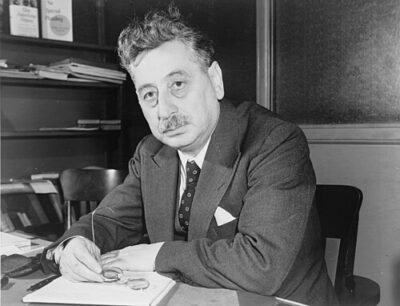
Sholem Asch
Sholem Asch was a Polish-Jewish novelist, dramatist, and essayist in the Yiddish language. Born November 1, 1880, in Kutno. Died July 10, 1957, in London. Awards include Anisfield-Wolf Book Awards.
Facts
22 facts · 2 confirmed by two sources · 13 cited · 7 from one source
What’s different
- Born: we show November 1, 1880 (Confirmed). Wikidata also lists January 1, 1880
Where this comes from
Papalocal keeps its own record. It started from these sources; what each one said is kept here as it was copied, so a change on their side never changes this page by itself. Tap one to read its version.
What Wikidata says · copied November 15, 2026 · revision 2568745647
- Described as
- Polish-Jewish novelist, dramatist, and essayist in the Yiddish language (1880-1957)
- Other names
- Shalom Ash, Sholom Asch
- Born
- November 1, 1880 · 4 references; January 1, 1880
- Died
- July 10, 1957 · 11 references
- Born in
- Kutno · 2 references
- Died in
- London · 3 references
- Citizen of
- United States; Poland · 1 reference; Israel; Russian Empire
- Occupation
- writer · 1 reference; novelist; short story writer; playwright · 2 references; essayist · 1 reference; journalist · 1 reference
- Genre
- drama
- Awards
- Anisfield-Wolf Book Awards (1947)
- Field
- creative and professional writing · 1 reference; prose · 1 reference; drama · 1 reference; journalism · 1 reference
- Children
- Moses Asch · 1 reference; Nathan Asch · 1 reference
- Wikipedias with a page
- 30
Wikidata item Q380439 (wikidata.org/wiki/Q380439), public domain (CC0). Copied November 15, 2026.
What Wikipedia says · copied November 15, 2026 · revision 1377965945
Sholem Asch (Yiddish: שלום אַש, Polish: Szalom Asz; 1 November 1880 – 10 July 1957), also written Shalom Ash, was a Polish-Jewish novelist, dramatist, and essayist in the Yiddish language who settled in the United States. A prolific and widely translated writer, Asch wrote about Jewish life in Eastern Europe and America, producing novels, short stories, and plays that reached international audiences. Asch initially wrote in Hebrew, but, on the advice of the Yiddish writer I.L. Peretz, he subsequently decided to write only in Yiddish, becoming a significant cultural figure in the Yiddishist movement.
Asch's career was marked by both critical acclaim and controversy. His 1904 work A Shtetl offered an idyllic portrait of traditional Polish-Jewish life. In 1920, a 12-volume set of his collected works was published in honor of his 40th birthday. His 1906 play God of Vengeance, set in a Jewish brothel and featuring a lesbian relationship, sparked fierce debates both within the Jewish community and the greater political landscape. God of Vengeance encountered bans, arrests, and an obscenity trial when it played on Broadway in 1923. Lord Chamberlain banned the London production in 1946. Asch's trilogy Three Cities (1929–31) chronicled Jewish life in St. Petersburg, Warsaw, and Moscow. Asch was awarded Poland's Polonia Restituta decoration in 1932.
In his later career, Asch wrote another trilogy: The Nazarene (1939), The Apostle (1943), and Mary (1949), about the lives of Jesus, Paul, and the Virgin Mary. While Asch intended these works as a bridge between Jews and Christians and remained Jewish throughout his life, the trilogy generated controversy and many critics within the Jewish literary community viewed the books as promoting Christianity. Time Magazine praised the series, in a review of the final book in the trilogy, published in 1949.
Asch was a founding member of the American Jewish Joint Distribution Committee and was active in relief efforts for Jewish war victims in Europe. In 1953, Asch left the United States, after being questioned by the House Committee on Un-American Activities and amid ongoing controversy over his writing. He stated, "I am returning to England with a broken heart." He then split his time between London, continental Europe, and Israel. He died in London in 1957. His house in Bat Yam, Israel, is now the Sholem Asch Museum.
Asch was nominated for the Nobel Prize in Literature in 1946.
In 2023, Asch was recognized as a notable Yiddishist figure in the exhibit, Yiddish: A Global Culture, at the Yiddish Book Center in Amherst, Massachusetts. This exhibit was curated by Chief Curator David Mazower, and curators Mindle Cohen and Caraid O'Brien. O'Brien has also translated Asch's plays into English and was credited by The New York Times with contributing to a modern revival of interest in Asch's work.
Asch's work has been translated into English, Hebrew, French, German, Russian and other languages.
In recent years, his hometown of Kutno, Poland has hosted the Sholem Asch Festival to honor him.
- Born, in its opening lines
- November 1, 1880
- Died, in its opening lines
- July 10, 1957
From the Wikipedia article “Sholem Asch” (en.wikipedia.org/wiki/Sholem_Asch), by its contributors, under CC BY-SA 4.0 (creativecommons.org/licenses/by-sa/4.0/). Copied November 15, 2026; not changed.
Confirmed Two sources agree. Cited One source, and it names where it got it. One source One source, without a reference of its own. Sources disagree The sources disagree. We show the best-supported value and keep theirs below.
