
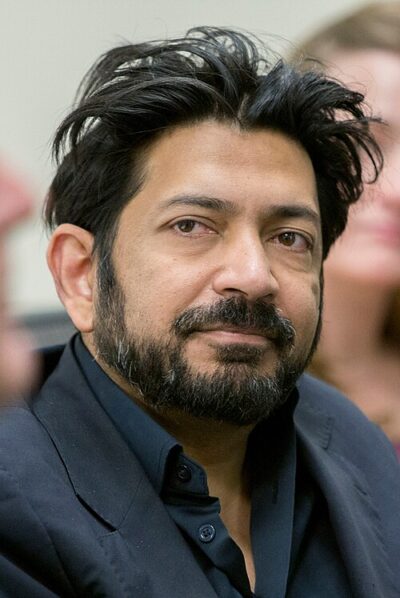
Siddhartha Mukherjee
Siddhartha Mukherjee is an Indian-American physician and writer. Born July 21, 1970, in New Delhi. Known for The Emperor of All Maladies. Educated at Stanford University and Magdalen College. Awards include Padma Shri in Medicine, Pulitzer Prize for General Nonfiction and PEN/E. O. Wilson Literary Science Writing Award.
Facts
27 facts · 1 confirmed by two sources · 10 cited · 16 from one source
Where this comes from
Papalocal keeps its own record. It started from these sources; what each one said is kept here as it was copied, so a change on their side never changes this page by itself. Tap one to read its version.
What Wikidata says · copied November 15, 2026 · revision 2555605040
- Described as
- Indian-American physician and writer (born 1970)
- Born
- July 21, 1970 · 2 references
- Born in
- New Delhi · 2 references
- Citizen of
- United States
- Occupation
- physician writer; essayist; oncologist · 1 reference; academic; non-fiction writer; scientist · 1 reference; physician · 1 reference; assistant professor · 1 reference
- Worked for
- Columbia University; Columbia University Irving Medical Center · 1 reference
- Education
- Stanford University · 1 reference; Magdalen College · 1 reference; Harvard Medical School · 1 reference; University of Oxford · 1 reference
- Known for
- The Emperor of All Maladies
- Awards
- Padma Shri in Medicine (2014) · 1 reference; Pulitzer Prize for General Nonfiction (2011) · 1 reference; PEN/E. O. Wilson Literary Science Writing Award (2011); Rhodes Scholarship (1993) · 2 references; Guardian First Book Award (2011) · 1 reference; Enlightener Prize (2023) · 1 reference
- Spouse
- Sarah Sze · 1 reference
- Lived in
- New York City
- Website
- http://siddharthamukherjee.com
- Wikipedias with a page
- 26
Wikidata item Q983450 (wikidata.org/wiki/Q983450), public domain (CC0). Copied November 15, 2026.
What Wikipedia says · copied November 15, 2026 · revision 1372525417
Siddhartha Mukherjee (Bengali: সিদ্ধার্থ মুখার্জী; born 21 July 1970) is an Indian physician, biologist, and author. His first book, The Emperor of All Maladies: A Biography of Cancer (2010), won the 2011 Pulitzer Prize for General Nonfiction, and Guardian First Book Award, among other awards. It was listed in the "All-Time 100 Nonfiction Books" (the 100 most influential books of the last century) by Time magazine in 2011. He followed it with The Gene: An Intimate History (2016), which was among The New York Times 100 best books of 2016, and a finalist for the Wellcome Trust Prize and the Royal Society Prize for Science Books. He won the 2019 Lewis Thomas Prize.
After completing secondary school education in India, Mukherjee studied biology at Stanford University, obtained a D.Phil. from University of Oxford as a Rhodes Scholar, and an M.D. from Harvard University. He joined New York–Presbyterian Hospital / Columbia University Medical Center in New York City in 2009. As of 2018, he is an associate professor of medicine in the Division of Hematology and Oncology.
Featured in the Time 100 list of most influential people in 2011, Mukherjee writes for The New Yorker and is a columnist in The New York Times. He is described as part of a select group of doctor-writers (such as Oliver Sacks and Atul Gawande) who have "transformed the public discourse on human health," and allowed a generation of readers a rare and intimate glimpse into the life of science and medicine. His research concerns the physiology of cancer cells, immunological therapy for blood cancers, and the discovery of bone- and cartilage-forming stem cells in the vertebrate skeleton.
The government of India conferred on him its fourth highest civilian award, the Padma Shri, in 2014.
- Born, in its opening lines
- July 21, 1970
From the Wikipedia article “Siddhartha Mukherjee” (en.wikipedia.org/wiki/Siddhartha_Mukherjee), by its contributors, under CC BY-SA 4.0 (creativecommons.org/licenses/by-sa/4.0/). Copied November 15, 2026; not changed.
Confirmed Two sources agree. Cited One source, and it names where it got it. One source One source, without a reference of its own. Sources disagree The sources disagree. We show the best-supported value and keep theirs below.
