
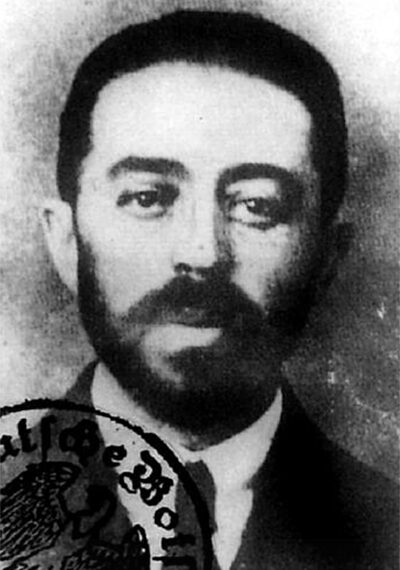
Sidney Reilly
Sidney Reilly was a Russian-born adventurer and secret agent. Born March 24, 1873, in Odesa. Died November 5, 1925, in Moscow. Awards include Military Cross.
Facts
16 facts · 2 confirmed by two sources · 2 cited · 12 from one source
Where this comes from
Papalocal keeps its own record. It started from these sources; what each one said is kept here as it was copied, so a change on their side never changes this page by itself. Tap one to read its version.
What Wikidata says · copied November 16, 2026 · revision 2541226196
- Described as
- Russian-born adventurer and secret agent (1873–1925)
- Other names
- Sidney George Reilly
- Born
- March 24, 1873
- Died
- November 5, 1925 · 1 reference
- Born in
- Odesa
- Died in
- Moscow
- Cause of death
- execution
- Citizen of
- Russian Empire; United Kingdom of Great Britain and Ireland
- Occupation
- spy; arms trader (1915) · 1 reference
- Worked for
- Secret Intelligence Service; Abram Zhivotovsky · 2 references
- Awards
- Military Cross
- Field
- New Scotland Yard
- Military branch
- British Army
- Military rank
- sub-lieutenant
- Lived in
- Odesa
- Wikipedias with a page
- 29
Wikidata item Q171958 (wikidata.org/wiki/Q171958), public domain (CC0). Copied November 16, 2026.
What Wikipedia says · copied November 16, 2026 · revision 1386098598
Sidney George Reilly (; c. 1873 – 5 November 1925), fictionalized as the "Ace of Spies", was a Russian-born adventurer and secret agent employed by Scotland Yard's Special Branch and later by the Foreign Section of the British Secret Service Bureau, the precursor to the modern British Secret Intelligence Service (MI6/SIS). He is alleged to have spied for at least four different great powers, and documentary evidence indicates that he was involved in espionage activities in 1890s London among Russian émigré circles, in Manchuria on the eve of the Russo-Japanese War (1904–05), and in an abortive 1918 coup d'état against Vladimir Lenin's Bolshevik government in Moscow.
Reilly disappeared in Soviet Russia in the mid-1920s, lured by the Cheka's Operation Trust. British diplomat and journalist R. H. Bruce Lockhart publicised his and Reilly's 1918 exploits to overthrow the Bolshevik government in Lockhart's 1932 book Memoirs of a British Agent. This became an international best-seller and garnered global fame for Reilly. The memoirs retold the efforts by Reilly, Lockhart, and other conspirators to sabotage the Bolshevik Revolution while still in its infancy.
The world press made Reilly into a household name within five years of his execution by Soviet agents in 1925, lauding him as a peerless spy and recounting his many espionage adventures. Newspapers dubbed him "the greatest spy in history" and "the Scarlet Pimpernel of Red Russia". The London Evening Standard described his exploits in an illustrated serial in May 1931 headlined "Master Spy". Ian Fleming used him as a model for James Bond in his novels set in the early Cold War. Reilly is considered to be "the dominating figure in the mythology of modern British espionage".
- Born, in its opening lines
- c. 1873
- Died, in its opening lines
- November 5, 1925
From the Wikipedia article “Sidney Reilly” (en.wikipedia.org/wiki/Sidney_Reilly), by its contributors, under CC BY-SA 4.0 (creativecommons.org/licenses/by-sa/4.0/). Copied November 16, 2026; not changed.
Confirmed Two sources agree. Cited One source, and it names where it got it. One source One source, without a reference of its own. Sources disagree The sources disagree. We show the best-supported value and keep theirs below.
