
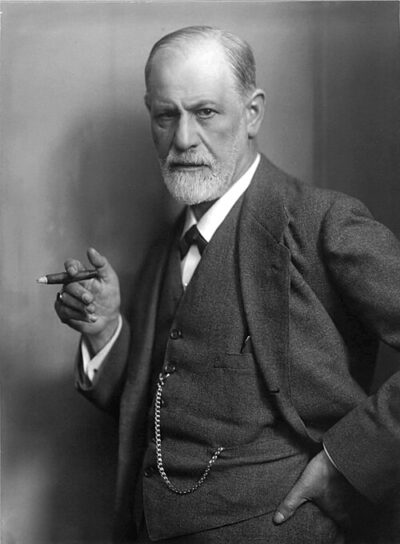
Sigmund Freud
Sigmund Freud was an Austrian psychiatrist and founder of psychoanalysis. Born May 6, 1856, in Příbor. Died September 23, 1939, in London. Positions held include professor. Known for The Interpretation of Dreams, Civilization and Its Discontents and Totem and Taboo. Educated at University of Vienna. Awards include Goethe Prize of the City of Frankfurt and Foreign Member of the Royal Society.
Facts
48 facts · 2 confirmed by two sources · 26 cited · 20 from one source
Where this comes from
Papalocal keeps its own record. It started from these sources; what each one said is kept here as it was copied, so a change on their side never changes this page by itself. Tap one to read its version.
What Wikidata says · copied November 16, 2026 · revision 2569997392
- Described as
- Austrian psychiatrist and founder of psychoanalysis (1856–1939)
- Other names
- Sigismund Schlomo Freud, Sigismund Freud, Freud, Sigmund Schlomo Freud
- Born
- May 6, 1856 · 26 references
- Died
- September 23, 1939 · 25 references
- Born in
- Příbor · 5 references
- Died in
- London · 5 references
- Buried in
- Golders Green Crematorium · 1 reference
- Cause of death
- laryngeal cancer
- Name at birth
- Sigismund Schlomo Freud
- Citizen of
- Austrian Empire · 1 reference; Cisleithania (–1918); Austria (1918–); Nazi Germany (1938–)
- Occupation
- psychoanalyst · 4 references; neurologist · 2 references; essayist · 2 references
- Positions held
- professor
- Worked for
- University of Vienna
- Education
- University of Vienna
- Member of
- Royal Society of London
- Known for
- The Interpretation of Dreams; Civilization and Its Discontents; Totem and Taboo; Three Essays on the Theory of Sexuality; The Ego and the Id; id, ego and super-ego · 1 reference
- Awards
- Goethe Prize of the City of Frankfurt (1930); Foreign Member of the Royal Society (1936) · 1 reference
- Field
- psychoanalysis · 1 reference; neurology · 1 reference
- Spouse
- Martha Bernays (1886–1939) · 3 references
- Children
- Anna Freud · 2 references; Ernst L. Freud · 2 references; Martin Freud · 3 references; Oliver Freud · 1 reference; Sophie Freud · 1 reference; Mathilde Freud · 1 reference
- Father
- Pepe Freud · 2 references
- Mother
- Amalia Freud · 1 reference
- Siblings
- Alexander Freud · 2 references; Anna Freud Bernays · 2 references; Pauline Regine Freud · 1 reference; Esther Adolfine Freud · 1 reference; Maria Freud · 1 reference; Regina Debora Freud · 1 reference; Julian Freud · 1 reference
- Religion
- atheism · 1 reference
- Lived in
- Vienna; London; Birth house of Sigmund Freud
- Wikipedias with a page
- 254
Wikidata item Q9215 (wikidata.org/wiki/Q9215), public domain (CC0). Copied November 16, 2026.
What Wikipedia says · copied November 16, 2026 · revision 1385756119
Sigmund Freud (born Sigismund Schlomo Freud; 6 May 1856 – 23 September 1939) was an Austrian neurologist and the founder of psychoanalysis, a clinical method for evaluating and treating pathologies arising from conflicts in the psyche through dialogue between patient and psychoanalyst, and the distinctive theory of mind and human agency it posits.
In creating psychoanalysis, Freud introduced therapeutic methods such as free association, the interpretation of dreams, and the analysis of transference phenomena that arise in the clinical setting. Freud's redefinition of sexuality to include infantile stages led him to formulate the Oedipus complex as a central tenet of psychoanalytical theory. His analysis of dreams as wish fulfillments provided him with models for the clinical analysis of symptom formation and the underlying mechanisms of repression. Accordingly, on this basis, Freud elaborated his theory of the unconscious and went on to develop a model of psychic structure comprising id, ego, and superego. Freud postulated the existence of libido (sexualised psychic energy), with which mental processes and structures are invested and that generates erotic attachments and a death drive, the source of compulsive repetition, hate, aggression, and neurotic guilt. In his later work, Freud developed a wide-ranging interpretation and critique of religion and culture.
Though less prevalent in diagnostic and clinical practice, psychoanalysis remains influential within psychology, psychiatry, psychotherapy, and across the humanities. It thus continues to generate debate
concerning its therapeutic efficacy, its scientific status, and whether it advances or hinders the feminist cause. Nonetheless, Freud's work has suffused contemporary Western thought and popular culture. W. H. Auden's 1940 poetic tribute to Freud describes him as "no more a person now but a whole climate of opinion / under whom we conduct our different lives".
- Born, in its opening lines
- May 6, 1856
- Died, in its opening lines
- September 23, 1939
From the Wikipedia article “Sigmund Freud” (en.wikipedia.org/wiki/Sigmund_Freud), by its contributors, under CC BY-SA 4.0 (creativecommons.org/licenses/by-sa/4.0/). Copied November 16, 2026; not changed.
Confirmed Two sources agree. Cited One source, and it names where it got it. One source One source, without a reference of its own. Sources disagree The sources disagree. We show the best-supported value and keep theirs below.
