
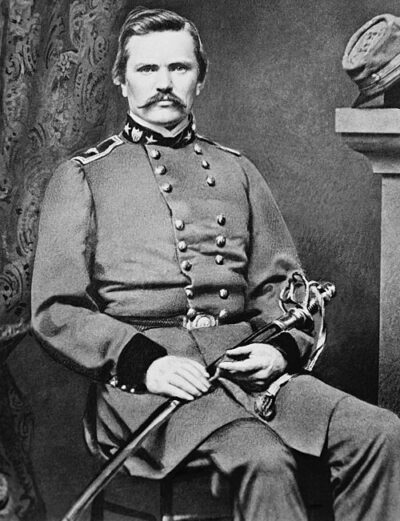
Simon Bolivar Buckner
Simon Bolivar Buckner was a Confederate Army general. Born April 1, 1823, in Hart County. Died January 8, 1914, in Hart County. Positions held include Governor of Kentucky (1887–1891). Educated at United States Military Academy.
Facts
21 facts · 2 confirmed by two sources · 3 cited · 16 from one source
Where this comes from
Papalocal keeps its own record. It started from these sources; what each one said is kept here as it was copied, so a change on their side never changes this page by itself. Tap one to read its version.
What Wikidata says · copied November 16, 2026 · revision 2522049237
- Described as
- Confederate Army general (1823-1914)
- Other names
- Simon Bolivar Buckner, Sr., Simon B. Buckner, Simon Buckner
- Born
- April 1, 1823 · 4 references
- Died
- January 8, 1914 · 5 references
- Born in
- Hart County
- Died in
- Hart County
- Buried in
- Frankfort Cemetery
- Cause of death
- kidney failure
- Citizen of
- United States
- Occupation
- military personnel · 1 reference; journalist
- Positions held
- Governor of Kentucky (1887–1891)
- Political party
- Democratic Party
- Education
- United States Military Academy
- Spouse
- Delia Claiborne Buckner (1885–1914); Mary Jane Kingsbury (1850–1874)
- Children
- Simon Bolivar Buckner Jr.; Lily Buckner Belknap
- Father
- Aylett H. Buckner · 1 reference
- Mother
- Elizabeth A. Morehead · 1 reference
- Military branch
- United States Army · 1 reference; Confederate States Army
- Military rank
- general
- Wikipedias with a page
- 23
Wikidata item Q638962 (wikidata.org/wiki/Q638962), public domain (CC0). Copied November 16, 2026.
What Wikipedia says · copied November 16, 2026 · revision 1375448544
Simon Bolivar Buckner ( SY-mən BOL-i-vər BUK-nər; April 1, 1823 – January 8, 1914) was an American soldier, Confederate military officer, and politician. He fought in the United States Army in the Mexican–American War. He later fought in the Confederate States Army during the American Civil War. After the war, he served as the 30th governor of Kentucky.
After graduating from the United States Military Academy at West Point, Buckner became an instructor there. He took a hiatus from teaching to serve in the Mexican–American War, participating in many of its major battles. He resigned from the army in 1855 to manage his father-in-law's real estate in Chicago, Illinois. He returned to his native state of Kentucky in 1857 and was appointed adjutant general by Governor Beriah Magoffin in 1861. In this position, he tried to enforce Kentucky's neutrality policy in the early days of the Civil War. When the state's neutrality was breached, Buckner accepted a commission in the Confederate Army after declining a similar commission to the Union Army. In 1862, he accepted Ulysses S. Grant's demand for an "unconditional surrender" at the Battle of Fort Donelson. He was the first Confederate general to surrender an army in the war. He spent five months as a prisoner of war. After his release, Buckner participated in Braxton Bragg's failed invasion of Kentucky and near the end of the war became chief of staff to Edmund Kirby Smith in the Trans-Mississippi Department.
In the years following the war, Buckner became active in politics. He was elected governor of Kentucky in 1887, in his second campaign for that office. His term was plagued by violent feuds in the eastern part of the state, including the Hatfield–McCoy feud and the Rowan County War. His administration was rocked by scandal when state treasurer James "Honest Dick" Tate absconded with $250,000 from the state's treasury. As governor, Buckner became known for vetoing special interest legislation. In the 1888 legislative session alone, he issued more vetoes than the previous ten governors combined. In 1895, he made an unsuccessful bid for a seat in the U.S. Senate. The following year, he joined the National Democratic Party, or "Gold Democrats", who favored a gold standard policy over the Free Silver position of the mainline Democrats. He was the National Democratic Party's candidate for Vice President of the United States in the 1896 election, but polled just over one percent of the vote on a ticket with his running mate, ex-Union general John M. Palmer. He never again sought public office and died on January 8, 1914.
- Born, in its opening lines
- April 1, 1823
- Died, in its opening lines
- January 8, 1914
From the Wikipedia article “Simon Bolivar Buckner” (en.wikipedia.org/wiki/Simon_Bolivar_Buckner), by its contributors, under CC BY-SA 4.0 (creativecommons.org/licenses/by-sa/4.0/). Copied November 16, 2026; not changed.
Confirmed Two sources agree. Cited One source, and it names where it got it. One source One source, without a reference of its own. Sources disagree The sources disagree. We show the best-supported value and keep theirs below.
