
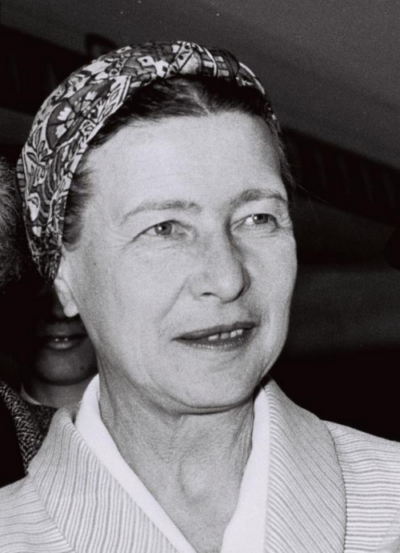
Simone de Beauvoir
Simone de Beauvoir was a French philosopher, social theorist and activist. Born January 9, 1908, in 6th arrondissement of Paris. Died April 14, 1986, in 14th arrondissement of Paris. Known for The Mandarins, When Things of the Spirit Come First and Pyrrhus and Cineas. Educated at University of Paris and Lycée Fénelon, Paris. Awards include Prix Goncourt, Jerusalem Prize and Austrian State Prize for European Literature.
Facts
46 facts · 2 confirmed by two sources · 20 cited · 23 from one source · 1 where the sources disagree
What’s different
- Cause of death: we show pulmonary edema (Sources disagree). Wikidata also lists pneumonia
Where this comes from
Papalocal keeps its own record. It started from these sources; what each one said is kept here as it was copied, so a change on their side never changes this page by itself. Tap one to read its version.
What Wikidata says · copied November 16, 2026 · revision 2565593727
- Described as
- French philosopher, social theorist and activist (1908–1986)
- Other names
- Simone Lucie Ernestine Marie Bertrand de Beauvoir, Le Castor, Castor, Simone-Lucie-Ernestine-Marie Bertrand de Beauvoir
- Born
- January 9, 1908 · 4 references
- Died
- April 14, 1986 · 4 references
- Born in
- 6th arrondissement of Paris · 1 reference
- Died in
- 14th arrondissement of Paris · 2 references
- Buried in
- Montparnasse Cemetery · 2 references
- Cause of death
- pneumonia; pulmonary edema · 1 reference
- Name at birth
- Simonne Lucie Ernestine Marie Bertrand de Beauvoir
- Citizen of
- France · 2 references
- Occupation
- political philosopher; journalist · 2 references; novelist · 1 reference; autobiographer · 1 reference; essayist · 1 reference; political activist; diarist; women letter writer
- Education
- University of Paris · 1 reference; Lycée Fénelon, Paris; Sorbonne; Catholic University of Paris · 1 reference
- Member of
- comité de lecture des éditions Gallimard (1944–1945)
- Known for
- The Mandarins · 1 reference; When Things of the Spirit Come First; Pyrrhus and Cineas; The Second Sex · 2 references; She Came to Stay; Force of Circumstance
- Awards
- Prix Goncourt (1954) · 2 references; Jerusalem Prize (1975); Austrian State Prize for European Literature (1978) · 1 reference; honorary doctorate of Concordia University; Benjamin E. Lippincott Award (1981) · 1 reference
- Field
- philosophy; essay; autobiography; novel · 1 reference; feminism · 2 references; existentialism · 1 reference
- Children
- Sylvie Le Bon-de Beauvoir (1980) · 1 reference
- Father
- Georges de Beauvoir
- Mother
- Françoise de Beauvoir
- Siblings
- Hélène de Beauvoir · 1 reference
- Religion
- atheism
- Lived in
- Paris; Marseille (1931–1932); Rouen (1932–1937)
- Wikipedias with a page
- 189
Wikidata item Q7197 (wikidata.org/wiki/Q7197), public domain (CC0). Copied November 16, 2026.
What Wikipedia says · copied November 16, 2026 · revision 1385565486
Simone Lucie Ernestine Marie Bertrand de Beauvoir (9 January 1908 – 14 April 1986) was a French existentialist philosopher, writer, social theorist, and feminist activist. Though she did not consider herself a philosopher, nor was she considered one at the time of her death, she had a significant influence on both feminist existentialism and feminist theory.
Beauvoir wrote novels, essays, short stories, biographies, autobiographies, and monographs on philosophy, politics, and social issues. She was best known for her "trailblazing work in feminist philosophy", The Second Sex (1949), a detailed analysis of women's oppression and a foundational tract of contemporary feminism. She was also known for her novels, the most famous of which were She Came to Stay (1943) and The Mandarins (1954).
Her most enduring contribution to literature is her memoirs, notably the first volume, Mémoires d'une jeune fille rangée (1958). She received the 1954 Prix Goncourt, the 1975 Jerusalem Prize, and the 1978 Austrian State Prize for European Literature. She was also nominated for the Nobel Prize in Literature in 1961, 1969 and 1973.
- Born, in its opening lines
- January 9, 1908
- Died, in its opening lines
- April 14, 1986
From the Wikipedia article “Simone de Beauvoir” (en.wikipedia.org/wiki/Simone_de_Beauvoir), by its contributors, under CC BY-SA 4.0 (creativecommons.org/licenses/by-sa/4.0/). Copied November 16, 2026; not changed.
Confirmed Two sources agree. Cited One source, and it names where it got it. One source One source, without a reference of its own. Sources disagree The sources disagree. We show the best-supported value and keep theirs below.
