
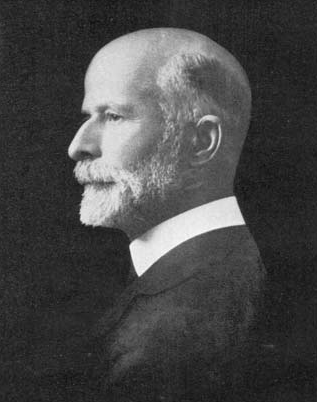
Solon Irving Bailey
Solon Irving Bailey was an American astronomer. Born December 29, 1854, in Lisbon. Died June 5, 1931, in Boston. Educated at Boston University and Harvard University. Awards include Fellow of the American Academy of Arts and Sciences.
Facts
13 facts · 2 confirmed by two sources · 2 cited · 9 from one source
Where this comes from
Papalocal keeps its own record. It started from these sources; what each one said is kept here as it was copied, so a change on their side never changes this page by itself. Tap one to read its version.
What Wikidata says · copied November 18, 2026 · revision 2567449923
- Described as
- American astronomer (1854–1931)
- Other names
- Solon I. Bailey
- Born
- December 29, 1854 · 2 references
- Died
- June 5, 1931 · 2 references
- Born in
- Lisbon
- Died in
- Boston · 1 reference
- Citizen of
- United States
- Occupation
- astronomer · 1 reference
- Worked for
- Harvard University
- Education
- Boston University; Harvard University
- Member of
- American Academy of Arts and Sciences; National Academy of Sciences
- Awards
- Fellow of the American Academy of Arts and Sciences
- Field
- astronomy · 1 reference
- Wikipedias with a page
- 19
Wikidata item Q1399047 (wikidata.org/wiki/Q1399047), public domain (CC0). Copied November 18, 2026.
What Wikipedia says · copied November 18, 2026 · revision 1384418480
Solon Irving Bailey (December 29, 1854 – June 5, 1931) was an American astronomer and discoverer of the asteroid 504 Cora, on June 30, 1902.
Bailey joined the staff of Harvard College Observatory in 1887. He received a bachelor's and master's from Boston University in 1881 and 1884, and a master's from Harvard University in 1888. After the observatory received the "Boyden Fund" bequest from the will of Uriah A. Boyden, Bailey played a major role in finding a site for Boyden Station in Arequipa, Peru, and was in charge of it from 1892 to 1919. He was also one of the first to carry out meteorological studies in Peru, traveling extensively in desolate areas at very high altitude. Boyden Station was moved to South Africa in 1927 due to better weather conditions and became known as the Boyden Observatory.
He made extensive studies of variable stars in globular clusters in the southern skies. He also performed a light-curve analysis measuring the rotation period of the near-Earth asteroid 433 Eros during its 1903 opposition. Bailey was acting director of Harvard College Observatory from 1919 to 1921 after the death of Edward Charles Pickering and prior to the appointment of Harlow Shapley. He worked as a senior colleague with Henrietta Leavitt. He was elected a Fellow of the American Academy of Arts and Sciences in 1892. Irving died on June 5, 1931, aged 76, in Hanover, New Hampshire, from an illness caused by heart disease.
- Born, in its opening lines
- December 29, 1854
- Died, in its opening lines
- June 5, 1931
From the Wikipedia article “Solon Irving Bailey” (en.wikipedia.org/wiki/Solon_Irving_Bailey), by its contributors, under CC BY-SA 4.0 (creativecommons.org/licenses/by-sa/4.0/). Copied November 18, 2026; not changed.
Confirmed Two sources agree. Cited One source, and it names where it got it. One source One source, without a reference of its own. Sources disagree The sources disagree. We show the best-supported value and keep theirs below.
