
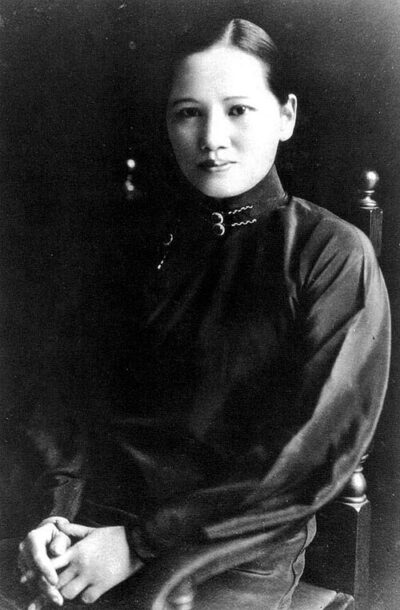
Soong Ching-ling
Soong Ching-ling was a former Vice President of the People's Republic of China and third wife of Sun Yat-sen. Born January 27, 1893, in Shanghai. Died May 29, 1981, in Beijing. Positions held include Honorary President of the People's Republic of China (1981), Vice President of the People's Republic of China (1959–1975) and Vice Chairperson of the Standing Committee of the National People's Congress (1975–1981). Educated at McTyeire School and Wesleyan College. Awards include International Stalin Prize for Peace.
Facts
34 facts · 2 confirmed by two sources · 9 cited · 23 from one source
Where this comes from
Papalocal keeps its own record. It started from these sources; what each one said is kept here as it was copied, so a change on their side never changes this page by itself. Tap one to read its version.
What Wikidata says · copied November 16, 2026 · revision 2569105972
- Described as
- former Vice President of the People's Republic of China and third wife of Sun Yat-sen (1893–1981)
- Other names
- Madame Sun Yat-sen, Song Qingling, Song Ch'ing-ling, Rosamond Soong, Rosamond Soong Ch'ing-ling
- Born
- January 27, 1893 · 5 references
- Died
- May 29, 1981 · 5 references
- Born in
- Shanghai · 1 reference
- Died in
- Beijing · 1 reference
- Buried in
- grave of Soong Ching-ling
- Cause of death
- leukemia
- Citizen of
- Qing dynasty (–1912); Republic of China (1912–1949); People's Republic of China (1949–)
- Occupation
- politician · 1 reference
- Positions held
- Honorary President of the People's Republic of China (1981); Vice President of the People's Republic of China (1959–1975); Vice Chairperson of the Standing Committee of the National People's Congress (1975–1981); Vice-Chairperson of the National Committee of the Chinese People's Political Consultative Conference; Chairman of the Standing Committee of the National People's Congress (1976–1978); National People's Congress deputy
- Political party
- Chinese Communist Party; Kuomintang; Revolutionary Committee of the Chinese Kuomintang · 1 reference
- Education
- McTyeire School; Wesleyan College
- Member of
- Soong sisters
- Awards
- International Stalin Prize for Peace (1951)
- Field
- civil and political rights; politics · 1 reference
- Spouse
- Sun Yat-sen (1915–1925) · 1 reference
- Father
- Charlie Soong · 1 reference
- Mother
- Ni Kwei-tseng
- Siblings
- Soong Ai-ling · 1 reference; Soong May-ling · 1 reference; T. V. Soong · 1 reference; Soong Tse-an; T. L. Soong
- Lived in
- People's Republic of China · 1 reference
- Wikipedias with a page
- 60
Wikidata item Q17132 (wikidata.org/wiki/Q17132), public domain (CC0). Copied November 16, 2026.
What Wikipedia says · copied November 16, 2026 · revision 1379702098
Soong Ch'ing-ling (27 January 1893 – 29 May 1981; Christian name Rosamonde or Rosamond) was a Chinese politician and activist. She was the wife of Sun Yat-sen, therefore known by Madame Sun Yat-sen and the "Mother of Modern China". A member of the Soong family, she and her family played a significant role in shaping the Republic of China. As a prominent leader of the left wing of the Kuomintang (KMT), she founded the Revolutionary Committee of the KMT. She entered the Communist government in 1949, and was the only female, non-Communist head of state of the People's Republic of China. She was named Honorary Chairman of the People's Republic of China and admitted to the Chinese Communist Party (CCP) a few weeks before her death in 1981.
Born in Shanghai and educated in the United States, she married Sun Yat-sen, the founder of the Republic of China and the KMT, as his third wife in 1915 and became a strong advocate for Sun's KMT-CCP coalition, opposing Chiang Kai-shek's split with the CCP in 1927. During the Second Sino-Japanese War she joined her sisters in China's wartime capital Chongqing to demonstrate national unity and support for the KMT-CCP alliance. However, during the subsequent Chinese Civil War she continued her support to the CCP, leading to a break in ties with her family. After the proclamation of the People's Republic of China (PRC) in 1949, she held several prominent positions in the Communist government, including Vice Chairman of the PRC (1949–1954; 1959–1975) and Vice Chairman of the Standing Committee of the National People's Congress (1954–1959; 1975–1981). She travelled abroad during the early 1950s, representing China at a number of international events.
Following the purge of President Liu Shaoqi in 1968, she and Dong Biwu as Vice Presidents became de facto Heads of State of China until 1972, when Dong was appointed Acting President. During the Cultural Revolution, Soong was protected from being purged, as the top name on A List of Cadres to Be Protected created by Zhou Enlai. Despite this, her Beijing home was invaded by Red Guards, and her parents' tombs in Shanghai were destroyed. Soong survived the political turmoil of the Cultural Revolution but appeared less frequently after 1976. As the acting Chairwoman of the Standing Committee of the National People's Congress from 1976 to 1978, Soong was again the acting Head of State, as the office of President had been abolished. During her final illness in May 1981, she was given the special title of "Honorary Chairman of the People's Republic of China".
- Born, in its opening lines
- January 27, 1893
- Died, in its opening lines
- May 29, 1981
From the Wikipedia article “Soong Ching-ling” (en.wikipedia.org/wiki/Soong_Ching-ling), by its contributors, under CC BY-SA 4.0 (creativecommons.org/licenses/by-sa/4.0/). Copied November 16, 2026; not changed.
Confirmed Two sources agree. Cited One source, and it names where it got it. One source One source, without a reference of its own. Sources disagree The sources disagree. We show the best-supported value and keep theirs below.
