
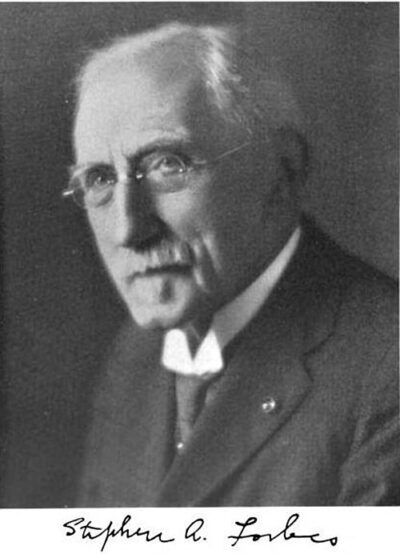
Stephen Alfred Forbes
Stephen Alfred Forbes was an American naturalist. Born May 29, 1844, in Silver Creek Township. Died March 13, 1930, in Urbana. Positions held include chairperson (1921). Educated at Illinois State University and Rush Medical College.
Facts
23 facts · 2 confirmed by two sources · 11 cited · 10 from one source
Where this comes from
Papalocal keeps its own record. It started from these sources; what each one said is kept here as it was copied, so a change on their side never changes this page by itself. Tap one to read its version.
What Wikidata says · copied November 20, 2026 · revision 2571602120
- Described as
- American naturalist (1844–1930)
- Other names
- Stephen A. Forbes, S. A. Forbes
- Born
- May 29, 1844 · 2 references
- Died
- March 13, 1930 · 2 references
- Born in
- Silver Creek Township · 1 reference
- Died in
- Urbana · 1 reference
- Buried in
- Mount Hope Cemetery and Mausoleum · 1 reference
- Citizen of
- United States
- Occupation
- naturalist; zoologist · 1 reference; entomologist · 1 reference; ecologist; ichthyologist; academic · 1 reference; university teacher · 1 reference; researcher · 1 reference
- Positions held
- chairperson (1921) · 1 reference
- Worked for
- University of Illinois Urbana-Champaign; Illinois State University (1872–1884) · 1 reference
- Education
- Illinois State University; Rush Medical College · 1 reference
- Member of
- National Academy of Sciences; American Philosophical Society (1919–)
- Field
- entomology · 1 reference; geology · 1 reference
- Wikipedias with a page
- 9
Wikidata item Q2344517 (wikidata.org/wiki/Q2344517), public domain (CC0). Copied November 20, 2026.
What Wikipedia says · copied November 20, 2026 · revision 1372336780
Stephen Alfred Forbes (May 29, 1844 – March 13, 1930) was the first chief of the Illinois Natural History Survey, a founder of aquatic ecosystem science and a dominant figure in the rise of American ecology. His publications are striking for their merger of extensive field observations with conceptual insights. Forbes believed that ecological knowledge was fundamental for human well being. Forbes was important to the development of ecological theory. He was acknowledged by the National Academy of Sciences as "the founder of the science of ecology in the United States".
While already famous as an economic entomologist, Forbes undertook studies of massive fish mortality in Lake Mendota, Wisconsin. He showed the connection of algae blooms and lake physics to fish kills, and embarked on a remarkable research program into lake ecology and river ecology. Many of his insights about lake ecology were collected in an influential paper, "The Lake as a Microcosm".
Notable for both conceptual creativity and the use of innovative quantitative methods, his work foreshadowed the ecosystem concept as well as modern ideas of behavioral ecology and food web dynamics. On top of this, Forbes introduced the concept of a "community of interest" that emphasized two major points: "the first that of a general community of interests among all the classes of organic beings here assembled, and the second that of the beneficent power of natural selection which compels such adjustments of the rated of destruction and of multiplication of the various species as shall best promote this common interest."
Forbes's studies of bird predation and the use of fungus to control the chinch bug were pioneering efforts in the study and application of insect diseases for the biological control of insect pests. They were important contributions to the establishment of integrated pest management in the twentieth century.
Forbes showed the importance of local knowledge in the early history of ecology in the United States.
- Born, in its opening lines
- May 29, 1844
- Died, in its opening lines
- March 13, 1930
From the Wikipedia article “Stephen Alfred Forbes” (en.wikipedia.org/wiki/Stephen_Alfred_Forbes), by its contributors, under CC BY-SA 4.0 (creativecommons.org/licenses/by-sa/4.0/). Copied November 20, 2026; not changed.
Confirmed Two sources agree. Cited One source, and it names where it got it. One source One source, without a reference of its own. Sources disagree The sources disagree. We show the best-supported value and keep theirs below.
