
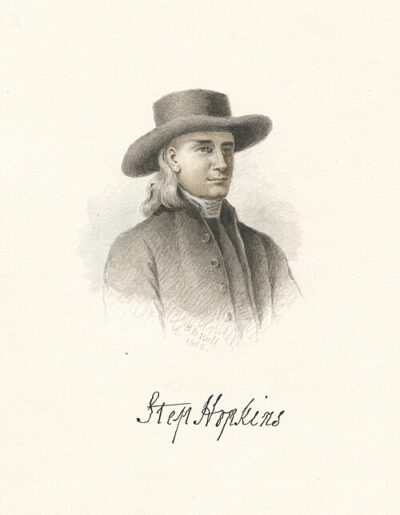
Stephen Hopkins
Stephen Hopkins was a Signer of Declaration of Independence. Born March 7, 1707, in Providence. Died July 13, 1785, in Providence. Positions held include colonial governor of Rhode Island (2 times) (1755–1768). Educated at National University of Córdoba.
Facts
17 facts · 2 confirmed by two sources · 6 cited · 9 from one source
Where this comes from
Papalocal keeps its own record. It started from these sources; what each one said is kept here as it was copied, so a change on their side never changes this page by itself. Tap one to read its version.
What Wikidata says · copied November 16, 2026 · revision 2551926556
- Described as
- Signer of Declaration of Independence (1707-1785)
- Born
- March 7, 1707 · 4 references
- Died
- July 13, 1785 · 4 references
- Born in
- Providence · 1 reference
- Died in
- Providence · 1 reference
- Buried in
- North Burial Ground · 1 reference
- Citizen of
- United States; Kingdom of Great Britain
- Occupation
- politician · 2 references; lawyer; judge; activist
- Positions held
- colonial governor of Rhode Island (2 times) (1755–1768)
- Education
- National University of Córdoba
- Member of
- American Philosophical Society
- Father
- William Hopkins · 1 reference
- Mother
- Ruth Hopkins · 1 reference
- Religion
- Quakers
- Wikipedias with a page
- 22
Wikidata item Q1399643 (wikidata.org/wiki/Q1399643), public domain (CC0). Copied November 16, 2026.
What Wikipedia says · copied November 16, 2026 · revision 1379665641
Stephen Hopkins (March 7, 1707 – July 13, 1785) was a Founding Father of the United States. He served as governor of the Colony of Rhode Island and Providence Plantations, chief justice of the Rhode Island Supreme Court, and was a signer of both the Continental Association and Declaration of Independence. Hopkins was from a prominent Rhode Island family. His grandfather, William Hopkins, was an influential colonial politician, while his great-grandfather Thomas Hopkins was among the original settlers of Providence Plantations. Thomas sailed from England in 1635 alongside his cousin, Benedict Arnold, who later became the first governor of the Rhode Island colony under the Royal Charter of 1663.
As a child, Hopkins was a voracious reader, becoming a serious student of the sciences, mathematics, and literature. He became a surveyor and astronomer and was involved in taking measurements during the 1769 transit of Venus across the Sun. He began his public service at age 23 as a justice of the peace in the newly established town of Scituate, Rhode Island. He soon became a justice of the Inferior Court of Common Pleas, while also serving at times as the speaker of the House of Deputies and president of the Scituate Town Council. While active in civic affairs, he also was part owner of an iron foundry and was a successful merchant who was portrayed in John Greenwood's 1750s satirical painting Sea Captains Carousing in Surinam. In May 1747, Hopkins was appointed as a justice of the Rhode Island Supreme Court, serving until May 1749. He became the third chief justice of this body in May 1751, serving until May 1755. In 1755, he was elected to his first term as governor of the colony, and he served in this capacity for 9 out of the next 15 years.
One of the most contentious political issues of his day was the use of paper money versus hard currency. His bitter political rival Samuel Ward championed hard currency, whereas Hopkins advocated the use of paper money. The rivalry between the two men became so heated that Hopkins sued Ward for £40,000, but he lost the case and had to pay costs. By the mid-1760s, the contention between the two men became a serious distraction to the government of the colony, and they attempted to placate each other—initially without success. Ultimately, both agreed to not run for office in 1768, and Josias Lyndon was elected governor of the colony as a compromise candidate.
In 1770, Hopkins once again became chief justice of the Rhode Island Supreme Court, and he became a principal player in the colony's handling of the 1772 Gaspee Affair, when a group of irate Rhode Island citizens boarded a British revenue vessel and burned it to the waterline. In 1774, he was given an additional important responsibility as one of Rhode Island's two delegates to the First Continental Congress, his former rival Samuel Ward being the other. Hopkins had become well known in the Thirteen Colonies ten years earlier when he published a pamphlet entitled The Rights of Colonies Examined which was critical of British Parliament and its taxation policies.
Hopkins signed the Declaration of Independence in the summer of 1776 with worsening palsy in his hands. He signed it by holding his right hand with his left and saying, "My hand trembles, but my heart does not." He served in the Continental Congress until September 1776, when failing health forced him to resign. He was a strong backer of the College of the English Colony of Rhode Island and Providence Plantations (later named Brown University) and became the institution's first chancellor. He died in Providence in 1785 at age 78 and is buried in the North Burial Ground there. Hopkins has been called Rhode Island's greatest statesman. In 1774, Hopkins owned six or seven slaves, making him among the top five percent of slaveholders in Providence at the time.
- Born, in its opening lines
- March 7, 1707
- Died, in its opening lines
- July 13, 1785
From the Wikipedia article “Stephen Hopkins (politician)” (en.wikipedia.org/wiki/Stephen_Hopkins_(politician)), by its contributors, under CC BY-SA 4.0 (creativecommons.org/licenses/by-sa/4.0/). Copied November 16, 2026; not changed.
Confirmed Two sources agree. Cited One source, and it names where it got it. One source One source, without a reference of its own. Sources disagree The sources disagree. We show the best-supported value and keep theirs below.
